Many custom options


And formats



One Mind Unity in Chinese / Japanese
Buy an One Mind Unity calligraphy wall scroll here!
Personalize your custom “One Mind Unity” project by clicking the button next to your favorite “One Mind Unity” title below.
One Mind / Unity
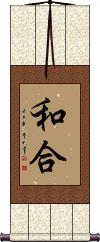
和合 means to blend, unite, or be of one mind.
和合 is usually used as a Buddhist term. It can also be defined as harmony, concord, agreement, unity, union, and harmonize/harmonization.
One Heart / One Mind / Heart and Soul
Isshin
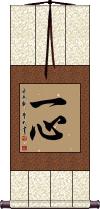
一心 can mean “one mind,” “single-minded focus,” or “wholehearted devotion,” from Chinese, Japanese Kanji, and old Korean Hanja.
Colloquially or figuratively, it means: wholeheartedly; heart and soul; of one mind; single-mindedness, wholeheartedness; one's whole heart; with the whole mind or heart; one mind in heart.
I'm not kidding, all of those came right from the dictionary for this one title.
In martial arts usage, this term emphasizes total commitment, where intent, attention, and action are unified without distraction.
In Japanese budō, it often conveys wholehearted dedication to practice or principle, whereas in Chinese usage it tends toward inner mental cultivation.
In Buddhism, this can refer to the bhūtatathatā, or the whole of things; the universe as one mind, or a spiritual unity.
In Japanese, this can be the female given name, Hitomi.
Body and Earth in Unity
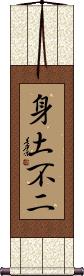
身土不二 (Shindofuni) is originally a Buddhist concept or proverb referring to the inseparability of body-mind and geographical circumstances.
This reads, “Body [and] earth [are] not two.”
Other translations or matching ideas include:
Body and land are one.
Body and earth cannot be separated.
Body earth sensory curation.
You are what you eat.
Indivisibility of the body and the land (because the body is made from food and food is made from the land).
Going further, this speaks of our human bodies and the land from which we get our food being closely connected. This phrase is often used when talking about natural and organic vegetables coming directly from the farm to provide the healthiest foods in Japan.
Character notes: 身(shin) in this context does not just mean your physical body but a concept including both body and mind.
土 (do) refers to the soil, earth, clay, land, or in some cases, locality. It's not the proper name of Earth, the planet. However, it can refer to the land or realm we live in.
Japanese note: This has been used in Japan, on and off, since 1907 as a slogan for a governmental healthy eating campaign (usually pronounced as shindofuji instead of the original shindofuni in this context). It may have been hijacked from Buddhism for this propaganda purpose, but at least this is “healthy propaganda.”
Korean note: The phrase 身土不二 was in use by 1610 A.D. in Korea, where it can be found in an early medical journal.
In modern South Korea, it's written in Hangul as 신토불이. Korea used Chinese characters (same source as Japanese Kanji) as their only written standard form of the language until about a hundred years ago. Therefore, many Koreans will recognize this as a native phrase and concept.
See Also: Strength and Love in Unity
Isshin-Ryu / Isshin Style

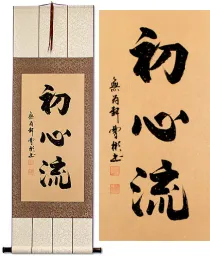
一心流 is the title for Isshin-Ryu.
The literal meaning is “one heart method.” You could also translate it as “Unified Hearts Method,” “One-Mind School” or “One-Heart Style.”
It implies people doing things as if with one heart and mind.
As a style or lineage name, this phrase suggests a school founded on simplicity, unity of intent, and clarity of principle rather than excessive technical complexity.
The second Kanji can mean the heart, mind, or essence of your being. Clearly, there's a multitude of ways you can define this title in English.
See Also: Isshin-Kai
This in-stock artwork might be what you are looking for, and ships right away...






Not the results for One Mind Unity that you were looking for?
Below are some entries from our dictionary that may match your One Mind Unity search:
| Characters If shown, 2nd row is Simp. Chinese |
Pronunciation Romanization |
Simple Dictionary Definition |
一心 see styles |
yī xīn yi1 xin1 i hsin hitomi ひとみ |
More info & calligraphy: One Heart / One Mind / Heart and Soul(adv,n) (1) one mind; (adv,n) (2) (See 一心に) wholeheartedness; one's whole heart; (female given name) Hitomi With the whole mind or heart; one mind of heart; also the bhūtatathatā, or the whole of things; the universe as one mind, or a spiritual unity. |
和合 see styles |
hé hé he2 he2 ho ho wagou / wago わごう |
More info & calligraphy: One Mind / Unity(n,vs,vi) harmony; concord; agreement; unity; union; (place-name, surname) Wagou To blend, unite, be of one mind, harmonize. |
一相 see styles |
yī xiàng yi1 xiang4 i hsiang issō |
lakṣana. One aspect, form, or side; ekatva, unity as contrasted with diversity; monism; the bhūtatathatā; the one mind in all things; cf. 一異. |
三身 see styles |
sān shēn san1 shen1 san shen sanmi さんみ |
{Buddh} trikaya (three bodies of the Buddha); (surname) Sanmi trikāya. 三寶身 The threefold body or nature of a Buddha, i.e. the 法, 報, and 化身, or dharmakāya, sambhogakāya, and nirmāṇakāya. The three are defined as 自性, 受用, and 變化, the Buddha-body per se, or in its essential nature; his body of bliss, which he "receives" for his own "use" and enjoyment; and his body of transformation, by which he can appear in any form; i.e. spiritual, or essential; glorified; revealed. While the doctrine of the trikāya is a Mahāyāna concept, it partly results from the Hīnayāna idealization of the earthly Buddha with his thirty-two signs, eighty physical marks, clairvoyance, clairaudience, holiness, purity, wisdom, pity, etc. Mahāyāna, however, proceeded to conceive of Buddha as the Universal, the All, with infinity of forms, yet above all our concepts of unity or diversity. To every Buddha Mahāyāna attributed a three-fold body: that of essential Buddha; that of joy or enjoyment of the fruits of his past saving labours; that of power to transform himself at will to any shape for omnipresent salvation of those who need him. The trinity finds different methods of expression, e.g. Vairocana is entitled 法身, the embodiment of the Law, shining everywhere, enlightening all; Locana is 報身; c.f. 三賓, the embodiment of purity and bliss; Śākyamuni is 化身 or Buddha revealed. In the esoteric sect they are 法 Vairocana, 報 Amitābha, and 化 Śākyamuni. The 三賓 are also 法 dharma, 報 saṅgha, 化 buddha. Nevertheless, the three are considered as a trinity, the three being essentially one, each in the other. (1) 法身 Dharmakāya in its earliest conception was that of the body of the dharma, or truth, as preached by Śākyamuni; later it became his mind or soul in contrast with his material body. In Mādhyamika, the dharmakāya was the only reality, i.e. the void, or the immateria1, the ground of all phenomena; in other words, the 眞如 the tathāgatagarbha, the bhūtatathatā. According to the Huayan (Kegon) School it is the 理or noumenon, while the other two are氣or phenomenal aspects. "For the Vijñānavāda... the body of the law as highest reality is the void intelligence, whose infection (saṃkleҫa) results in the process of birth and death, whilst its purification brings about Nirvāṇa, or its restoration to its primitive transparence" (Keith). The "body of the law is the true reality of everything". Nevertheless, in Mahāyāna every Buddha has his own 法身; e.g. in the dharmakāya aspect we have the designation Amitābha, who in his saṃbhogakāya aspect is styled Amitāyus. (2) 報身Sambhogakāya, a Buddha's reward body, or body of enjoyment of the merits he attained as a bodhisattva; in other words, a Buddha in glory in his heaven. This is the form of Buddha as an object of worship. It is defined in two aspects, (a) 自受用身 for his own bliss, and (b) 他受用身 for the sake of others, revealing himself in his glory to bodhisattvas, enlightening and inspiring them. By wisdom a Buddha's dharmakāya is attained, by bodhisattva-merits his saṃbhogakāya. Not only has every Buddha all the three bodies or aspects, but as all men are of the same essence, or nature, as Buddhas, they are therefore potential Buddhas and are in and of the trikāya. Moreover, trikāya is not divided, for a Buddha in his 化身 is still one with his 法身 and 報身, all three bodies being co-existent. (3) 化身; 應身; 應化身 nirmāṇakāya, a Buddha's transformation, or miraculous body, in which he appears at will and in any form outside his heaven, e.g. as Śākyamuni among men. |
胎藏界 see styles |
tāi zàng jiè tai1 zang4 jie4 t`ai tsang chieh tai tsang chieh taizō kai |
Garbhadhātu, or Garbhakośa-(dhātu), the womb treasury, the universal source from which all things are produced; the matrix; the embryo; likened to a womb in which all of a child is conceived— its body, mind, etc. It is container and content; it covers and nourishes; and is the source of all supply. It represents the 理性 fundamental nature, both material elements and pure bodhi, or wisdom in essence or purity; 理 being the garbhadhātu as fundamental wisdom, and 智 acquired wisdom or knowledge, the vajradhātu. It also represents the human heart in its innocence or pristine purity, which is considered as the source of all Buddha-pity and moral knowledge. And it indicates that from the central being in the maṇḍala, viz. the Sun as symbol of Vairocana, there issue all the other manifestations of wisdom and power, Buddhas, bodhisattvas, demons, etc. It is 本覺 original intellect, or the static intellectuality, in contrast with 始覺 intellection, the initial or dynamic intellectuality represented in the vajradhātu; hence it is the 因 cause and vajradhātu the 果 effect; though as both are a unity, the reverse may be the rule, the effect being also the cause; it is also likened to 利他 enriching others, as vajradhātu is to 自利 enriching self. Kōbō Daishi, founder of the Yoga or Shingon 眞言 School in Japan, adopted the representation of the ideas in maṇḍalas, or diagrams, as the best way of revealing the mystic doctrine to the ignorant. The garbhadhātu is the womb or treasury of all things, the universe; the 理 fundamental principle, the source; its symbols are a triangle on its base, and an open lotus as representing the sun and Vairocana. In Japan this maṇḍala is placed on the east, typifying the rising sun as source, or 理. The vajradhātu is placed west and represents 智 wisdom or knowledge as derived from 理 the underlying principle, but the two are essential one to the other, neither existing apart. The material and spiritual; wisdom-source and intelligence; essence and substance; and similar complementary ideas are thus portrayed; the garbhadhātu may be generally considered as the static and the vajradhātu as the dynamic categories, which are nevertheless a unity. The garbhadhātu is divided into 三部 three sections representing samādhi or quiescence, wisdom-store, and pity-store, or thought, knowledge, pity; one is called the Buddha-section, the others the Vajra and Lotus sections respectively; the three also typify vimokṣa, prajñā, and dharmakāya, or freedom, understanding, and spirituality. There are three heads of these sections, i. e. Vairocana, Vajrapāṇi, and Avalokiteśvara; each has a mother or source, e. g. Vairocana from Buddha's-eye; and each has a 明王 or emanation of protection against evil; also a śakti or female energy; a germ-letter, etc. The diagram of five Buddhas contains also four bodhisattvas, making nine in all, and there are altogether thirteen 大院 or great courts of various types of ideas, of varying numbers, generally spoken of as 414. Cf. 金剛界; 大日; 兩部. |
心身一如 see styles |
shinjinichinyo しんじんいちにょ shinshinichinyo しんしんいちにょ |
(yoji) body and mind as one; mind-body unity |
身心一如 see styles |
shēn xīn yī rú shen1 xin1 yi1 ru2 shen hsin i ju shin jin ichinyo しんじんいちにょ |
(yoji) body and mind as one; mind-body unity unity of body and mind |
Variations: |
shinshinichinyo; shinjinichinyo しんしんいちにょ; しんじんいちにょ |
(yoji) body and mind as one; mind-body unity |
The following table may be helpful for those studying Chinese or Japanese:
| Title | Characters | Romaji (Romanized Japanese) | Various forms of Romanized Chinese | |
| One Mind Unity | 和合 | wagou / wago wago / wago | hé hé / he2 he2 / he he / hehe | ho ho / hoho |
| One Heart One Mind Heart and Soul | 一心 | isshin / ishin | yī shì dài yi1 shi4 dai4 yi shi dai yishidai | i shih tai ishihtai |
| Body and Earth in Unity | 身土不二 | shindofuni / shindofuji | ||
| Isshin-Ryu Isshin Style | 一心流 | isshin ryuu isshinryuu ishin ryu | yī xīn liú yi1 xin1 liu2 yi xin liu yixinliu | i hsin liu ihsinliu |

Successful Chinese Character and Japanese Kanji calligraphy searches within the last few hours...



