Buy a Custom Soldier Chinese or Japanese Calligraphy Wall Scroll
We have many options to create artwork with the Chinese characters / Asian symbols / Japanese Kanji for Soldier on a wall scroll.
See also: Warrior | Fighter | Military Proverbs of Ancient Asia
1. Soldiers
2. American Soldier / American Serviceman
3. Marine / Soldier of the Sea
4. Military Veteran / Retired Soldier
9. Warrior Monk / Soldier Priest
10. Warrior of God / Soldier of God
11. Ghost Warrior
13. Army / Military
14. Art of War
16. Enlisted Sailor
17. Marine
18. Marine Corps
Soldiers
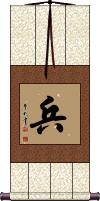
兵 can be used to express soldiers, troops, a force, an army, weapons, arms, military, warfare, tactics, strategy, or warlike.
The final meaning depends on context. It's also part of the Chinese title for the Terracotta soldiers. In fact, this character is usually used in compound words (words of more than one character). Sometimes this single character is the title used for the pawns in a chess game (in a related issue, this is also a nickname for soldiers with the rank of Private).
See Also: Military Veteran / Retired Soldier | Warrior
American Soldier / American Serviceman
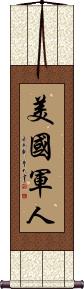
美國軍人 means “American Soldier” or literally “American Military Person.”
This can also be translated as “American military personnel,” or “American serviceman.” Gender is not specified in this title, so it's appropriate for male or female soldiers.
Marine / Soldier of the Sea
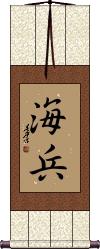
海兵 is a way to express “Marine” as in an individual “Soldier of the Sea” in Japanese Kanji and old Korean Hanja characters (not to be confused with Korean Hangul).
Breaking down each character, this means:
“ocean/sea soldier/army/warrior.”
Please note that this Japanese/Korean version roughly means “sailor” or “navy” in Chinese.
See Also: Military Veteran / Retired Soldier
Military Veteran / Retired Soldier
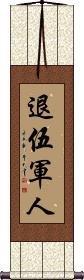
退伍軍人 is the Chinese title for a military veteran.
The first two characters mean “retired from the ranks,” or discharged.
The last two characters mean serviceman, soldier, or military personnel.
Soldier / Private
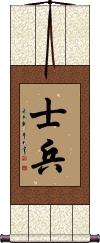
士兵 means “Soldier” but more specifically, a rank-and-file soldier (a private or troop - you could say a ground-pounder). Our other entry for “solider / serviceman” is probably better for a wall scroll (since someday, you will be promoted).
Note: In Japanese, they use these characters in the opposite order to create the same meaning word. In that order, it's pronounced “heishi” in Japanese. Just let us know if you want it in Japanese Kanji order when you place your order.
Soldier of the Gods
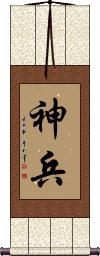
神兵 is a Japanese, Chinese, and Korean title that means “soldier dispatched by a god,” or “soldier under the protection of the gods.”
神兵 is used more in Japanese (especially in animation) than the other languages.
Soldier of Fortune
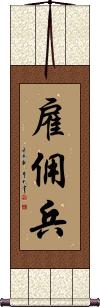
雇佣兵 is “soldier of fortune” in Chinese.
It can also be read as “mercenary” or “hired gun.”
Soldier of Fortune
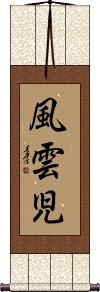
風雲児 is “soldier of fortune” in Japanese.
It can also be read as “lucky adventurer” or “adventurer who takes advantage of troubled times.”
Soldier / Serviceman
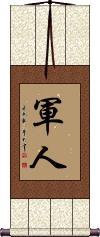
軍人 means “Soldier” or literally “Military Person.”
This can also be translated as “military personnel,” “soldier,” or “serviceman” (it is unisex, so male or female is not indicated).
See Also: Military Veteran / Retired Soldier
Warrior Monk / Soldier Priest
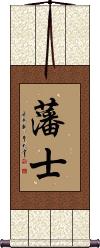
藩士 is a strange title for a wall scroll, but it may suit you if you see yourself as a warrior monk.
This title is not commonly used but will be understood in Chinese and Japanese. It can also be read as “armed monks.”
Warrior of God / Soldier of God
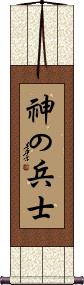
神の兵士 means “Warrior of God” or “Soldier of God” in Japanese.
Ghost Warrior
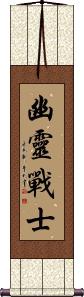
幽靈戰士 means Ghost Warrior or Ghost Soldier in Chinese.
This title is used for at least one movie and a video game (about a sniper).
Active Duty Military
Person on Active Duty
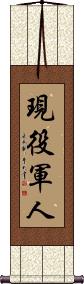
現役軍人 means “Active Duty Soldier” or literally “Active Duty Military Person.”
This title is a great way to show pride in being an active duty member of the armed forces.
The first two characters mean “active duty” and the second two characters can mean “military personnel,” “soldier,” or “serviceman” (it is unisex, so male or female is not indicated).
See Also: Military Veteran / Retired Soldier
Army / Military
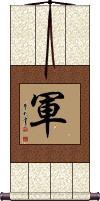
軍 means army, military, or arms.
軍 is also a character used in the compound word that means “army general.” It's the “gun” in the well-known Japanese title “Shogun” which means general.
See Also: Shogun / Japanese General | Navy | Marine | Military Veteran / Retired Soldier
Art of War
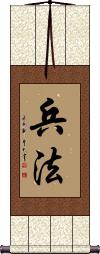
兵法 means “Art of War.”
It is also part of the title of a famous book of tactics by Sun Tzu. 兵法 could also be translated as “military strategy and tactics,” “military skills” or “army procedures.” If you are a military tactician, this is the wall scroll for you.
See Also: Military Veteran / Retired Soldier
Sun Tzu - Art of War
military strategy, tactics, and procedure
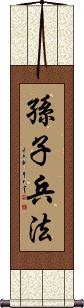
孫子兵法 is the full title of the most famous book of military proverbs about warfare.
The English title is “Sun Tzu's The Art of War.”
The last two characters have come to be known in the west as “The Art of War,” but a better translation would be “military strategy and tactics,” “military skills” or “army procedures.”
Note: Sometimes the author's name is Romanized as “Sun Zi” or “Sunzi.”
It's written the same in Chinese, Japanese Kanji, and Korean Hanja.
See Also: Military Veteran / Retired Soldier | Warrior
Enlisted Sailor
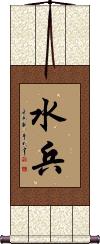
水兵 are the Chinese and Japanese characters for “Sailor.”
Specifically, this refers to an enlisted sailor.
These two characters literally mean “water soldier.”
See Also: Military Veteran / Retired Soldier
Marine
Amphibious Warrior
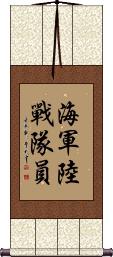
海軍陸戰隊員 is the Chinese way to express “Marine.” (as in a member of the Marine Corps). It is not country-specific, so it could be the Royal Marines, U.S. Marines, Chinese Marines, etc.
In Australian English, they would translate this as “Naval Infantryman.”
Breaking down each character this means:
“ocean/sea military/arms shore/land fighting/war/battle corps/team/group person/member.” Note that the first two characters are presented together but outside of this phrase mean “navy” (sea military).
See Also: Warrior | Military Veteran / Retired Soldier | Navy | Art of War
Marine Corps
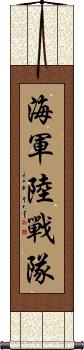
海軍陸戰隊 is the Chinese way to express “Marine Corps.” This could be the Marine Corps of virtually any country that has an amphibious military force.
Let me know if you want a more specific title, such as British Royal Marines or U.S. Marine Corps.
The Chinese title for Marines is very verbose...
Breaking down each character this means:
“ocean/sea military/arms shore/land fighting/war/battle corps/team/group.”
See Also: Military Veteran / Retired Soldier
Marine Corps
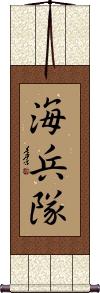
海兵隊 is the Japanese and Korean way to express “Marine Corps” or simply “Marines.” It is not specific, so this can be the Marine Corps of any country, such as the British Royal Marines to the U.S. Marines.
Breaking down each character, this means:
“ocean/sea soldiers/army corps/regiment/group.”
See Also: Military Veteran / Retired Soldier
Military Engineering
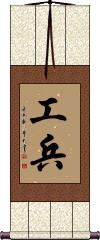
工兵 means the “engineering corps” of the army or other branches of the military.
The first character alone means work, worker, skill, profession, trade, craft, construction, or labor. The second character means army, force, or military.
See Also: Military Veteran / Retired Soldier
Military Intelligence
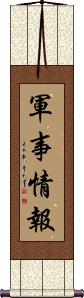
軍事情報 is the full way to say “Military Intelligence.”
The first two characters mean “military affairs.”
The second two characters mean “intelligence” or “information-gathering.”
If you work in the G2 section of your military unit, this is the wall scroll for you.
See Also: Military Veteran / Retired Soldier
United States Marine Corps
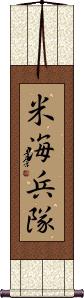
米海兵隊 is the Japanese way to write “United States Marine Corps” or simply “U.S. Marines.”
Breaking down each Kanji, this means:
“rice (American) ocean/sea soldiers/army/military corps/regiment/group.”
This title will only make sense in Japanese, it is not the same in Chinese! Make sure you know your audience before ordering a custom wall scroll.
If you are wondering about rice, America is known as “rice country” or “rice kingdom” when literally translated. The Kanji for rice is often used as an abbreviation in front of words (like a sub-adjective) to make something “American.” Americans say “rice burner” for a Japanese car and “rice rocket” for a Japanese motorcycle. If you did the same in Japanese, it would have the opposite meaning.
Note: I have not verified this but I’ve found this title used for U.S. Marines in Korean articles, so it’s most likely a normal Korean term as well (but only in Korean Hanja).
See Also: Marine Corps | Navy | Chinese or Korean Army General | Art of War | Warrior | Military Veteran / Retired Soldier
This in-stock artwork might be what you are looking for, and ships right away...
The following table may be helpful for those studying Chinese or Japanese:
| Title | Characters | Romaji (Romanized Japanese) | Various forms of Romanized Chinese | |
| Soldiers | 兵 | hei | bīng / bing1 / bing | ping |
| American Soldier American Serviceman | 美國軍人 美国军人 | méi guó jūn rén mei2 guo2 jun1 ren2 mei guo jun ren meiguojunren | mei kuo chün jen meikuochünjen |
|
| Marine Soldier of the Sea | 海兵 | kai hei / kaihei | ||
| Military Veteran Retired Soldier | 退伍軍人 退伍军人 | tuì wǔ jūn rén tui4 wu3 jun1 ren2 tui wu jun ren tuiwujunren | t`ui wu chün jen tuiwuchünjen tui wu chün jen |
|
| Soldier Private | 士兵 | shì bīng / shi4 bing1 / shi bing / shibing | shih ping / shihping | |
| Soldier of the Gods | 神兵 | shin pei / shinpei | shén bīng shen2 bing1 shen bing shenbing | shen ping shenping |
| Soldier of Fortune | 雇佣兵 | gù yōng bīng gu4 yong1 bing1 gu yong bing guyongbing | ku yung ping kuyungping |
|
| Soldier of Fortune | 風雲児 | fuu un ji / fuuunji / fu un ji | ||
| Soldier Serviceman | 軍人 军人 | gun jin / gunjin | jūn rén / jun1 ren2 / jun ren / junren | chün jen / chünjen |
| Warrior Monk Soldier Priest | 藩士 | sou hei / souhei / so hei | sēng bīng seng1 bing1 seng bing sengbing | seng ping sengping |
| Warrior of God Soldier of God | 神の兵士 | kami no heishi kaminoheishi | ||
| Ghost Warrior | 幽靈戰士 幽灵战士 | yōu líng zhàn shì you1 ling2 zhan4 shi4 you ling zhan shi youlingzhanshi | yu ling chan shih yulingchanshih |
|
| Active Duty Military | 現役軍人 现役军人 | geneki gunjin genekigunjin | xiàn yì jūn rén xian4 yi4 jun1 ren2 xian yi jun ren xianyijunren | hsien i chün jen hsienichünjen |
| Army Military | 軍 军 | gun | jūn / jun1 / jun | chün |
| Art of War | 兵法 | hyou hou / hyouhou / hyo ho | bīng fǎ / bing1 fa3 / bing fa / bingfa | ping fa / pingfa |
| Sun Tzu - Art of War | 孫子兵法 孙子兵法 | son shi hyou hou sonshihyouhou son shi hyo ho | sūn zǐ bīng fǎ sun1 zi3 bing1 fa3 sun zi bing fa sunzibingfa | sun tzu ping fa suntzupingfa |
| Enlisted Sailor | 水兵 | suihei | shuǐ bīng shui3 bing1 shui bing shuibing | shui ping shuiping |
| Marine | 海軍陸戰隊員 海军陆战队员 | hǎi jūn lù zhàn duì yuán hai3 jun1 lu4 zhan4 dui4 yuan2 hai jun lu zhan dui yuan haijunluzhanduiyuan | hai chün lu chan tui yüan haichünluchantuiyüan |
|
| Marine Corps | 海軍陸戰隊 海军陆战队 | hǎi jūn lù zhàn duì hai3 jun1 lu4 zhan4 dui4 hai jun lu zhan dui haijunluzhandui | hai chün lu chan tui haichünluchantui |
|
| Marine Corps | 海兵隊 海兵队 | kaiheitai | ||
| Military Engineering | 工兵 | kouhei / kohei | gōng bīng gong1 bing1 gong bing gongbing | kung ping kungping |
| Military Intelligence | 軍事情報 军事情报 | gunji-jouhou gunji-joho | jūn shì qíng bào jun1 shi4 qing2 bao4 jun shi qing bao junshiqingbao | chün shih ch`ing pao chünshihchingpao chün shih ching pao |
| United States Marine Corps | 米海兵隊 | bei kai hei tai beikaiheitai | ||
| In some entries above you will see that characters have different versions above and below a line. In these cases, the characters above the line are Traditional Chinese, while the ones below are Simplified Chinese. | ||||



