I am shipping orders on Thursday this week. News and More Info

Many custom options...

Tan Paper and Copper Silk Love Wall Scroll
Red Paper and Ivory Silk Love Wall Scroll
Orange Paper Love Scroll
Crazy Blue and Gold Silk Love Scroll


And formats...

Love Vertical Portrait
Love Horizontal Wall Scroll
Love Vertical Portrait

Strong Will in Chinese / Japanese...

Buy a Strong Will calligraphy wall scroll here!

Personalize your custom “Strong Will” project by clicking the button next to your favorite “Strong Will” title below...


  1. Strong-Willed / Strong of Heart

  2. Strong / Healthy

  3. Strong and Beautiful

  4. The Weak are Meat, The Strong Eat

  5. Woman of Strong Character / Woman Hero

  6. Strong Hearted / Strong Willed

  7. Strong Mind Strong Body

  8. Strong Body, Strong Mind

  9. Strong / Healthy

10. Strong Woman

11. Strong Willed

12. Live Strong

13. The Strong One

14. Live Strong

15. Strong / Powerful

16. Strong Minded

17. Strong / Robust

18. Strong / Powerful / Force

19. Mighty / Powerful / Strong

20. Strong-Minded Woman

21. Strength: Strong and Solid

22. Fierce and courageous training defeats the strong and protects the body.

23. Stay Strong / Iron Will

24. Strong bones come from hard knocks

25. Firm Belief / Strong Faith

26. Stay Strong / Indestructible / Unbreakable

27. Tempering Makes Strong Steel

28. Perseverance

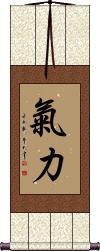
29. Strength / Ability

30. Immovable Mind

31. Physical Strength

32. Unbreakable

33. Mental Toughness

34. Power / Strength

35. Spiritual Strength / Strength of Spirit

36. To a Willing Heart, All Things Are Possible

37. Fortitude / Strength of Character

38. Indomitable / Persistence / Fortitude

39. Inner Strength

40. Robust / Sturdy

41. Patience / Perseverance

42. Perseverance / Fortitude

43. Tenacious / Tenacity

44. Indomitable / Unyielding

45. Inner Strength

46. Perseverance

47. Perseverance / Fortitude

48. Inner Strength / Self-Improvement

49. Inner Strength is Better than Outward Appearance

50. Perseverance / Indomitable / Invincible Fortitude

51. Patience / Perseverance / To Endure / Tolerant

52. Always Striving for Inner Strength

53. Perseverance / Will-Power

54. Determination to Achieve / Will-Power
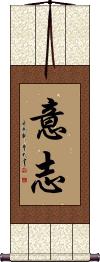
55. Will-Power / Self-Control

56. Free Will

57. No Pain No Gain

58. Sumo Wrestler

59. Inner Strength is Better than Outward Appearance

60. Resiliency

61. Romantic Passion

62. Intensity

63. Unbeatable

64. Jacques

65. Herculean Strength

66. Almighty / Omnipotent

67. Tsuyoi

68. Sherry

69. Iron Man

70. Conquering Yourself is a Sign of Strength

71. Longing for Lover

72. Love Faith Strength

73. Courage and Strength

74. True Love

75. Perception of Knowledge

76. Good Health

77. Gojukan / Goju-Kan

78. Shitsujitsu Goken

79. God is Good

80. Big Wave

81. Resilient in the Face of Adversity

82. Okinawan Goju-Kan

83. Do not fear the task: Cooperation will lead to success

84. Desire / Craving

85. Silent / Solitary

86. Unwavering Determination and Resolve

87. Christian / Disciple of Christ

88. Joshua 1:9

89. Warrior

90. Phoenix

91. Tathata / Ultimate Nature of All Things

92. Tiger

93. Gutsy / Daring / Bold

94. Family / Household

95. Cuong Nhu

96. Profound / Powerful Words

97. Undaunted After Repeated Setbacks

98. With all the strength of your heart


Strong-Willed / Strong of Heart

 ki no tsuyo i
Strong-Willed / Strong of Heart  Scroll

気の強い means strong-willed or strong of heart in Japanese.

Here's the character breakdown of this Japanese title:
気 (ki) spirit; mind; heart; nature; motivation; intention; feelings; essence.
の (no) possessive particle.
強い (tsuyoi) strong; powerful; mighty; potent; resistant; resilient; durable.


Note: Because this selection contains some special Japanese Hiragana characters, it should be written by a Japanese calligrapher.

Strong / Healthy

 sukoyaka
Strong / Healthy Scroll

健やか is a verbose way to say strong and healthy in Japanese. 健やか is the “strong” that is appropriate for an athlete.

Beyond “healthy,” it can also mean strength, persistence, vigorous, or invigoration.

Japanese also use the first Kanji to mean the same thing. This version adds two hiragana which serve to emphasize or amplify the word and clarify the meaning.


Note: Because this selection contains some special Japanese Hiragana characters, it should be written by a Japanese calligrapher.

Strong and Beautiful

 jiàn měi
 takemi
Strong and Beautiful Scroll

We don't really have a word like 健美 in English, but these two characters create a word that means “strong and beautiful.” It could also be translated as “healthy and beautiful.”

Note: 健美 is a word in Chinese and Korean, but it's also the family name Takemi in Japanese. The characters hold the same meaning in Japanese; however, it's like having the English name Stillwell when few people would perceive the meanings of still and well.

The Weak are Meat, The Strong Eat

Meaning: Survival of the fittest

 ruò ròu qiáng shí
 jaku niku kyoo shoku
The Weak are Meat, The Strong Eat Scroll

弱肉強食 is a Japanese and Chinese proverb that literally means “The weak are meat; the strong eat” or “The weak are prey to the strong.”

The closest English version is, “Survival of the fittest.” It also fits with the ideas of, “predatory behavior,” or “The law of the jungle.”

Woman of Strong Character / Woman Hero

 nǚ jié
 joketsu
Woman of Strong Character / Woman Hero Scroll

女傑 can mean brave woman, heroine, lady of character, distinguished woman, outstanding woman, and sometimes prominent woman.

Some people might use this to give a title to women like Amelia Earhart, Rosa Parks, Queen Elizabeth the First, Joan of Arc, Mulan Fa, Yevdokiya Nikolayevna Zavaliy, Harriet Tubman, Anne Frank, Clara Barton, and Jane Eyre.

I use it for a woman like Araceli Segarra (the first woman from Spain to climb Mt. Everest) and gave one of my daughters the middle name of Araceli.

Strong Hearted / Strong Willed

 yì zhì jiān qiáng
Strong Hearted / Strong Willed Scroll

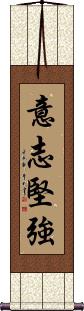
意志堅強 can mean either “strong-hearted,” “strong-willed” or “determination.”

The first two characters can be translated as “will,” “willpower,” “determination,” “volition,” “intention,” or “intent.” But, it should be noted that this first part possesses the element of “heart” in the lower portion of both characters (they also partially carry the meaning “with the whole heart”).

The last two characters mean “strong” or “staunch.”

Chinese word order and grammar are a bit different than English, so in this case, they are in reverse order of English but have the correct meaning in a natural form.


See Also:  Discipline | Will-Power

Strong Mind Strong Body

 qiáng zhuàng de shēn tǐ jiān qiáng de xīn tài
Strong Mind Strong Body Scroll

強壯的身體堅強的心態 is the Chinese phrase for “Strong Mind, Strong Body,” however, the character order is actually “Strong Body, Strong Mind,” as that's the more natural word order in Chinese.

Strong Body, Strong Mind

 tsuyo i karada tsuyo i kokoro
Strong Body, Strong Mind Scroll

強い体強い心 is a way to write “strong mind, strong body” in Japanese.

Each of the two lines starts with 強い (tsuyoi) which means: strong; powerful; mighty; potent; resistant; resilient; durable; tough; stiff; hard; inflexible.

The body is represented with 体 (the ancient version is 體, romanized as karada), which means: body; build; physique; posture; torso; trunk; health.

Mind is represented with 心 (kokoro), which can mean heart, mind, or soul, depending on context.

強い體強い心 is not a common phrase in Japanese, so it's not the most natural title for calligraphy. In English, you might want to write it, “strong mind, strong body” but, “strong mind, strong body,” is more natural in Japanese.


Note: Because this selection contains some special Japanese Hiragana characters, it should be written by a Japanese calligrapher.

Strong / Healthy

 jiàn
 ken
 
Strong / Healthy Scroll

This “strong” character is the more “healthy” version of strong. 健 is the “strong” that is appropriate for an athlete.

Beyond “healthy,” it can also mean strength, persistence, vigorous, or invigorated/invigoration.

Strong Woman

 nǚ qiáng rén
Strong Woman Scroll

女強人 is the best way to say “strong woman” or “strong and independent woman” in Chinese.

Grammar in China is a bit different, so these three characters literally read as “female strength person” or “woman strong person.” This might sound funny in English, but this is a natural-sounding title in Chinese.

Strong Willed

 yìng qì
Strong Willed Scroll

硬氣 means firm, unyielding, or strong-willed in Chinese.

If you take pride in being strong-willed or a bit stubborn, this could be for you.

 jiān qiáng shēng huó
Live Strong Scroll

While hard to translate directly, 堅強生活 is the best way to write “Live Strong” in Chinese. If you are a cancer survivor or support Lance Armstrong's ideas, this is a nice selection for a wall scroll.

The first two characters mean strong or staunch. The last two mean living or life (daily existence). While the Chinese version is the reverse order of “Live Strong” it is the only way to write it in a natural form that is grammatically correct.

Note that we are in no way affiliated or connected to Lance or his foundation. This translation is offered because of multiple requests from customers whose philosophies or ideas match those of the Live Strong idea.

The Strong One

 tsuyoi mono
The Strong One Scroll

強いもの means “strong one,” in Japanese.


Note: Because this selection contains some special Japanese Hiragana characters, it should be written by a Japanese calligrapher.

 tsuyoku ikiru
Live Strong Scroll

強く生きる is “Live Strong” in Japanese.

If you are a cancer survivor, or simply support Lance Armstrong's ideas, this is a nice selection for a wall scroll.


Note that we are in no way affiliated or connected to Lance, nor his foundation.


Note: Because this selection contains some special Japanese Hiragana characters, it should be written by a Japanese calligrapher.

Strong / Powerful

 qiáng zhuàng
 kyousou
Strong / Powerful Scroll

強壯 is an adjective that means powerful or strong.

It can also be translated as able-bodied, robust, or sturdy.
This version of strength also suggests muscularity.


壮Note that the second character was simplified in Japan after WWII (also simplified in mainland China but not for calligraphy). If you want the modern Japanese/simplified version, please click on the Kanji shown to the right.


See Also:  Strength | Vitality | Health

Strong Minded

 yào qiáng
Strong Minded Scroll

要強 means “strong-minded” in Chinese.

This refers to someone who is or encourages someone to be eager to excel or eager to get ahead in life.

Strong / Robust

 zhuàng
 sou
 
Strong / Robust Scroll

This “strong” character means “to strengthen” or robust. This brings images of a muscle-bound hulk of a weight lifter or bodybuilder to an Asian person who sees this character.

Note that in Korean and Japanese, this character is normally part of compound words, and is not seen alone too often.


壮Note that the this character was simplified in Japan after WWII (also simplified in mainland China but not for calligraphy). If you want the modern Japanese/simplified version, please click on the Kanji shown to the right.

Strong / Powerful / Force

 qiáng
 kyou
 
Strong / Powerful / Force Scroll

強 is a character that means strong, strength, force, powerful, better, stubborn, and stiff (yes, all of this in one character).

This “strong” has less to do with physical strength and more to do with having a winning attitude, or just having the ability to win at something.

Note that most of the time, this character is pronounced “qiang” but when used with the meaning of stubborn, unyielding, or stiff, it is pronounced “jiang” in Chinese.

Also, sometimes “qiang” is used in modern Chinese to describe people that do crazy things (For example: Bicycling from Beijing to Tibet alone). I sometimes can be found outside my Beijing apartment wearing nothing but shorts and a tee-shirt while eating ice cream during a snow storm, just to hear my neighbors call me “qiang.” Maybe they mean “strong” but perhaps they are using the new meaning of “crazy strong.”

強 can also be a Chinese surname that romanizes as Jiang in the mainland or Chiang if from Taiwan.

強 is a valid Korean Hanja character with the same meaning but is mostly used in compound Korean words.

強 is used in Japanese (though normally in compound words). In Japanese, it has the same meaning but in some contexts can mean “a little more than...” or “a little over [some amount].” Most Japanese would read this as tough, strength, stiff, hard, inflexible, obstinate, or stubborn.

The variant 彊 is sometimes seen in older literature.

Mighty / Powerful / Strong

 qiáng dà
 kyoudai
Mighty / Powerful / Strong Scroll

強大 can mean mighty, powerful, large, formidable, or strong.

This term is often used to describe soldiers/troops/warriors and whole armies.

Strong-Minded Woman

 reppu
Strong-Minded Woman Scroll

烈婦 is a Japanese title for a strong-minded woman, virtuous woman, or heroin.

In some contexts, it can refer to a pure or chaste woman.

Strength: Strong and Solid

 qiáng gù
 kyouko
Strength: Strong and Solid Scroll

強固 means firmness, stability, security, and strength in Japanese.

It's not used commonly in China, but it means “powerful,” “firm,” “solid,” “strong,” or “better than others” in Chinese. There is a slight variation in the top of the first character between Chinese and Japanese. Because this is more of a Japanese word, we are showing the Japanese form here.

強固 is also a Korean word, but Korean Hanja uses the Chinese form of the first character (one tiny stroke is a little different), so just let me know if your audience is Korean when you place your order, and we'll have it written in the Chinese/Korean version.

Fierce and courageous training defeats the strong and protects the body.

 gāng yǒng zhī měng liàn shèng qiáng ér bǎo tǐ
Fierce and courageous training defeats the strong and protects the body. Scroll

This is a martial arts phrase that roughly translates as, “Fierce and courageous training defeats the strong and protects the body,” or “Brave and fierce training result in victory over the strong and defend the body.”

Stay Strong / Iron Will

 tesshin sekichou
Stay Strong / Iron Will Scroll

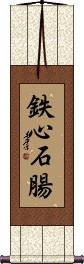
鉄心石腸 is a Japanese proverb that suggests you should have the inner-strength and will as hard and steadfast as iron.

It's the Japanese way of saying, “stay strong.” This is an especially uplifting thing to say to a person in distress or recovering from a disaster. It's kind of the survivor's creed.

If you literally translate this, it means “iron will, stone guts” or “iron heart, rock-hard bowels.”

Strong bones come from hard knocks

 bù kē bù pèng gǔ tóu bù yìng
Strong bones come from hard knocks Scroll

不磕不碰骨頭不硬 is a Chinese proverb that literally translates as: Without being knocked around a bit, [one's] bones won't become hard.

Figuratively, this means: One can't become strong without first being tempered by “hard knocks.”

While true for everyone, this sounds like the “Iron Body” form of Kung Fu, where practitioners' bodies are beaten (and often bone fractured) in order to become stronger.
For the rest of us, this is just about how we can be tempered and build character through the hardships in our lives.

This is not a common title for a wall scroll in China.

Firm Belief / Strong Faith

 jiān xìn
 ken shin
Firm Belief / Strong Faith Scroll

堅信 means to believe firmly, with firm faith, or without any doubt.

Japanese Christians sometimes use this term to mean the rite of confirmation.

This can also be the Japanese given name Kenshin.

Stay Strong / Indestructible / Unbreakable

 jīn gāng bù huài
 kon gou fu e
Stay Strong / Indestructible / Unbreakable Scroll

金剛不壞 is originally a Buddhist term for “The diamond indestructible.”

Sometimes, it's written 金剛不壞身, The diamond-indestructible body.

Outside that context, it still means firm and solid, sturdy and indestructible, unshakable, or adamantine (a mythological indestructible material).


壊 Note: If you order this from the Japanese master calligrapher, the last Kanji will look like the one shown to the right.

Tempering Makes Strong Steel

Hardship Develops Strong Character

 bǎi liàn cái chéng gāng
Tempering Makes Strong Steel Scroll

百煉才成鋼 / 百煉纔成鋼 literally translates as: Only after much tempering is steel produced.

Figuratively, this means: True character must be tested in hardship.

This is a mild form of saying, “Whatever doesn't kill me, makes me stronger.”

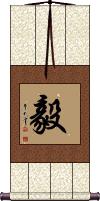
Perseverance

 yì
 see note
 
Perseverance Scroll

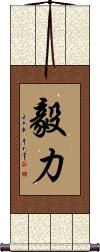
毅 is the simplest way to express perseverance in Chinese and Korean Hanja.
This single-character version leaves a bit of mystery about what kind of perseverance you might want to convey.

In Korean, this is usually associated with “strength of character.”

In Japanese, this character can be pronounced in a dozen different ways (so we have left out the Japanese pronunciation guide that normally appears above). In Japanese, this Kanji would usually be translated as “strong” (perhaps strong-willed).


See Also:  Tenacity | Fortitude | Strength | Undaunted

Strength / Ability

 lì liàng
 riki ryou
Strength / Ability Scroll

力量 is a general strength term.

It can refer to mental or physical strength (depending on context). 力量 can also be used to describe strength in terms of capability, capacity, ability, and even tact. Some may translate this as power or force.

Immovable Mind

fudoshin

 fu dou shin
Immovable Mind Scroll

不動心 is one of the five spirits of the warrior (budo) and is often used as a Japanese martial arts tenet.

Under that context, places such as the Budo Dojo define it this way: An unshakable mind and an immovable spirit is the state of fudoshin. It is courage and stability displayed both mentally and physically. Rather than indicating rigidity and inflexibility, fudoshin describes a condition that is not easily upset by internal thoughts or external forces. It is capable of receiving a strong attack while retaining composure and balance. It receives and yields lightly, grounds to the earth, and reflects aggression back to the source.

Other translations of this title include imperturbability, steadfastness, keeping a cool head in an emergency, or keeping one's calm (during a fight).

The first two Kanji alone mean immobility, firmness, fixed, steadfastness, motionless, and idle.

The last Kanji means heart, mind, soul, or essence.

Together, these three Kanji create a title defined as “immovable mind” within the context of Japanese martial arts. However, in Chinese, it would mean “motionless heart,” and in Korean Hanja, “wafting heart” or “floating heart.”

Physical Strength

 tǐ lì
 tai ryoku
Physical Strength Scroll

體力 means “physical strength,” “physical power,” or “physical stamina” in Chinese, ancient Japanese, and old Korean Hanja.


See Also:  Fortitude | Health

Physical Strength

 tǐ lì
 tairyoku
Physical Strength Scroll

体力 means “physical strength” or “physical power.”

The first character was first simplified in Japan. Later, that simplified version became the standard in mainland China. Just in case you want this version, it is offered here. I suggest it if your audience is Japanese. Most Chinese know the older traditional version, which looks like 體力.

体力 can also be defined: stamina; endurance; physical strength; resilience; resistance to disease; clout; stability.

 kowa re na i
Unbreakable Scroll

壊れない means unbreakable in Japanese.

The first two characters mean to be broken, to break, to fall through, and to come to nothing. But the last two characters create a negative meaning (like adding “un-” to “breakable”).


Note: Because this selection contains some special Japanese Hiragana characters, it should be written by a Japanese calligrapher.


See Also:  Indomitable Spirit

Mental Toughness

 mentarutafunesu
Mental Toughness Scroll

メンタルタフネス is a Japanese Katakana word for mental toughness.

Katakana is a character set used in Japanese to approximate borrowed English or foreign words. So this is supposed to sound like mental toughness does in English.


Note: Because this title is entirely Japanese Katakana, it should be written by a Japanese calligrapher.

Power / Strength

 lì
 chikara / ryoku
 
Power / Strength Scroll

力 is the simplest form of “power” or “strength.”

In Japanese, it is pronounced “chikara” when used alone, and “ryoku” when used in a sentence (there are also a few other possible pronunciations of this Kanji in Japanese).

In some contexts, this can mean ability, force, physical strength, capability, and influence.


See Also:  Strength | Vitality | Health

Spiritual Strength / Strength of Spirit

 jīng shén lì liàng
 seishin rikiryou
Spiritual Strength / Strength of Spirit Scroll

精神力量 is a title that speaks of one's soul or spirit and the capacity or strength that soul possesses.

The first two characters mean mind, heart, spirit, and/or soul.

The last two characters mean strength, capacity, or ability.

Note: Separately, these are two words in Japanese and can be pronounced, but this does not make a natural title in Japanese (best if your audience is Chinese).

To a Willing Heart, All Things Are Possible

Where there is a will, there is a way

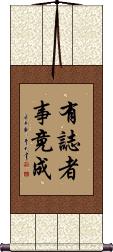
 yǒu zhì zhě shì jìng chéng
To a Willing Heart, All Things Are Possible Scroll

有志者事竟成 is an old Chinese proverb that has been translated many different ways into English. As you read the translations below, keep in mind that in Chinese, heart=mind.

Nothing is impossible to a willing heart.
Nothing is impossible to a willing mind.
Nothing is difficult to a willing heart.
Where there is a will, there is a way.
Nothing in the world is impossible if you set your mind to doing it.
A willful man will have his way.
If you wish it, you will do it.
A determined heart can accomplish anything.
All things are possible with a strong mind.


Fortitude / Strength of Character

 gāng yì
 gouki
Fortitude / Strength of Character Scroll

剛毅 is a Japanese and Chinese word that means resolute and firm, fortitude, firmness of character, hardihood, manliness, or macho.


See Also:  Perseverance | Strength | Tenacity

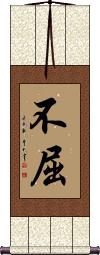
Indomitable / Persistence / Fortitude

 bù qū
 fukutsu
Indomitable / Persistence / Fortitude Scroll

不屈 is the short form of a longer Chinese word and also a word used in Korean and Japanese to express the idea of being indomitable. It literally means “will not bend,” “will not crouch,” “will not yield,” “will not flinch,” or “will not submit.”

Note: Some will translate this as “indomitable spirit”; however, technically, there is no character to suggest the idea of “spirit” in this word.


See Also:  Tenacity | Fortitude | Strength | Undaunted

Inner Strength

 nèi lì
 nai ryoku
Inner Strength Scroll

內力 is the shorter version of inner strength (can also be translated as “internal force”). The first character holds the meaning of “inner” or “internal.” The second character means “power,” “force,” or “strength.”

內力 is a Kung Fu way of talking about an inner power or strength from within. This is a way to express “inner chi.” This is something that you might hear in a real Chinese Kung Fu movie.

While understood in Chinese and Japanese, this can have a secondary meaning of “inner stress” in Japanese.

Robust / Sturdy

 qiáng jiàn
 kyouken
Robust / Sturdy Scroll

強健 means robustness or sturdiness in regards to being healthy and fit.

This can also be used to say “persistently good health.”

Patience / Perseverance

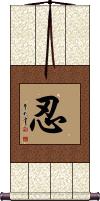
 rěn
 nin
 
Patience / Perseverance Scroll

忍 contains the ideas of patience, equanimity, perseverance, forbearance, and endurance. Alone, this single character can be a bit ambiguous or flexible. It can also mean to endure, to bear, to put up with, or to conceal. If you want to simply decide what this character means to you within the general meaning but keep it a mystery to others, this is a good choice.

If you want to be more direct, you may want to choose one of our other selections that mean perseverance or patience (you will see this character within those larger words/phrases).

There is a secondary meaning in Japanese since this is the first character of the word ninja.

忍Note that when writing this as Kanji, Japanese will tend to write it in the form shown to the right. If you select our Japanese master calligrapher, please expect this Kanji form (yes, it's just one stroke that is slightly different in location, crossing another stroke in the Japanese Kanji form).


See Also:  Perseverance | Patience | Tenacious

Perseverance / Fortitude

 jiān rèn
Perseverance / Fortitude Scroll

堅韌 is a short word meaning “fortitude,” “steadfast,” and “persistent.”

Tenacious / Tenacity

 wán qiáng
 gan kyou
Tenacious / Tenacity Scroll

頑強 means “Tenacious,” “Hard to Defeat,” or “Dogged.”

Alone, the first character means mischievous, obstinate, or stubborn. But it loses some of the mischievous meaning when the second character is added.

The second character means strength, force, power, or better.


See Also:  Determination | Dedication | Devotion | Never Give Up

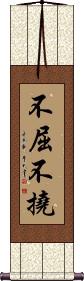
Indomitable / Unyielding

 bù qū bù náo
 fu kutsu fu tou
Indomitable / Unyielding Scroll

不屈不撓 means “Indomitable” or “Unyielding.”

不屈不撓 is a long word by Chinese standards. At least, it is often translated as a single word into English. It's actually a proverb in Chinese.

If you want to break it down, you can see that the first and third characters are the same. Both mean “not” (they work as a suffix to make a negative or opposite meaning to whatever character follows).

The second character means “bendable.”

The last means “scratched” or “bothered.”

So this really means “Won't be bent, can't be bothered.” I have also seen it written as “Will not crouch, will not submit.” This comes from the fact that the second character can mean “to crouch” and the last can mean “to submit” (as in “to give in” such as “submitting to the rule of someone else”). This may explain better why these four characters mean “indomitable.”

Notes:
Some will translate this as “indomitable spirit”; however, technically, there is no character to suggest the idea of “spirit” in this word.
Other translations include indefatigability, indomitableness, or unremitting tenacity.

The first two characters can be stand-alone words in Chinese.
In Japanese, this is considered two words (with very similar meanings). It's more common to see the word order flipped to 不撓不屈 in Japanese.
The same characters are used in old Korean Hanja. Just like in Japanese, the words are swapped to 不撓不屈 creating a word pronounced “불요불굴” in Korean.


See 不撓不屈


See Also:  Tenacity | Fortitude | Strength | Undaunted

Inner Strength

 nèi zài lì liàng
Inner Strength Scroll

內在力量 is the slightly-verbose way to say inner strength.

The first two characters mean “intrinsic” or “inner.” The second two characters mean “power,” “force” or “strength” (especially physical strength). 內在力量 is more a short phrase rather than just a word in Chinese and Korean. This can sort of be understood in Japanese but it's not normal/proper Japanese.

Perseverance

 jiān rèn bù bá
Perseverance Scroll

堅韌不拔 is about perseverance, being steadfast and persistent.

堅韌不拔 is a great phrase for you if you commit to your goals and overcome obstacles, no matter how long it takes.

The translation of this proverb literally means “something so persistent or steadfast, that it is not uprootable, movable, or surpassable.”

Other translations include being firm and indomitable or tenacious and unyielding.


See Also:  Tenacious | Devotion | Persistence | Indomitable

Perseverance / Fortitude

 jiǎn rěn
 ken nin
Perseverance / Fortitude Scroll

堅忍 means persistent, steadfast, fortitude, and/or perseverance.

The first character means strong, solid, firm, unyielding, or resolute.
The second character means to beat, endure, or tolerate.
Together they speak of the strength from within yourself. Some may also translate this as long-suffering in a more Biblical sense.

堅忍 is a common term in Chinese and Korean Hanja but a little less commonly used in modern Japanese Kanji. For that reason, this selection is best if your audience is Chinese or Korean.


忍忍 Note that when writing this as Kanji, Japanese will tend to write the second Kanji a little differently. If you select our Japanese master calligrapher, please expect the form where the little horizontal stroke crosses the vertical stroke. See differences in the images to the right. Technically, they are both the same character, and will be read the same in either language.

Inner Strength / Self-Improvement

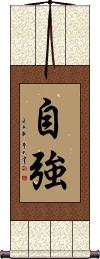
 zì qiáng
Inner Strength / Self-Improvement Scroll

自強 is the kind of inner strength that applies to a person who has will-power and can inspire themselves to do great things.

自強 can also be the creed of a person that always pursues self-improvement.

Other translations: self-strengthening, striving for improvement, self-improvement, striving to become stronger, and self-renewal.

Inner Strength is Better than Outward Appearance

 naimen no tsuyosa ha gaiken no yosa ni masaru
Inner Strength is Better than Outward Appearance Scroll

内面の強さは外見の良さに勝る is a Japanese proverb that literally translates as “inner/internal strength/power [versus] outward-appearance [the] merit/virtue/good quality [does] excel/surpass/exceed/outweigh.”

More naturally in English, this would be “Inner Strength Outweighs Outward Appearance.”


Note: Because this selection contains some special Japanese Hiragana characters, it should be written by a Japanese calligrapher.

Perseverance / Indomitable / Invincible Fortitude

 jiān rěn bù bá
 kenninfubatsu
Perseverance / Indomitable / Invincible Fortitude Scroll

堅忍不抜 means determined, steadfast, unswerving, or unshakable in Japanese.

This is the Japanese version of an old Chinese 4-character perseverance proverb.
This would be understood in Chinese, but it's not commonly written this way in Chinese.


忍Note that when writing this as Kanji, Japanese calligraphers sometimes write the second Kanji in the form shown to the right. Yes, it’s just one stroke that is slightly different in location, crossing another stroke in this alternate Japanese Kanji form. If you have a preference, let us know when you order.

Due to some odd computer coding conventions, these two character forms were combined/merged into the same code point - thus, you will not see Kanji images of more Japanese form as you select options for your scroll.

Patience / Perseverance / To Endure / Tolerant

 rěn nài
 nin tai
Patience / Perseverance / To Endure / Tolerant Scroll

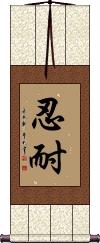
忍耐 is patience, the quiet hope, and trust that things will turn out right.

You wait without complaining. You are tolerant and accepting of difficulties and mistakes. You picture the end in the beginning and persevere to meet your goals.

忍耐 can also mean “to endure,” “restrain oneself,” or “forbearance,” and in some contexts, it can mean “perseverance” or “endurance.”

忍耐 is also used as a tenet of Taekwondo, Tang Soo Do, and other Korean martial arts where it's titled “Endurance” and romanized as “In Neh.”


忍Note that when writing this as Kanji, Japanese will tend to write the first character in the form shown to the right. If you select our Japanese master calligrapher, please expect this Kanji form (yes, it’s just one stroke that is slightly different in location, crossing another stroke in the Japanese Kanji form).


See Also:  Peace | Harmony | Perseverance

Always Striving for Inner Strength

 zì qiáng bú xī
Always Striving for Inner Strength Scroll

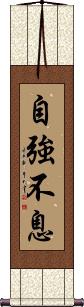
自強不息 is a proverb or idiom that suggests that the pursuit of self-improvement is eternal. It can also be a suggestion to strive unremittingly in life.

The first two characters mean inner strength with the idea of self-improvement. The last two characters mean “never rest” or “striving without giving up.”

Some will translate these four characters as “Exert and strive hard without any let-up.”

Perseverance / Will-Power

 yì lì
Perseverance / Will-Power Scroll

毅力 is a way to express “perseverance” with the idea of “willpower” in Chinese and old Korean Hanja. It can also mean “strong-willed.”

The first character means “strong” and “persistent,” while the second means “strength” and “power.”

Determination to Achieve / Will-Power

 yì zhì
 ishi
Determination to Achieve / Will-Power Scroll

意志 is a Chinese, Korean, and Japanese word that means “determination to achieve.” It can also be translated as: will; willpower; determination; volition; intention; or intent.

In Japanese, this can also be the given name, Ishi.

Will-Power / Self-Control

 yì zhì lì
 ishi ryoku
Will-Power / Self-Control Scroll

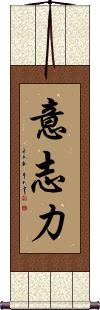
意志力 is a form of willpower or self-control and is about having the determination or tenacity to keep going.

In Japanese, this is the power of will, the strength of will, volition, intention, intent, or determination.

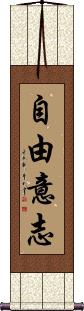
 zì yóu yì zhì
 jiyuu ishi
Free Will Scroll

自由意志 is a concept that has existed for thousands of years that humans can understand right and wrong, then make a decision one way or the other (thus affecting their fate).

Sources such as Confucius, Buddhist scriptures, the Qur'an, and the Bible all address this idea.

As for the characters shown here, the first two mean free, freedom, or liberty. The last two mean “will.”

Can be romanized from Japanese as jiyū-ishi, jiyuu-ishi, and sometimes jiyuu-ishii.
It's 자유의지 or jayuu-yiji in Korean and zìyóu yìzhì in Chinese.


See Also:  Freedom | Fate

No Pain No Gain

 itami naku shite erumono wa nashi
No Pain No Gain Scroll

痛みなくして得るものなし is a Japanese phrase that means “no pain, no gain.”

This suggests that with pain, a gain must follow.

The pain Kanji here can also be translated as sorrow or suffering. The gain can also mean profit, advantage, or benefit. In the Japanese Buddhist context, that gain Kanji can mean rebirth in paradise, entering nirvana.

The character breakdown:
痛みなく (itami naku) pain; ache; sore; grief; distress. The naku part adds the meaning of “a lot of” or “extended”
して (shite) and then. (indicates a causative expression; acts as a connective particle)
得る (eru) to get; to acquire; to obtain; to procure; to earn; to win; to gain; to secure; to attain.
もの (mono) conjunctive particle indicating a cause or reason.
なし (nashi) none of; -less; without; no.


Note: Because this selection contains some special Japanese Hiragana characters, it should be written by a Japanese calligrapher.

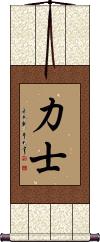
Sumo Wrestler

 lì shì
 ri kishi
Sumo Wrestler Scroll

力士 literally means “strong man” but is more commonly used as a title for sumo wrestlers.

In Japanese, this is a Rikishi.

力士 is also used in Chinese and old Korean with the same meaning. Occasionally, this will also be used to refer to a strong or mighty man, hero, demigod, etc. But anyone in the CJK world will first think of a sumo wrestler before the more literary usage as a strong man or demigod.

Inner Strength is Better than Outward Appearance

 biǎo zhuàng bù rú lǐ zhuàng
Inner Strength is Better than Outward Appearance Scroll

表壯不如里壯 literally translates as: [Better to be] strong inside than [to be] strong outside.

The ancient original meaning was:
[An] able [husband] outside [working to support a family is] not as good as [an] able [wife] inside [working and saving to take care of the family].

The current meaning is:
Inner strength is more important than outward appearance.

 qiáng rèn
Resiliency Scroll

This Chinese word means resilient or “tough and strong.”

Romantic Passion

 jī qíng
 gekijou
Romantic Passion Scroll

Beyond romantic passion, 激情 also means “strong emotion” or “fervor.”


The meaning in Japanese is a little more radical, as beyond "passion" it can be understood as "violent emotion" or "fury."

 qiáng liè
 kyouretsu
Intensity Scroll

強烈 means intensity in regard to strength.

Note: In some contexts, this can mean violently strong or severe.

 wàn fū bù dāng
Unbeatable Scroll

萬夫不當 is a Chinese proverb that literally means, “Unbeatable by even 10,000 men.”

This is understood to mean extremely brave and strong.

 jié kè
Jacques Scroll

杰克 is the name Jacques in Chinese (Mandarin).

This version has a strong “j” sound. This one sounds somewhere between the English names “Jack” and “Jake.”

Herculean Strength

 qiáng lì
 kyou ryoku
Herculean Strength Scroll

強力 means herculean strength, powerful, or strong.

I've even heard this described as “strength to carry a mountain.”


Note: This can also be the Japanese surname Gouriki (like Mr. Strong).

Almighty / Omnipotent

 quán néng
 zennou
Almighty / Omnipotent Scroll

全能 means almighty or omnipotent in Chinese, Japanese Kanji, and old Korean Hanja.

In some contexts, this can mean all-round or strong in every area (especially in athletics).

 tsuyoi
Tsuyoi Scroll

強い means strong, potent, competent, domineering, tough, brawny, powerful, healthy, rugged, skilled, resilient, solid, or fierce.

This word is ambiguous without context, so it can mean any or all of these things if you wish.

Sherry

(strong wine)

 xuě lì
Sherry Scroll

Just for fun, if you want to name yourself after the alcoholic drink, you can use this name.

雪利 is what they call sherry (extra strong wine) in China.

 tetsujin
Iron Man Scroll

鉄人 is a Japanese title that means iron man or strong man.

鉄人 is sometimes used as a given name romanized as Tetsujin, Temujin, Tetsundo, Tetsuhito, or Tetsuto.

Conquering Yourself is a Sign of Strength

 zì shèng zhě qiáng yě
Conquering Yourself is a Sign of Strength Scroll

自勝者強也 means “One who conquers oneself is strong” in Chinese.

自勝 = Self-overcoming or self-conquering
者 = is
強 = Strength
也 = Also

Longing for Lover

 sī liàn
Longing for Lover Scroll

思戀 is a term used for when you miss a lover.

It suggests that you are separated (not by choice) and have longed for each other. It's a strong feeling of missing your lover.

Love Faith Strength

 ài xìn qiáng
Love Faith Strength Scroll

愛信強 is the shortest way to write the word list, “love faith strength.”

The first character is love, the second is faith or believe, and the third means strong or strength.


It should be noted that word lists like this are not as natural sounding in Chinese as word lists can be in English. it’s more common to have a full phrase (with subject, verb, and object) or single words on calligraphy wall scrolls in Asia.

Courage and Strength

 yǒng lì
 yuu ri
Courage and Strength Scroll

勇力 is a very short way to say “courage and strength” in Chinese and Japanese.

In Japanese, it's read more like “strong courage” or “powerful courage.” This can also be the personal name Yuri or Yuuri in Japanese.

 okuunoai
True Love Scroll

屋烏の愛 is a Japanese way to express true love or deep love.

The phrase literally suggests that this is a love for someone so strong that it can reach a crow perched on that person's roof.

Perception of Knowledge

 zhī shi
 chishiki
Perception of Knowledge Scroll

知識 has the very strong meaning of “knowledge” and, in some contexts, “learning.”

The first character represents “to know” or “to realize.”

The second character alone refers to the ability to “recognize” or “realize” and can also be used to mean “knowing.”


See Also:  Wisdom | Learn From Wisdom

 jiàn kāng
 kenkou
Good Health Scroll

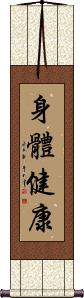
健康 is the best way to express good health in Chinese, Korean, and Japanese.

健康 also suggests the ideas of being solid, strong, sound, wholesome, and at peace.

Can also be used to express healthy, vitality, or well-being.


See Also:  Health | Vitality | Wellness

Gojukan / Goju-Kan

 gou juu kan
Gojukan / Goju-Kan Scroll

剛柔館 is the martial arts style Gojukan or Goju-Kan.

The meaning is “hardness [and] softness hall.”

剛 = Hard, firm, or strong.
柔 = Soft, softness, flexible, supple, yielding, gentleness, or pliant.
館 = Hall, building, school room, or an alternate word for a dojo.

Shitsujitsu Goken

 shitsu jitsu gou ken
Shitsujitsu Goken Scroll

質実剛健 is a Japanese word that can mean “unaffected and sincere, with fortitude and vigor” or “simplicity and fortitude.”

The first two characters, 質実 mean simplicity or the “essence of something.”
The last two, 剛健, mean strength, fortitude, or strong composure.

 shén zhēn měi hǎo
God is Good Scroll

神真美好 means “God is good,” in Chinese.

You can also translate this as “God is really good” or “God is so good.”

The last two characters are a version of good that suggests very strong goodness. The characters read, “beautifully good.”

 tāo
 nami
 
Big Wave Scroll

濤 is the Chinese character for “Big Wave.”

It suggests a wave unlike most, strong and powerful.

濤 is technically also a Japanese Kanji, and Korean Hanja but it's not commonly used in those Asian languages. Pronunciation in Japanese and Korean is provided above for reference only. Just order this if your audience is Chinese.

Resilient in the Face of Adversity

 u ta re tsuyo i
Resilient in the Face of Adversity Scroll

打たれ強い is often used as a martial arts term.

It means being able to take a lot of punishment or being able to take a hit. In Japanese baseball, it can also refer to the pitcher's ability to keep his cool when the batter gets a hit. 打たれ強い is generally about being resilient and strong in the face of criticism or adversity.


Note: Because this selection contains some special Japanese Hiragana characters, it should be written by a Japanese calligrapher.

Okinawan Goju-Kan

 okinawa gou juu kan
Okinawan Goju-Kan Scroll

沖縄剛柔館 is the martial arts style Okinawan Gojukan or Okinawan Goju-Kan.

The meaning is “Okinawa hardness [and] softness hall.”

沖縄 = Okinawa.
剛 = Hard, firm, or strong.
柔 = Soft, softness, flexible, supple, yielding, gentleness, or pliant.
館 = Hall, building, school room, or an alternate word for a dojo.

Do not fear the task: Cooperation will lead to success

Do not fear strong winds waves; just be sure to row in unison
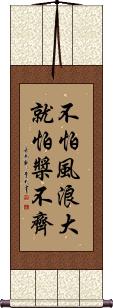
 bù pà fēng làng dà jiù pà jiǎng bù qí
Do not fear the task: Cooperation will lead to success Scroll

不怕风浪大就怕桨不齐 is a Chinese proverb that literally translates as: Do not fear strong winds [and] high waves; what [one should] worry about whether or not you're rowing in unison.

Figuratively, this means: However difficult the task, the key to success lies in making collective efforts.

I like to translate this as “Don't sweat the details, just get together and get it done.”

Desire / Craving

 yù wàng
 yokubou
Desire / Craving Scroll

欲望 is a word that means strong desire, while some might translate it as “lust.”

The first character of this word means desire, longing, hunger, covetousness, greed, passion, desire, craving, or wish. The second character means to hope for, ambition, desire, aspire, expect, gaze (into the distance), or look for something.

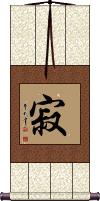
Silent / Solitary

 jì
 jaku
 
Silent / Solitary Scroll

寂 means silent, solitary, quiet, calm, still, rest, or tranquil.

This also has a strong association with Buddhism where it can mean “entering into Nirvana.” In that context, this is sometimes used to refer to the passing of a Buddhist monk (he is silent, as he has entered Nirvana). For the living, this is about tranquility (especially of mind).

Some will also use this to mean “elegant simplicity.”

From Sanskrit, this can represent praśama, vivikta, śānti, or nibbāna (nirvāṇa).

Unwavering Determination and Resolve

 jiān dìng jué xīn
Unwavering Determination and Resolve Scroll

This can be translated as unwavering determination, unwavering resolve, or strong determination.

堅定 means unwavering, firm, steady, staunch, and/or resolute.

決心 means determination, resolve, resolution, determined, firm and resolute, or to make up one's mind.

If you want a longer version, 堅定不移的決心 is also a popular phrase with a similar meaning. Contact me if you want that instead.

Christian / Disciple of Christ

 jī dū tú
 kirisuto
Christian / Disciple of Christ Scroll

基督徒 is a very strong and direct word in Chinese for “Christian.”

The literal translation of the first two characters is “Christ.”

The last character means apprentice, follower, or disciple.

Altogether these three characters mean “Christ's Disciple” or “Christ's Apprentice.” 基督徒 is a pretty cool title to hang on your wall if you are a devout Christian.

Also used by Japanese Christians (but may be unfamiliar to non-Christian Japanese people).


See Also:  Jesus Christ | God of Abraham

 wǒ qǐ méi yǒu fēn fù nǐ ma nǐ dāng gāng qiáng zhuàng dǎn bù yào jù pà yě bù yào jīng huáng yīn wèi nǐ wú lùn wǎng nǎ lǐ qù yē hé huá nǐ de shén bì yǔ nǐ tóng zài
Joshua 1:9 Scroll

Here is the full translation of Joshua 1:9 into Chinese.

The text with punctuation:
我岂没有吩咐你吗?你当刚强壮胆。不要惧怕,也不要惊惶。因为你无论往哪里去,耶和华你的神必与你同在。 Hand-painted calligraphy does not retain punctuation.

This translation comes from the 1919 Chinese Union Bible.

For reference, from the KJV, this reads, “Have not I commanded thee? Be strong and of a good courage; be not afraid, neither be thou dismayed: for the LORD thy God is with thee whithersoever thou goest.”

 wǔ shì
 bu shi
Warrior Scroll

The first character, 武, is the spirit or essence of a warrior. The second character, 士, means soldier, officer, or official. 武士 is also used appropriately enough to describe a piece of a chess game. 武士 can also be translated as a soldier, cavalier, palace guard, or samurai, and sometimes as a knight. I've occasionally seen this translated as strong man or tough man (gender not necessarily implied).

By far, 武士 is the most common way to write warrior in Chinese characters, Japanese Kanji, and old Korean Hanja.

Note: In Japanese, this is Bushi, as in Bushido.


See Also:  Knight | Army | Marines | Samurai

Phoenix (female)

 huáng
 ou
 
Phoenix (female) Scroll

凰 is another simple way to write “Phoenix” in Chinese. 凰 is the specifically female element of a phoenix, so this is how you write “female phoenix.” 凰 is sometimes used to represent the female empress (many times in history, China was ruled by a woman, in much the same way queens came to power in Europe).

Note that the emperor is always represented as a dragon (not the male version of a phoenix).

If you see yourself as a strong woman, this might be a calligraphy scroll for you to express “woman power” or “powerful woman” in a cool way.

Tathata / Ultimate Nature of All Things
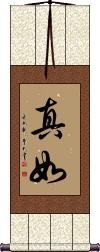
 zhēn rú
 shinnyo
Tathata / Ultimate Nature of All Things Scroll

真如 comes from the Sanskrit and Pali word often romanized as “tathata” or “tathatā.” Originally written, “तथता.”

It's a Buddhist term often translated as “thusness” or “suchness,” but this does not explain it.
A better explanation may be “the ultimate nature of all things” or “ultimate truth.” However, this gives it too strong of a feeling. This concept is sometimes described as being in awe of the simple nature of something - like a blade of grass blowing in the wind or ripples on water. It is what it is supposed to be, these things follow their nature. Amazing in their mundane simplicity.

Every sect of Buddhism will have a slightly different flavor or explanation, so don't get fixated on one definition.


Notes: Sometimes Buddhists use the word dharmatā, a synonym to tathatā.

In Japan, this can also be the female given name Mayuki, or the surname Majo.

Tiger

Year of the Tiger / Zodiac Sign

 hǔ
 tora
 
Tiger Scroll

虎 is the character for tiger in Chinese, old Korean Hanja, and Japanese Kanji.

Since you already know what a tiger is, here's some trivia: If you look at the Japanese pronunciation, you might remember a movie called “Tora Tora Tora” which was the code word used to initiate the attack on Pearl Harbor. It simply means “Tiger Tiger Tiger.”

In Chinese culture, the tiger is considered to be the king of all animals (in much the way we see the lion in western culture).

From the Chinese Zodiac, if you were born in the year of the tiger, you . . .

Have a strong personality.
Are full of self-confidence.
Love adventure
Don't like to obey others.


See also our Chinese Zodiac or Tiger Calligraphy pages.

Gutsy / Daring / Bold

 pò lì
 hakuryoku
Gutsy / Daring / Bold Scroll

迫力 is a Chinese word that is a form of personal strength.

It is a word that describes a person who is willing to take a risk. In English, we might say, “Someone with guts.”

An example might be a person that is not rich but invests a lot of money into something (knowing they could double their money or lose it all). Win or lose, this is a person that knows or pushes their potential.

Tearing this word apart, the first character means “to compel,” urgent, urge, force, imminent, or “spur on.” The second means power, strong, bear, or exert.

Note: 迫力 is also a word in Japanese Kanji and Korean Hanja but with a meaning more like force, intensity, appeal, strength, impact, force, or simply power.

Family / Household

 jiā tíng
 ka tei
Family / Household Scroll

家庭/傢庭 is a common way to express family, household, or home in Chinese, Japanese Kanji, and old Korean Hanja.

However, for a wall scroll, we recommend the single-character form (which is just the first character of this two-character word). If you want that, just click here: Family Single-Character

The first character means “family” or “home.” The second means “courtyard” or “garden.” When combined, the meaning is a bit different, as it becomes “household” or “family.” The home and/or property traditionally has a strong relationship with family in Asia. Some Chinese, Korean, and Japanese families have lived in the same house for 7 or more generations!

 gāng róu
 gong1 jau4
 gou juu
Cuong Nhu Scroll

剛柔 is a term that means hardness and softness or hard and soft.

剛柔 is also the Chinese character origin of the martial arts style known as Cương Nhu.

Cương Nhu or Cuong Nhu was founded by Grandmaster Ngo Dong in 1965 in Hue, Vietnam, and brought to the U.S. in 1971.

剛 means hard, firm, strong, and just.
柔 means soft, flexible, supple, yielding, softness, and/or gentleness.

Until it was romanized in the mid-17th century by Portuguese missionaries with later influence by French missionaries, Vietnamese was exclusively written in Chinese characters. With some research, you can still figure out the original way to write most Vietnamese words and titles in Chinese characters. That is what I did here to figure out that Cuong Nhu would have been 剛柔 if established in ancient Vietnam.


Same characters are used in Japanese for various Goju schools of Okinawan martial arts, though not the same lineage as the Vietnamese style described above.

Profound / Powerful Words

 rù mù sān fēn
Profound / Powerful Words Scroll

入木三分 is a four-character Chinese proverb that translates in English to a strong form of “profound” or “written with a forceful hand.”

But there is much more to the story...

The deep meaning behind this proverb comes from a man named Wan Xizhi, who lived in the third century.

He was a great writer and calligrapher whose writing style influenced generations of other writers and calligraphers.

He once wrote words on a piece of wood to be taken to an engraver.
When the engraver began to carve the characters into the wood, he found that Wang Xizhi's writing had penetrated the wood about 3/8 of an inch.

Thus people believed that his words were so powerful and profound that they caused the ink from his brush to penetrate the wood deeply.

The proverb literally means “penetrated wood three fen” (A fen is an ancient Chinese measurement of a little over 1/8 of an inch or almost 4mm).

Undaunted After Repeated Setbacks

Persistence to overcome all challenges
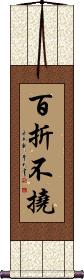
 bǎi zhé bù náo
 hyaku setsu su tou
Undaunted After Repeated Setbacks Scroll

百折不撓 is a Chinese proverb that means “Be undaunted in the face of repeated setbacks.”

More directly translated, it reads, “[Overcome] a hundred setbacks, without flinching.” 百折不撓 is of Chinese origin but is commonly used in Japanese and somewhat in Korean (same characters, different pronunciation).

This proverb comes from a long, and occasionally tragic story of a man that lived sometime around 25-220 AD. His name was Qiao Xuan, and he never stooped to flattery but remained an upright person at all times. He fought to expose the corruption of higher-level government officials at great risk to himself.

Then when he was at a higher level in the Imperial Court, bandits were regularly capturing hostages and demanding ransoms. But when his own son was captured, he was so focused on his duty to the Emperor and the common good that he sent a platoon of soldiers to raid the bandits' hideout, and stop them once and for all even at the risk of his own son's life. While all of the bandits were arrested in the raid, they killed Qiao Xuan's son at first sight of the raiding soldiers.

Near the end of his career, a new Emperor came to power, and Qiao Xuan reported to him that one of his ministers was bullying the people and extorting money from them. The new Emperor refused to listen to Qiao Xuan and even promoted the corrupt Minister. Qiao Xuan was so disgusted that in protest, he resigned from his post as minister (something almost never done) and left for his home village.

His tombstone reads “Bai Zhe Bu Nao” which is now a proverb used in Chinese culture to describe a person of strong will who puts up stubborn resistance against great odds.

My Chinese-English dictionary defines these 4 characters as “keep on fighting despite all setbacks,” “be undaunted by repeated setbacks,” and “be indomitable.”

Our translator says it can mean “never give up” in modern Chinese.

Although the first two characters are translated correctly as “repeated setbacks,” the literal meaning is “100 setbacks” or “a rope that breaks 100 times.” The last two characters can mean “do not yield” or “do not give up.”
Most Chinese, Japanese, and Korean people will not take this absolutely literal meaning but will instead understand it as the title suggests above. If you want a single big word definition, it would be indefatigability, indomitableness, persistence, or unyielding.


See Also:  Tenacity | Fortitude | Strength | Perseverance | Persistence

With all the strength of your heart

 omoi kiri
With all the strength of your heart Scroll

思い切り can be translated as “with all one's strength,” “with all one's heart,” “to the limits of your heart,” or “to the end of your heart/emotions.”

The character breakdown:
思い (omoi) thought; mind; heart; feelings; emotion; sentiment; love; affection; desire; wish; hope; expectation; imagination; experience
切り (kiri) bounds; limits.


Note: Because this selection contains some special Japanese Hiragana characters, it should be written by a Japanese calligrapher.


This in-stock artwork might be what you are looking for, and ships right away...

Gallery Price: $61.00

Your Price: $33.88

Gallery Price: $61.00

Your Price: $33.88


The following table may be helpful for those studying Chinese or Japanese...

Title CharactersRomaji (Romanized Japanese)Various forms of Romanized Chinese
Strong-Willed
Strong of Heart
氣の強い
気の強い
ki no tsuyo i
kinotsuyoi
Strong
Healthy
健やかsukoyaka
Strong and Beautiful健美takemijiàn měi / jian4 mei3 / jian mei / jianmeichien mei / chienmei
The Weak are Meat, The Strong Eat弱肉強食jaku niku kyoo shoku
jakunikukyooshoku
jaku niku kyo shoku
ruò ròu qiáng shí
ruo4 rou4 qiang2 shi2
ruo rou qiang shi
ruorouqiangshi
jo jou ch`iang shih
jojouchiangshih
jo jou chiang shih
Woman of Strong Character
Woman Hero
女傑
女杰
joketsunǚ jié / nv3 jie2 / nv jie / nvjienü chieh / nüchieh
Strong Hearted
Strong Willed
意志堅強
意志坚强
yì zhì jiān qiáng
yi4 zhi4 jian1 qiang2
yi zhi jian qiang
yizhijianqiang
i chih chien ch`iang
ichihchienchiang
i chih chien chiang
Strong Mind Strong Body強壯的身體堅強的心態
强壮的身体坚强的心态
qiáng zhuàng de shēn tǐ jiān qiáng de xīn tài
qiang2 zhuang4 de shen1 ti3 jian1 qiang2 de xin1 tai4
qiang zhuang de shen ti jian qiang de xin tai
ch`iang chuang te shen t`i chien ch`iang te hsin t`ai
chiang chuang te shen ti chien chiang te hsin tai
Strong Body, Strong Mind強い體強い心
強い体強い心
tsuyo i karada tsuyo i kokoro
tsuyoikaradatsuyoikokoro
Strong
Healthy
kenjiàn / jian4 / jianchien
Strong Woman女強人
女强人
nǚ qiáng rén
nv3 qiang2 ren2
nv qiang ren
nvqiangren
nü ch`iang jen
nüchiangjen
nü chiang jen
Strong Willed硬氣
硬气
yìng qì / ying4 qi4 / ying qi / yingqiying ch`i / yingchi / ying chi
Live Strong堅強生活
坚强生活
jiān qiáng shēng huó
jian1 qiang2 sheng1 huo2
jian qiang sheng huo
jianqiangshenghuo
chien ch`iang sheng huo
chienchiangshenghuo
chien chiang sheng huo
The Strong One強いものtsuyoi mono
tsuyoimono
Live Strong強く生きるtsuyoku ikiru
tsuyokuikiru
Strong
Powerful
強壯
强壮
kyousou / kyosoqiáng zhuàng
qiang2 zhuang4
qiang zhuang
qiangzhuang
ch`iang chuang
chiangchuang
chiang chuang
Strong Minded要強
要强
yào qiáng
yao4 qiang2
yao qiang
yaoqiang
yao ch`iang
yaochiang
yao chiang
Strong
Robust

sou / sozhuàng / zhuang4 / zhuangchuang
Strong
Powerful
Force

kyou / kyoqiáng / qiang2 / qiangch`iang / chiang
Mighty
Powerful
Strong
強大
强大
kyoudai / kyodaiqiáng dà / qiang2 da4 / qiang da / qiangdach`iang ta / chiangta / chiang ta
Strong-Minded Woman烈婦reppu / repu
Strength: Strong and Solid強固
强固
kyouko / kyokoqiáng gù / qiang2 gu4 / qiang gu / qiangguch`iang ku / chiangku / chiang ku
Fierce and courageous training defeats the strong and protects the body.剛勇之猛練勝強而保體
刚勇之猛练胜强而保体
gāng yǒng zhī měng liàn shèng qiáng ér bǎo tǐ
gang1 yong3 zhi1 meng3 lian4 sheng4 qiang2 er2 bao3 ti3
gang yong zhi meng lian sheng qiang er bao ti
kang yung chih meng lien sheng ch`iang erh pao t`i
kang yung chih meng lien sheng chiang erh pao ti
Stay Strong
Iron Will
鉄心石腸tesshin sekichou
tesshinsekichou
teshin sekicho
Strong bones come from hard knocks不磕不碰骨頭不硬
不磕不碰骨头不硬
bù kē bù pèng gǔ tóu bù yìng
bu4 ke1 bu4 peng4 gu3 tou2 bu4 ying4
bu ke bu peng gu tou bu ying
bukebupenggutoubuying
pu k`o pu p`eng ku t`ou pu ying
pukopupengkutoupuying
pu ko pu peng ku tou pu ying
Firm Belief
Strong Faith
堅信
坚信
ken shin / kenshinjiān xìn / jian1 xin4 / jian xin / jianxinchien hsin / chienhsin
Stay Strong
Indestructible
Unbreakable
金剛不壞 / 金剛不壊
金刚不坏
kon gou fu e
kongoufue
kon go fu e
jīn gāng bù huài
jin1 gang1 bu4 huai4
jin gang bu huai
jingangbuhuai
chin kang pu huai
chinkangpuhuai
Tempering Makes Strong Steel百煉才成鋼 / 百煉纔成鋼
百炼才成钢
bǎi liàn cái chéng gāng
bai3 lian4 cai2 cheng2 gang1
bai lian cai cheng gang
bailiancaichenggang
pai lien ts`ai ch`eng kang
pailientsaichengkang
pai lien tsai cheng kang
Perseverancesee note / seenote / se noteyì / yi4 / yii
Strength
Ability
力量riki ryou / rikiryou / riki ryolì liàng / li4 liang4 / li liang / liliang
Immovable Mind不動心fu dou shin
fudoushin
fu do shin
Physical Strength體力
体力
tai ryoku / tairyokutǐ lì / ti3 li4 / ti li / tilit`i li / tili / ti li
Physical Strength體力
体力
tairyokutǐ lì / ti3 li4 / ti li / tilit`i li / tili / ti li
Unbreakable壊れないkowa re na i
kowarenai
Mental Toughnessメンタルタフネスmentarutafunesu
Power
Strength
chikara / ryokulì / li4 / li
Spiritual Strength
Strength of Spirit
精神力量seishin rikiryou
seishinrikiryou
seishin rikiryo
jīng shén lì liàng
jing1 shen2 li4 liang4
jing shen li liang
jingshenliliang
ching shen li liang
chingshenliliang
To a Willing Heart, All Things Are Possible有志者事竟成 / 有誌者事竟成
有志者事竟成
yǒu zhì zhě shì jìng chéng
you3 zhi4 zhe3 shi4 jing4 cheng2
you zhi zhe shi jing cheng
youzhizheshijingcheng
yu chih che shih ching ch`eng
yuchihcheshihchingcheng
yu chih che shih ching cheng
Fortitude
Strength of Character
剛毅
刚毅
gouki / gokigāng yì / gang1 yi4 / gang yi / gangyikang i / kangi
Indomitable
Persistence
Fortitude
不屈fukutsubù qū / bu4 qu1 / bu qu / buqupu ch`ü / puchü / pu chü
Inner Strength內力
内力
nai ryoku / nairyokunèi lì / nei4 li4 / nei li / neili
Robust
Sturdy
強健
强健
kyouken / kyokenqiáng jiàn
qiang2 jian4
qiang jian
qiangjian
ch`iang chien
chiangchien
chiang chien
Patience
Perseverance
ninrěn / ren3 / renjen
Perseverance
Fortitude
堅韌
坚韧
jiān rèn / jian1 ren4 / jian ren / jianrenchien jen / chienjen
Tenacious
Tenacity
頑強
顽强
gan kyou / gankyou / gan kyowán qiáng
wan2 qiang2
wan qiang
wanqiang
wan ch`iang
wanchiang
wan chiang
Indomitable
Unyielding
不屈不撓
不屈不挠
fu kutsu fu tou
fukutsufutou
fu kutsu fu to
bù qū bù náo
bu4 qu1 bu4 nao2
bu qu bu nao
buqubunao
pu ch`ü pu nao
puchüpunao
pu chü pu nao
Inner Strength內在力量
内在力量
nèi zài lì liàng
nei4 zai4 li4 liang4
nei zai li liang
neizaililiang
nei tsai li liang
neitsaililiang
Perseverance堅韌不拔
坚韧不拔
jiān rèn bù bá
jian1 ren4 bu4 ba2
jian ren bu ba
jianrenbuba
chien jen pu pa
chienjenpupa
Perseverance
Fortitude
堅忍
坚忍
ken nin / kenninjiǎn rěn / jian3 ren3 / jian ren / jianrenchien jen / chienjen
Inner Strength
Self-Improvement
自強
自强
zì qiáng / zi4 qiang2 / zi qiang / ziqiangtzu ch`iang / tzuchiang / tzu chiang
Inner Strength is Better than Outward Appearance内面の強さは外見の良さに勝るnaimen no tsuyosa ha gaiken no yosa ni masaru
Perseverance
Indomitable
Invincible Fortitude
堅忍不抜 / 堅忍不拔
坚忍不拔
kenninfubatsujiān rěn bù bá
jian1 ren3 bu4 ba2
jian ren bu ba
jianrenbuba
chien jen pu pa
chienjenpupa
Patience
Perseverance
To Endure
Tolerant
忍耐nin tai / nintairěn nài / ren3 nai4 / ren nai / rennaijen nai / jennai
Always Striving for Inner Strength自強不息
自强不息
zì qiáng bú xī
zi4 qiang2 bu2 xi1
zi qiang bu xi
ziqiangbuxi
tzu ch`iang pu hsi
tzuchiangpuhsi
tzu chiang pu hsi
Perseverance
Will-Power
毅力yì lì / yi4 li4 / yi li / yilii li / ili
Determination to Achieve
Will-Power
意志ishiyì zhì / yi4 zhi4 / yi zhi / yizhii chih / ichih
Will-Power
Self-Control
意志力ishi ryoku / ishiryokuyì zhì lì
yi4 zhi4 li4
yi zhi li
yizhili
i chih li
ichihli
Free Will自由意志jiyuu ishi / jiyuuishi / jiyu ishizì yóu yì zhì
zi4 you2 yi4 zhi4
zi you yi zhi
ziyouyizhi
tzu yu i chih
tzuyuichih
No Pain No Gain痛みなくして得るものなしitami naku shite erumono wa nashi
Sumo Wrestler力士ri kishi / rikishilì shì / li4 shi4 / li shi / lishili shih / lishih
Inner Strength is Better than Outward Appearance表壯不如里壯
表壮不如里壮
biǎo zhuàng bù rú lǐ zhuàng
biao3 zhuang4 bu4 ru2 li3 zhuang4
biao zhuang bu ru li zhuang
biaozhuangburulizhuang
piao chuang pu ju li chuang
piaochuangpujulichuang
Resiliency強韌
强韧
qiáng rèn
qiang2 ren4
qiang ren
qiangren
ch`iang jen
chiangjen
chiang jen
Romantic Passion激情gekijou / gekijojī qíng / ji1 qing2 / ji qing / jiqingchi ch`ing / chiching / chi ching
Intensity強烈
强烈
kyouretsu / kyoretsuqiáng liè
qiang2 lie4
qiang lie
qianglie
ch`iang lieh
chianglieh
chiang lieh
Unbeatable萬夫不當
万夫不当
wàn fū bù dāng
wan4 fu1 bu4 dang1
wan fu bu dang
wanfubudang
wan fu pu tang
wanfuputang
Jacques杰克jié kè / jie2 ke4 / jie ke / jiekechieh k`o / chiehko / chieh ko
Herculean Strength強力
强力
kyou ryoku / kyouryoku / kyo ryokuqiáng lì / qiang2 li4 / qiang li / qianglich`iang li / chiangli / chiang li
Almighty
Omnipotent
全能zennou / zennoquán néng
quan2 neng2
quan neng
quanneng
ch`üan neng
chüanneng
chüan neng
Tsuyoi強いtsuyoi
Sherry雪利xuě lì / xue3 li4 / xue li / xuelihsüeh li / hsüehli
Iron Man鉄人tetsujin
Conquering Yourself is a Sign of Strength自勝者強也zì shèng zhě qiáng yě
zi4 sheng4 zhe3 qiang2 ye3
zi sheng zhe qiang ye
zishengzheqiangye
tzu sheng che ch`iang yeh
tzushengchechiangyeh
tzu sheng che chiang yeh
Longing for Lover思戀
思恋
sī liàn / si1 lian4 / si lian / silianssu lien / ssulien
Love Faith Strength愛信強
爱信強
ài xìn qiáng
ai4 xin4 qiang2
ai xin qiang
aixinqiang
ai hsin ch`iang
aihsinchiang
ai hsin chiang
Courage and Strength勇力yuu ri / yuuri / yu riyǒng lì / yong3 li4 / yong li / yongliyung li / yungli
True Love屋烏の愛okuunoai / okunoai
Perception of Knowledge知識
知识
chishikizhī shi / zhi1 shi / zhi shi / zhishichih shih / chihshih
Good Health健康kenkou / kenkojiàn kāng
jian4 kang1
jian kang
jiankang
chien k`ang
chienkang
chien kang
Gojukan
Goju-Kan
剛柔館
刚柔馆
gou juu kan
goujuukan
go ju kan
Shitsujitsu Goken質実剛健shitsu jitsu gou ken
shitsujitsugouken
shitsu jitsu go ken
God is Good神真美好shén zhēn měi hǎo
shen2 zhen1 mei3 hao3
shen zhen mei hao
shenzhenmeihao
shen chen mei hao
shenchenmeihao
Big Wave
namitāo / tao1 / taot`ao / tao
Resilient in the Face of Adversity打たれ強いu ta re tsuyo i
utaretsuyoi
Okinawan Goju-Kan沖縄剛柔館
沖縄刚柔馆
okinawa gou juu kan
okinawagoujuukan
okinawa go ju kan
Do not fear the task: Cooperation will lead to success不怕風浪大就怕槳不齊
不怕风浪大就怕桨不齐
bù pà fēng làng dà jiù pà jiǎng bù qí
bu4 pa4 feng1 lang4 da4 jiu4 pa4 jiang3 bu4 qi2
bu pa feng lang da jiu pa jiang bu qi
pu p`a feng lang ta chiu p`a chiang pu ch`i
pu pa feng lang ta chiu pa chiang pu chi
Desire
Craving
欲望yokubou / yokuboyù wàng / yu4 wang4 / yu wang / yuwangyü wang / yüwang
Silent
Solitary
jakujì / ji4 / jichi
Unwavering Determination and Resolve堅定決心
坚定决心
jiān dìng jué xīn
jian1 ding4 jue2 xin1
jian ding jue xin
jiandingjuexin
chien ting chüeh hsin
chientingchüehhsin
Christian
Disciple of Christ
基督徒kirisutojī dū tú
ji1 du1 tu2
ji du tu
jidutu
chi tu t`u
chitutu
chi tu tu
Joshua 1:9我豈沒有吩咐你嗎你當剛強壯膽不要懼怕也不要驚惶因為你無論往哪里去耶和華你的神必與你同在
我岂没有吩咐你吗你当刚强壮胆不要惧怕也不要惊惶因为你无论往哪里去耶和华你的神必与你同在
wǒ qǐ méi yǒu fēn fù nǐ ma nǐ dāng gāng qiáng zhuàng dǎn bù yào jù pà yě bù yào jīng huáng yīn wèi nǐ wú lùn wǎng nǎ lǐ qù yē hé huá nǐ de shén bì yǔ nǐ tóng zài
wo3 qi3 mei2 you3 fen1 fu4 ni3 ma ni3 dang1 gang1 qiang2 zhuang4 dan3 bu4 yao4 ju4 pa4 ye3 bu4 yao4 jing1 huang2 yin1 wei4 ni3 wu2 lun4 wang3 na3 li3 qu4 ye1 he2 hua2 ni3 de shen2 bi4 yu3 ni3 tong2 zai4
wo qi mei you fen fu ni ma ni dang gang qiang zhuang dan bu yao ju pa ye bu yao jing huang yin wei ni wu lun wang na li qu ye he hua ni de shen bi yu ni tong zai
wo ch`i mei yu fen fu ni ma ni tang kang ch`iang chuang tan pu yao chü p`a yeh pu yao ching huang yin wei ni wu lun wang na li ch`ü yeh ho hua ni te shen pi yü ni t`ung tsai
wo chi mei yu fen fu ni ma ni tang kang chiang chuang tan pu yao chü pa yeh pu yao ching huang yin wei ni wu lun wang na li chü yeh ho hua ni te shen pi yü ni tung tsai
Warrior武士bu shi / bushiwǔ shì / wu3 shi4 / wu shi / wushiwu shih / wushih
Phoenix (female)ou / ohuáng / huang2 / huang
Tathata
Ultimate Nature of All Things
真如shinnyozhēn rú / zhen1 ru2 / zhen ru / zhenruchen ju / chenju
Tigertorahǔ / hu3 / hu
Gutsy
Daring
Bold
迫力hakuryokupò lì / po4 li4 / po li / polip`o li / poli / po li
Family
Household
家庭 / 傢庭
家庭
ka tei / kateijiā tíng / jia1 ting2 / jia ting / jiatingchia t`ing / chiating / chia ting
Cuong Nhu剛柔gou juu / goujuu / go jugāng róu / gang1 rou2 / gang rou / gangroukang jou / kangjou
Profound
Powerful Words
入木三分rù mù sān fēn
ru4 mu4 san1 fen1
ru mu san fen
rumusanfen
ju mu san fen
jumusanfen
Undaunted After Repeated Setbacks百折不撓
百折不挠
hyaku setsu su tou
hyakusetsusutou
hyaku setsu su to
bǎi zhé bù náo
bai3 zhe2 bu4 nao2
bai zhe bu nao
baizhebunao
pai che pu nao
paichepunao
With all the strength of your heart思い切りomoi kiri / omoikiri
In some entries above you will see that characters have different versions above and below a line.
In these cases, the characters above the line are Traditional Chinese, while the ones below are Simplified Chinese.


Dictionary

Lookup Strong Will in my Japanese & Chinese Dictionary


Successful Chinese Character and Japanese Kanji calligraphy searches within the last few hours...


5 Tenets of TaekwondoA Moment of Time is as Precious as GoldAadenAbdulrahmanAbigailAchievement AccomplishmentAddiAdeliaAdityaAdiyanAdriaAdrianaAdriannaAdrielAhmaAhsanAileenAilingAishaAizaAlexandraAlexeiAlfredoAliaAlishAlishaAliyahAlizaAlokAlphonseAlvinAlyaAlyshaAlyssaAmalAmaliAmbitionAmeliaAmirAmitaAmmarAnasAndreaAndreiAndrewsAngieAnikAnjaneAnshuAntonellaAntoniaAreebaArelyArifArisbethAritaArradArslanArunaArvinAsadAshrafAthenaAureliaAuriAvivaAyanyiAyeshaAylaAymanAzkaBalanceBambiBarnabyBattojutsuBayuBe Like WaterBeauBeautiful WomanBeautiful Woman ProverbBelief TrustBeloved Son Beloved ChildBenevolenceBereniceBertBethanyBharathiBhaveshBiancaBlack DragonBlessed by GodBodhisattvaBraedenBrave the WavesBrenBrendaBrielleBrooklynBrotherly LoveBuckyBujinkanBushido CodeCaliCalm MindCamiCamillaCarmenCarolineCassieCeciliaCelineCelioChaudharyCheoCheriChieCierraClaireCleoClintCrisCristinaCrouching Tiger Hidden DragonCrystelleDaisyDakotaDalphonDamarisDanaeDanielaDanniDarioDarshanDarwinDaryaDayanaDeath Before DishonorDedicationDestinyDevinDevotionDianaDivyaDominicDonyaDoodDurellEduardoEilidhEleanorElianaElinaElisaEllianaElviraEmanEmberEmilEmiliaEmilyEmmanuelEnduranceEnlightenmentEnthusiasmEnzoEricEstherEttaEugeniaEvelinaEwanExperience is the Mother of WisdomFaisalFaizFaizanFallen AngelFamily Over EverythingFaridFarzanaFatimaFear NothingFierceFire TigerFollow Your HeartForever LoveForever YoungFrankieFreddyFreedomFurinaFurinkazanFuto FukutsuGabeGabrieleGabrielleGemini SymbolGenerosityGennaGhaleGianni

All of our calligraphy wall scrolls are handmade.

When the calligrapher finishes creating your artwork, it is taken to my art mounting workshop in Beijing where a wall scroll is made by hand from a combination of silk, rice paper, and wood.
After we create your wall scroll, it takes at least two weeks for air mail delivery from Beijing to you.

Allow a few weeks for delivery. Rush service speeds it up by a week or two for $10!

When you select your calligraphy, you'll be taken to another page where you can choose various custom options.


A nice Chinese calligraphy wall scroll

The wall scroll that Sandy is holding in this picture is a "large size"
single-character wall scroll.
We also offer custom wall scrolls in small, medium, and an even-larger jumbo size.

A professional Chinese Calligrapher

Professional calligraphers are getting to be hard to find these days.
Instead of drawing characters by hand, the new generation in China merely type roman letters into their computer keyboards and pick the character that they want from a list that pops up.

There is some fear that true Chinese calligraphy may become a lost art in the coming years. Many art institutes in China are now promoting calligraphy programs in hopes of keeping this unique form of art alive.

Trying to learn Chinese calligrapher - a futile effort

Even with the teachings of a top-ranked calligrapher in China, my calligraphy will never be good enough to sell. I will leave that to the experts.

A high-ranked Chinese master calligrapher that I met in Zhongwei

The same calligrapher who gave me those lessons also attracted a crowd of thousands and a TV crew as he created characters over 6-feet high. He happens to be ranked as one of the top 100 calligraphers in all of China. He is also one of very few that would actually attempt such a feat.


Check out my lists of Japanese Kanji Calligraphy Wall Scrolls and Old Korean Hanja Calligraphy Wall Scrolls.

Some people may refer to this entry as Strong Will Kanji, Strong Will Characters, Strong Will in Mandarin Chinese, Strong Will Characters, Strong Will in Chinese Writing, Strong Will in Japanese Writing, Strong Will in Asian Writing, Strong Will Ideograms, Chinese Strong Will symbols, Strong Will Hieroglyphics, Strong Will Glyphs, Strong Will in Chinese Letters, Strong Will Hanzi, Strong Will in Japanese Kanji, Strong Will Pictograms, Strong Will in the Chinese Written-Language, or Strong Will in the Japanese Written-Language.

2 people have searched for Strong Will in Chinese or Japanese in the past year.
Strong Will was last searched for by someone else on Dec 8th, 2025