Many custom options


And formats



Power of Understanding and Wisdom in Chinese / Japanese
Buy a Power of Understanding and Wisdom calligraphy wall scroll here!
Personalize your custom “Power of Understanding and Wisdom” project by clicking the button next to your favorite “Power of Understanding and Wisdom” title below.
Power of Understanding and Wisdom
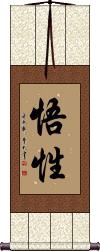
悟性 means the power of understanding and insight in Chinese.
It is often associated with Neo-Confucianism. In that regard, it means to realize, perceive, or have the perception of man's true nature. It can also mean finding your soul, the soul of others, or the soul of the world. Some will translate this simply as the state of being “savvy.”
In Japanese, this is often translated as wisdom and understanding.
Daodejing / Tao Te Ching - Chapter 27
The Mastery of Effortless Skill

Chapter 27 of the Daodejing reveals a profound truth about mastery: the highest skill leaves no trace, requires no force, and appears almost invisible.
善行無轍跡,
善言無瑕謫,
善數不用籌策,
善閉無關鍵而不可開,
善結無繩約而不可解。
是以聖人常善救人,
故無棄人;
常善救物,
故無棄物。
是謂襲明。
故善人者,不善人之師;
不善人者,善人之資。
不貴其師,不愛其資,
雖智大迷,
是謂要妙。
The sage moves through life with such natural harmony that nothing seems imposed; doors need no locks, knots require no rope, and actions leave no mark behind.
This is the essence of wúwéi (effortless action), where true ability arises from deep alignment with the Tao rather than deliberate effort.
At its heart, this chapter teaches compassion without exception. The sage “abandons no one and nothing,” recognizing value in all people and all things. Even those who seem flawed or unrefined are not rejected, but understood as part of a greater whole with each person both a student and a teacher in the unfolding of life.
Laozi reminds us that wisdom is not about perfection or control, but about subtle awareness. The truly skilled individual does not rely on tools, rules, or rigid structures; instead, they embody an intuitive understanding that makes their actions naturally complete.
In this way, excellence becomes quiet, effortless, and beyond imitation.
This teaching also reflects a deeper philosophical insight: Opposites are interdependent. The “good” person learns from the “not good,” and the “not good” provides the material for growth. To reject either is to misunderstand the balance of existence itself.
As calligraphy, Daodejing Chapter 27 serves as a reminder to cultivate inner mastery rather than outward display. It is a meditation on refinement, humility, and the quiet power of skill perfected through harmony with the natural order.
Note: The Chinese text used here is based on the early Mawangdui silk manuscript tradition (2nd century BCE). The Guodian manuscripts do NOT preserve Chapter 27 in full form.
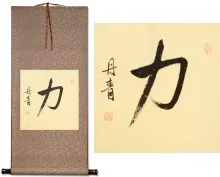
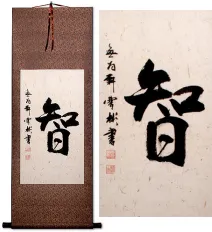
This in-stock artwork might be what you are looking for, and ships right away...






Not the results for Power of Understanding and Wisdom that you were looking for?
Below are some entries from our dictionary that may match your Power of Understanding and Wisdom search:
| Characters If shown, 2nd row is Simp. Chinese |
Pronunciation Romanization |
Simple Dictionary Definition |
慧 see styles |
huì hui4 hui megumi めぐみ |
More info & calligraphy: Wisdom / Intelligence(1) wisdom; enlightenment; (2) (Buddhist term) prajna (one of the three divisions of the noble eightfold path); wisdom; (female given name) Megumi prajñā ; sometimes jñāna. Wisdom, discernment, understanding; the power to discern things and their underlying principles and to decide the doubtful. It is often interchanged with 智, though not correctly, for zhi means knowledge, the science of the phenomenal, while hui refers more generally to principles or morals. It is part of the name of many monks, e.g. 慧可 Huike; 慧思Huisi. |
悟性 see styles |
wù xìng wu4 xing4 wu hsing gosei / gose ごせい |
More info & calligraphy: Power of Understanding and Wisdomwisdom; understanding |
通 see styles |
tòng tong4 t`ung tung michiaki みちあき |
classifier for an activity, taken in its entirety (tirade of abuse, stint of music playing, bout of drinking etc) (n,n-suf,adj-na) (1) authority; expert; connoisseur; well-informed person; (counter) (2) counter for messages, letters, notes, documents, etc.; (noun or adjectival noun) (3) understanding (esp. of male-female relations); tact; insight; (4) supernatural powers; magical powers; (given name) Michiaki Permeate, pass through, pervade; perceive, know thoroughly; communicate; current; free, without hindrance, unimpeded universal; e.g. 神通 supernatural, ubiquitous powers. There are categories of 五通, 六通, and 十通, all referring to supernatural powers; the five are (1) knowledge of the supernatural world; (2) deva vision; (3) deva hearing; (4) knowledge of the minds of all others; (5) knowledge of all the transmigrations of self and all others. The six are the above together with perfect wisdom for ending moral hindrance and delusion. The ten are knowing all previous transmigrations, having deva hearing, knowing the minds of others, having deva vision, showing deva powers, manifesting many bodies or forms, being anywhere instantly, power of bringing glory to one's domain, manifesting a body of transformation, and power to end evil and transmigration. |
文殊 see styles |
wén shū wen2 shu1 wen shu monju もんじゅ |
Manjushri, the Bodhisattva of keen awareness (Buddhist term) Manjushri; Manjusri; Bodhisattva that represents transcendent wisdom; (p,s,f) Monju (文殊師利) Mañjuśrī 滿殊尸利 -later 曼殊室利. 文殊 is also used for Mañjunātha, Mañjudeva, Mañjughoṣa, Mañjuṣvara, et al. T., hjamdpal; J., Monju. Origin unknown; presumably, like most Buddhas and bodhisattvas, an idealization of a particular quality, in his case of Wisdom. Mañju is beautiful, Śrī; good fortune, virtue, majesty, lord, an epithet of a god. Six definitions are obtained from various scriptures: 妙首 (or 頭 ) wonderful or beautiful) head; 普首 universal head; 濡首 glossy head (probably a transliteration); 敬首 revered head; 妙德 wonderful virtue (or power); 妙吉祥 wonderfully auspicious; the last is a later translation in the 西域記. As guardian of wisdom 智慧 he is often placed on Śākyamuni's left, with 普顯 on the right as guardian of law 理, the latter holding the Law, the former the wisdom or exposition of it; formerly they held the reverse positions. He is often represented with five curls or waves to his hair indicating the 五智 q. v. or the five peaks; his hand holds the sword of wisdom and he sits on a lion emblematic of its stern majesty: but he has other forms. He is represented as a youth, i. e. eternal youth. His present abode is given as east of the universe, known as 淸涼山 clear and cool mountain, or a region 寶住 precious abode, or Abode of Treasures, or 寶氏 from which he derives one of his titles, 寶相如來. One of his dhāraṇīs prophesies China as his post-nirvāṇa realm. In past incarnations he is described as being the parent of many Buddhas and as having assisted the Buddha into existence; his title was 龍種上佛 the supreme Buddha of the nāgas, also 大身佛 or 神仙佛; now his title is 歡喜藏摩尼寶精佛 The spiritual Buddha who joyfully cares for the jewel: and his future title is to be 普現佛 Buddha universally revealed. In the 序品 Introductory Chapter of the Lotus Sutra he is also described as the ninth predecessor or Buddha-ancestor of Śākyamuni. He is looked on as the chief of the Bodhisattvas and represents them, as the chief disciple of the Buddha, or as his son 法王子. Hīnayāna counts Śāriputra as the wisest of the disciples, Mahāyāna gives Mañjuśrī the chief place, hence he is also styled 覺母 mother, or begetter of understanding. He is shown riding on either a lion or a peacock, or sitting on a white lotus; often he holds a book, emblem of wisdom, or a blue lotus; in certain rooms of a monastery he is shown as a monk; and he appears in military array as defender of the faith. His signs, magic words, and so on, are found in various sutras. His most famous centre in China is Wu-tai shan in Shansi. where he is the object of pilgrimages, especially of Mongols. The legends about him are many. He takes the place in Buddhism of Viśvakarman as Vulcan, or architect, of the universe. He is one of the eight Dhyāni-bodhisattvas, and sometimes has the image of Akṣobhya in his crown. He was mentioned in China as early as the fourth century and in the Lotus Sutra he frequently appears, especially as the converter of the daughter of the Dragon-king of the Ocean. He has five messengers 五使者 and eight youths 八童子 attending on him. His hall in the Garbhadhātu maṇḍala is the seventh, in which his group numbers twenty-five. His position is northeast. There are numerous sutras and other works with his name as title, e. g. 文殊師利問菩提經 Gayaśīrṣa sūtra, tr. by Kumārajīva 384-417: and its 論 or .Tīkā of Vasubandhu, tr. by Bodhiruci 535. see list in B. N. |
胎藏界 see styles |
tāi zàng jiè tai1 zang4 jie4 t`ai tsang chieh tai tsang chieh taizō kai |
Garbhadhātu, or Garbhakośa-(dhātu), the womb treasury, the universal source from which all things are produced; the matrix; the embryo; likened to a womb in which all of a child is conceived— its body, mind, etc. It is container and content; it covers and nourishes; and is the source of all supply. It represents the 理性 fundamental nature, both material elements and pure bodhi, or wisdom in essence or purity; 理 being the garbhadhātu as fundamental wisdom, and 智 acquired wisdom or knowledge, the vajradhātu. It also represents the human heart in its innocence or pristine purity, which is considered as the source of all Buddha-pity and moral knowledge. And it indicates that from the central being in the maṇḍala, viz. the Sun as symbol of Vairocana, there issue all the other manifestations of wisdom and power, Buddhas, bodhisattvas, demons, etc. It is 本覺 original intellect, or the static intellectuality, in contrast with 始覺 intellection, the initial or dynamic intellectuality represented in the vajradhātu; hence it is the 因 cause and vajradhātu the 果 effect; though as both are a unity, the reverse may be the rule, the effect being also the cause; it is also likened to 利他 enriching others, as vajradhātu is to 自利 enriching self. Kōbō Daishi, founder of the Yoga or Shingon 眞言 School in Japan, adopted the representation of the ideas in maṇḍalas, or diagrams, as the best way of revealing the mystic doctrine to the ignorant. The garbhadhātu is the womb or treasury of all things, the universe; the 理 fundamental principle, the source; its symbols are a triangle on its base, and an open lotus as representing the sun and Vairocana. In Japan this maṇḍala is placed on the east, typifying the rising sun as source, or 理. The vajradhātu is placed west and represents 智 wisdom or knowledge as derived from 理 the underlying principle, but the two are essential one to the other, neither existing apart. The material and spiritual; wisdom-source and intelligence; essence and substance; and similar complementary ideas are thus portrayed; the garbhadhātu may be generally considered as the static and the vajradhātu as the dynamic categories, which are nevertheless a unity. The garbhadhātu is divided into 三部 three sections representing samādhi or quiescence, wisdom-store, and pity-store, or thought, knowledge, pity; one is called the Buddha-section, the others the Vajra and Lotus sections respectively; the three also typify vimokṣa, prajñā, and dharmakāya, or freedom, understanding, and spirituality. There are three heads of these sections, i. e. Vairocana, Vajrapāṇi, and Avalokiteśvara; each has a mother or source, e. g. Vairocana from Buddha's-eye; and each has a 明王 or emanation of protection against evil; also a śakti or female energy; a germ-letter, etc. The diagram of five Buddhas contains also four bodhisattvas, making nine in all, and there are altogether thirteen 大院 or great courts of various types of ideas, of varying numbers, generally spoken of as 414. Cf. 金剛界; 大日; 兩部. |
The following table may be helpful for those studying Chinese or Japanese:
| Title | Characters | Romaji (Romanized Japanese) | Various forms of Romanized Chinese | |
| Power of Understanding and Wisdom | 悟性 | gosei | wù xìng / wu4 xing4 / wu xing / wuxing | wu hsing / wuhsing |
| Daodejing Tao Te Ching - Chapter 27 | 善行無轍跡善言無瑕謫善數不用籌策善閉無關鍵而不可開善結無繩約而不可解是以聖人常善救人故無棄人常善救物故無棄物是謂襲明故善人者不善人之師不善人者善人之資不貴其師不愛其資雖智大迷是謂要妙 善行无辙迹善言无瑕谪善数不用筹策善闭无关键而不可开善结无绳约而不可解是以圣人常善救人故无弃人常善救物故无弃物是谓袭明故善人者不善人之师不善人者善人之资不贵其师不爱其资虽智大迷是谓要妙 | shàn xíng wú zhé jì shàn yán wú xiá zhé shàn shù bù yòng chóu cè shàn bì wú guān jiàn ér bù kě kāi shàn jié wú shéng yuē ér bù kě jiě shì yǐ shèng rén cháng shàn jiù rén gù wú qì rén cháng shàn jiù wù gù wú qì wù shì wèi xí míng gù shàn rén zhě bù shàn rén zhī shī bù shàn rén zhě shàn rén zhī zī bù guì qí shī bù ài qí zī suī zhì dà mí shì wèi yào miào shan4 xing2 wu2 zhe2 ji4 shan4 yan2 wu2 xia2 zhe2 shan4 shu4 bu4 yong4 chou2 ce4 shan4 bi4 wu2 guan1 jian4 er2 bu4 ke3 kai1 shan4 jie2 wu2 sheng2 yue1 er2 bu4 ke3 jie3 shi4 yi3 sheng4 ren2 chang2 shan4 jiu4 ren2 gu4 wu2 qi4 ren2 chang2 shan4 jiu4 wu4 gu4 wu2 qi4 wu4 shi4 wei4 xi2 ming2 gu4 shan4 ren2 zhe3 bu4 shan4 ren2 zhi1 shi1 bu4 shan4 ren2 zhe3 shan4 ren2 zhi1 zi1 bu4 gui4 qi2 shi1 bu4 ai4 qi2 zi1 sui1 zhi4 da4 mi2 shi4 wei4 yao4 miao4 shan xing wu zhe ji shan yan wu xia zhe shan shu bu yong chou ce shan bi wu guan jian er bu ke kai shan jie wu sheng yue er bu ke jie shi yi sheng ren chang shan jiu ren gu wu qi ren chang shan jiu wu gu wu qi wu shi wei xi ming gu shan ren zhe bu shan ren zhi shi bu shan ren zhe shan ren zhi zi bu gui qi shi bu ai qi zi sui zhi da mi shi wei yao miao | shan hsing wu che chi shan yen wu hsia che shan shu pu yung ch`ou ts`e shan pi wu kuan chien erh pu k`o k`ai shan chieh wu sheng yüeh erh pu k`o chieh shih i sheng jen ch`ang shan chiu jen ku wu ch`i jen ch`ang shan chiu wu ku wu ch`i wu shih wei hsi ming ku shan jen che pu shan jen chih shih pu shan jen che shan jen chih tzu pu kuei ch`i shih pu ai ch`i tzu sui chih ta mi shih wei yao miao shan hsing wu che chi shan yen wu hsia che shan shu pu yung chou tse shan pi wu kuan chien erh pu ko kai shan chieh wu sheng yüeh erh pu ko chieh shih i sheng jen chang shan chiu jen ku wu chi jen chang shan chiu wu ku wu chi wu shih wei hsi ming ku shan jen che pu shan jen chih shih pu shan jen che shan jen chih tzu pu kuei chi shih pu ai chi tzu sui chih ta mi shih wei yao miao |
|
| In some entries above you will see that characters have different versions above and below a line. In these cases, the characters above the line are Traditional Chinese, while the ones below are Simplified Chinese. | ||||

Successful Chinese Character and Japanese Kanji calligraphy searches within the last few hours...



