Many custom options...


And formats...



Bare in Chinese / Japanese...
Buy a Bare calligraphy wall scroll here!
Personalize your custom “Bare” project by clicking the button next to your favorite “Bare” title below...
Bare

巴雷 is the name Bare in Chinese (Mandarin).
Bare
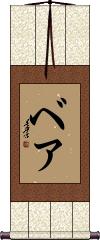
ベア is the name Bare in Japanese Katakana.
Note: Because this title is entirely Japanese Katakana, it should be written by a Japanese calligrapher.
If you cannot bite, do not show your teeth
If you cannot fight, don't start one
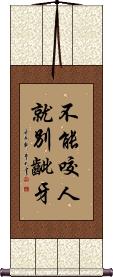
不能咬人就别龇牙 is a Chinese proverb that literally translates as: [if you] can't bite people, don't bare [your] teeth.
Figuratively, this means: Don't show your anger if you can't do anything about the situation.
Some will also say this means “Don't start a fight that you cannot win.” Others will say it means that you must be willing to back up your words (perhaps with your fists).
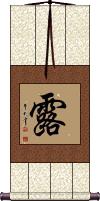
露 is the Chinese, Japanese Kanji, and old Korean Hanja for dew.
Depending on the context in which this character is used, it can also mean: tears; syrup; nectar; outdoors (not under cover); to show; to reveal; to betray; to expose; scanty; bare; unconcealed; naked; public.
露 can be a Chinese surname Lu. 露 can also be the Japanese surname Tsuyuzaki or Tsuyusaki, and the given names Tsuyu or Akira.
Oddly, 露 is sometimes used as an abbreviation for Russia.
In the Buddhist context, 露 also means dew, but can be a symbol of transience. Sometimes used as a metaphor to expose or disclose knowledge and truth.
7. Right Mindfulness / Right Memory / Perfect Mindfulness
Samyak Smriti / Samyak Smrti / Samma Sati
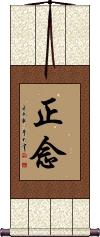
正念 is one of the Noble Eightfold Paths of Buddhism. Right Mindfulness, along with Right Effort and Right Concentration, constitute the path to Concentration or Perfect Thought.
Right Mindfulness is about remaining focused on one's body, feelings, mind, and mental qualities. It's also about being ardent, aware, and mindful, and supposes that you've already put aside worldly desire and aversion.
Monk Bhikkhu Bodhi described this as “The mind is deliberately kept at the level of bare attention, a detached observation of what is happening within us and around us in the present moment.” When practicing right mindfulness, the mind is trained to remain in the present, open, quiet, and alert, contemplating the present event.
Another definition: Ongoing mindfulness of body, feelings, thinking, and objects of thought.
This term is exclusively used by devout Buddhists. It is not a common term, and is remains an unknown concept to most Japanese and Chinese people.
See Also: Buddhism | Enlightenment | Noble Eightfold Path
Not the results for Bare that you were looking for?
Below are some entries from our dictionary that may match your Bare search...
| Characters If shown, 2nd row is Simp. Chinese |
Pronunciation Romanization |
Simple Dictionary Definition |
佛 see styles |
fú fu2 fu hotoke ほとけ |
More info & calligraphy: Buddhism / Buddha(surname) Hotoke Buddha, from budh to "be aware of", "conceive", "observe", "wake"; also 佛陀; 浮圖; 浮陀; 浮頭; 浮塔; 勃陀; 勃馱; 沒馱; 母馱; 母陀; 部陀; 休屠. Buddha means "completely conscious, enlightened", and came to mean the enlightener. he Chinese translation is 覺 to perceive, aware, awake; and 智 gnosis, knowledge. There is an Eternal Buddha, see e.g. the Lotus Sutra, cap. 16, and multitudes of Buddhas, but the personality of a Supreme Buddha, an Ādi-Buddha, is not defined. Buddha is in and through all things, and some schools are definitely Pan-Buddhist in the pantheistic sense. In the triratna 三寳 commonly known as 三寳佛, while Śākyamuni Buddha is the first "person" of the Trinity, his Law the second, and the Order the third, all three by some are accounted as manifestations of the All-Buddha. As Śākyamuni, the title indicates him as the last of the line of Buddhas who have appeared in this world, Maitreya is to be the next. As such he is the one who has achieved enlightenment, having discovered the essential evil of existence (some say mundane existence, others all existence), and the way of deliverance from the constant round of reincarnations; this way is through the moral life into nirvana, by means of self-abnegation, the monastic life, and meditation. By this method a Buddha, or enlightened one, himself obtains Supreme Enlightenment, or Omniscience, and according to Māhāyanism leads all beings into the same enlightenment. He sees things not as they seem in their phenomenal but in their noumenal aspects, as they really are. The term is also applied to those who understand the chain of causality (twelve nidānas) and have attained enlightenment surpassing that of the arhat. Four types of the Buddha are referred to: (1) 三藏佛the Buddha of the Tripiṭaka who attained enlightenment on the bare ground under the bodhi-tree; (2) 通佛the Buddha on the deva robe under the bodhi-tree of the seven precious things; (3) 別佛the Buddha on the great precious Lotus throne under the Lotus realm bodhi-tree; and (4) 圓佛the Buddha on the throne of Space in the realm of eternal rest and glory where he is Vairocana. The Hīnayāna only admits the existence of one Buddha at a time; Mahāyāna claims the existence of many Buddhas at one and the same time, as many Buddhas as there are Buddha-universes, which are infinite in number. |
赤 see styles |
chì chi4 ch`ih chih sekizaki せきざき |
More info & calligraphy: Scarlet / Red / Crimson(1) red; crimson; scarlet; (2) red-containing colour (e.g. brown, pink, orange); (3) (colloquialism) Red (i.e. communist); (4) (abbreviation) red light; (5) (abbreviation) red ink (i.e. in finance or proof-reading); (in) the red; (adj-no,n-pref) (6) complete; total; perfect; obvious; (7) copper; (surname) Sekizaki kaṣāya 袈沙野, red, hot; south; naked. |
兀 see styles |
wù wu4 wu |
(literary) rising to a height; towering; (literary) bald; bare; (literary) still; yet |
嘊 啀 see styles |
ái ai2 ai |
to growl (of dog); to bare fangs |
屼 see styles |
wù wu4 wu |
bare hill |
徒 see styles |
tú tu2 t`u tu toumei / tome とうめい |
(bound form) disciple; apprentice; believer; (derog.) wrongdoer (as in 騙徒|骗徒[pian4 tu2] "swindler" or 叛徒[pan4 tu2] "traitor" etc); (bound form) on foot; (bound form) bare; empty; (bound form) to no avail; in vain; (bound form) merely; just; only; (bound form) prison sentence party; set; gang; company; person; (personal name) Toumei On foot; a follower, disciple; in vain; banishment. |
禿 秃 see styles |
tū tu1 t`u tu hage はげ |
bald (lacking hair or feathers); barren; bare; denuded; blunt (lacking a point); (of a piece of writing) unsatisfactory; lacking something (1) (hist) children's hairstyle of short untied hair; child with short untied hair; (2) (hist) young girl working as a servant for a high-class prostitute (Edo period); (3) (archaism) baldness; bald head; (surname) Hage Bald. |
袒 see styles |
tǎn tan3 t`an tan tan |
to bare bare one's chest |
裼 see styles |
xī xi1 hsi |
to bare the upper body |
齜 龇 see styles |
zī zi1 tzu |
projecting teeth; to bare one's teeth |
両肌 see styles |
ryouhada / ryohada りょうはだ morohada もろはだ |
both bare shoulders; stripped to the waist |
偏袒 see styles |
piān tǎn pian1 tan3 p`ien t`an pien tan hendan |
to bare one shoulder; (fig.) to side with; to discriminate in favor of Bare on one side, i. e. to wear the toga, or robe, over the right shoulder, baring the other as a mark of respect. |
光腳 光脚 see styles |
guāng jiǎo guang1 jiao3 kuang chiao |
bare feet |
光著 光着 see styles |
guāng zhe guang1 zhe5 kuang che |
bare; naked |
剥く see styles |
muku むく |
(transitive verb) (1) (kana only) to peel; to skin; to pare; to hull; to strip; (transitive verb) (2) (kana only) to bare (teeth, fangs); to open wide (eyes) |
唯事 see styles |
wéi shì wei2 shi4 wei shih yuiji ただごと |
trivial matter a bare entity |
地肌 see styles |
jihada じはだ |
(1) texture; grain; (2) one's skin (lacking makeup, etc.); natural skin; bare skin; scalp; (3) surface of the earth; bare ground; (4) surface of a sword blade |
地膚 see styles |
jihada じはだ |
(1) texture; grain; (2) one's skin (lacking makeup, etc.); natural skin; bare skin; scalp; (3) surface of the earth; bare ground; (4) surface of a sword blade |
山肌 see styles |
yamahada やまはだ |
mountain's surface; bare surface of a mountain |
山膚 see styles |
yamahada やまはだ |
mountain's surface; bare surface of a mountain |
岩肌 see styles |
iwahada いわはだ |
bare rock; rock surface; rock face |
徒手 see styles |
tú shǒu tu2 shou3 t`u shou tu shou toshu としゅ |
with bare hands; unarmed; fighting hand-to-hand; freehand (drawing) (1) being empty-handed; bare hands (in a fight); (2) (See 徒手空拳・2) being penniless |
摘発 see styles |
tekihatsu てきはつ |
(noun, transitive verb) exposing; unmasking; laying bare |
攘臂 see styles |
rǎng bì rang3 bi4 jang pi |
to bare one's arms (in agitation) |
於少 于少 see styles |
yú shǎo yu2 shao3 yü shao oshō |
bare necessity |
暴露 see styles |
bào lù bao4 lu4 pao lu bakuro ばくろ |
to expose; to reveal; to lay bare; also pr. [pu4 lu4] (noun/participle) disclosure; exposure; revelation |
枕心 see styles |
zhěn xīn zhen3 xin1 chen hsin |
bare pillow (i.e. the pillow without pillow-case) |
武松 see styles |
wǔ sōng wu3 song1 wu sung takematsu たけまつ |
Wu Song, a heroic outlaw of Liangshan Marsh in the classic novel Water Margin 水滸傳|水浒传[Shui3 hu3 Zhuan4], whose exploits include killing a tiger with his bare hands (surname) Takematsu |
歹偏 see styles |
gatsuhen がつへん |
(See 一タ偏) kanji "bare bone" radical at left |
濯濯 see styles |
zhuó zhuó zhuo2 zhuo2 cho cho |
bare and bald (of mountains); bright and brilliant; fat and sleek |
Click here for more Bare results from our dictionary
The following table may be helpful for those studying Chinese or Japanese...
| Title | Characters | Romaji (Romanized Japanese) | Various forms of Romanized Chinese | |
| Bare | 巴雷 | bā léi / ba1 lei2 / ba lei / balei | pa lei / palei | |
| Bare | ベア | bea | ||
| If you cannot bite, do not show your teeth | 不能咬人就別齜牙 不能咬人就别龇牙 | bù néng yǎo rén jiù bié zī yá bu4 neng2 yao3 ren2 jiu4 bie2 zi1 ya2 bu neng yao ren jiu bie zi ya bunengyaorenjiubieziya | pu neng yao jen chiu pieh tzu ya | |
| Dew | 露 | ro | lòu / lou4 / lou | |
| 7. Right Mindfulness Right Memory Perfect Mindfulness | 正念 | sei nen / seinen | zhèng niàn zheng4 nian4 zheng nian zhengnian | cheng nien chengnien |
| In some entries above you will see that characters have different versions above and below a line. In these cases, the characters above the line are Traditional Chinese, while the ones below are Simplified Chinese. | ||||

Successful Chinese Character and Japanese Kanji calligraphy searches within the last few hours...



