Buy a Custom Live Chinese or Japanese Calligraphy Wall Scroll
We have many options to create artwork with the Chinese characters / Asian symbols / Japanese Kanji for Live on a wall scroll or portrait.
If you want to create a cool Live wall scroll, this is the place. Below you will find a few Asian symbols that express the idea of Live.
Switched to secondary search mode due to lack of results using primary.
These secondary results may not be very accurate. Try a different but similar meaning word or phrase for better results. Or:
Look up in my Japanese Kanji & Chinese Character Dictionary(My dictionary is a different system then the calligraphy search you just tried)
If you want a special phrase, word, title, name, or proverb, feel free to contact me, and I will translate your custom calligraphy idea for you.
1. Bushido / The Way of the Samurai
2. Fall Down Seven Times, Get Up Eight
3. Life Energy / Spiritual Energy
4. Reiki
7. Dignity / Honor / Sanctity / Integrity
8. Daodejing / Tao Te Ching - Chapter 33
9. A Life of Serenity Yields Understanding
10. Drinking the water of a well: One should never forget who dug it
11. Healing Hands
12. Integrity
15. Undaunted After Repeated Setbacks
16. Eternal Friendship / Friends Forever
18. All Tenets of the Noble Eightfold Path
19. Soul Mates
20. Heaven Blesses the Diligent
21. Impermanence
23. Rabbit / Hare
25. Better to be Happy than Rich
26. Triple Truth of Japanese Buddhism
27. Live Laugh Love
28. Life in Balance / Balancing Life
29. Mercy / Compassion / Buddhist Loving Kindness
30. Not Only Can Water Float A Boat, It Can Sink It Also
31. Each Time You Stumble and Fall, You Gain Experience and Wisdom
32. 4. Right Action / Perfect Conduct
33. Eternity / Always and Forever
34. Healthy Living
36. Purified Spirit / Enlightened Attitude
37. 100 Years of Happy Marriage
38. 2. Right Resolve / Right Thought / Right Intention / Perfect Resolve
40. Clarity
41. Ikigai
43. Life in Harmony / Balanced Life
44. A Life of Happiness and Prosperity
45. Live Laugh Love
46. Mountain Travels Poem by Dumu
47. Sacrifice / Devotion / Dedication
49. Success
50. Work Unselfishly for the Common Good
51. Ultimate Loyalty to Your Country
52. Adventure
53. Karma
54. Life Force
55. A Life of Happiness and Prosperity
56. Live In The Moment / Live In The Now
57. Longevity / Long Life Wishes
58. Smooth Sailing
59. Tranquility Yields Transcendence
60. Year-In Year-Out Have Abundance
61. Beautiful Life / Life in Perfect Harmony
62. Bonsai / Penzai
63. Buddha Heart / Mind of Buddha
64. Destiny / Fate
65. Eternal Life / Future Life
66. Four Noble Truths: Suffering
67. Guan Shi Yin: Protector Of Life
69. Life in Harmony / Balanced Life
71. Live For The Day
72. Live Love Die
74. Live Strong
76. The Middle Way
77. Musashi
78. New Beginning
79. No Regrets
80. One who walks by the river may end up with wet feet
83. Sword of Death
84. Always Striving for Inner Strength
89. 3. Right Speech / Right Talk / Perfect Speech
90. 5. Right Living / Right Livelihood / Perfect Livelihood
91. Banzai / Wansui
94. Choose Life
96. Doctor
97. Earth
99. Eternal Life / Everlasting Life / Immortality
100. Eternal / Eternity
Bushido / The Way of the Samurai
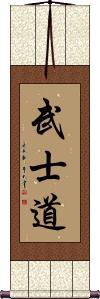
武士道 is the title for “The Code of the Samurai.”
Sometimes called “The Seven Virtues of the Samurai,” “The Bushido Code,” or “The Samurai Code of Chivalry.”
This would be read in Chinese characters, Japanese Kanji, and old Korean Hanja as “The Way of the Warrior,” “The Warrior's Way,” or “The Warrior's Code.”
It's a set of virtues that the Samurai of Japan and ancient warriors of China and Korea had to live and die by. However, while known throughout Asia, this title is mostly used in Japan and thought of as being of Japanese origin.
The seven commonly-accepted tenets or virtues of Bushido are Rectitude 義, Courage 勇, Benevolence 仁, Respect 礼(禮), Honour 名誉, Honesty 誠, and Loyalty 忠実. These tenets were part of oral history for generations, thus, you will see variations in the list of Bushido tenets depending on who you talk to.
See our page with just Code of the Samurai / Bushido here
Fall Down Seven Times, Get Up Eight
Always rising after a fall or repeated failures
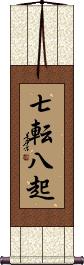
七転八起 is a Japanese proverb that relays the vicissitudes of life, with the meaning “seven times down eight times up.”
Some would more naturally translate it into English as “Always rising after a fall or repeated failures” or compare it to the English, “If at first, you don't succeed, try, try again.”
The first Kanji is literally “7.” The second means “fall down” (sometimes this Kanji means “turn around,” “revolve” or “turn over” but in this case, it holds the meaning of “fall”). The third is “8.” And the last is “get up,” “rouse,” or “rise.”
if you fail 7 times, you should recover from those events and be prepared to rise an 8th time. This also applies if it is the world or circumstances that knock you down seven times...
...just remember that you have the ability to bounce back from any type of adversity.
Note: This can be pronounced in two ways. One is “shichi ten hakki” or “shichitenhakki.” The other is “nana korobi ya oki” also written, “nanakorobi-yaoki.”
Special Note: The second character is a Kanji that is not used in China. Therefore, please select a Japanese calligrapher for this title.
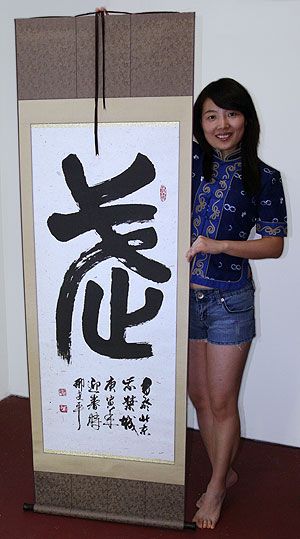
Life Energy / Spiritual Energy
Chi Energy: Essence of Life / Energy Flow
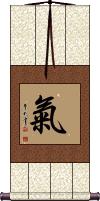
This 氣 energy flow is a fundamental concept of traditional Asian culture.
氣 is romanized as “Qi” or “Chi” in Chinese, “Gi” in Korean, and “Ki” in Japanese.
Chi is believed to be part of everything that exists, as in “life force” or “spiritual energy.” It is most often translated as “energy flow” or literally as “air” or “breath.” Some people will simply translate this as “spirit,” but you must consider the type of spirit we're talking about. I think this is weighted more toward energy than spirit.
The character itself is a representation of steam (or breath) rising from rice. To clarify, the character for rice looks like this: 
Steam was apparently seen as visual evidence of the release of “life energy” when this concept was first developed. The Qi / Chi / Ki character is still used in compound words to mean steam or vapor.
The etymology of this character is a bit complicated. It's suggested that the first form of this character from bronze script (about 2500 years ago) looked like these samples: 

However, it was easy to confuse this with the character for the number three. So the rice radical was added by 221 B.C. (the exact time of this change is debated). This first version with the rice radical looks like this: 
The idea of Qi / Chi / Ki is really a philosophical concept. It's often used to refer to the “flow” of metaphysical energy that sustains living beings. Yet there is much debate that has continued for thousands of years as to whether Qi / Chi / Ki is pure energy or consists partially or fully of matter.
You can also see the character for Qi / Chi / Ki in common compound words such as Tai Chi / Tai Qi, Aikido, Reiki, and Qi Gong / Chi Kung.
In the modern Japanese Kanji, the rice radical has been changed into two strokes that form an X.
 The original and traditional Chinese form is still understood in Japanese, but we can also offer that modern Kanji form in our custom calligraphy. If you want this Japanese Kanji, please click on the character to the right instead of the “Select and Customize” button above.
More language notes: This is pronounced like “chee” in Mandarin Chinese, and like “key” in Japanese.
This is also the same way to write this in Korean Hanja where it is Romanized as “gi” and pronounced like “gee” but with a real G-sound, not a J-sound.
Though Vietnamese no longer use Chinese characters in their daily language, this character is still widely known in Vietnam.
See Also: Supernatural Energy | Life Force | Vitality | Eternal Wheel of Life | Birth Old-Age Sickness Death | Wolf Spirit / Soul of a Wolf
Reiki
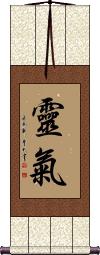
靈氣 is the title of a healing practice now found globally but with origins in Japan.
Special note: Outside of the context of the healing practice of Reiki, this means “aura” or “spiritual essence that surrounds all living things.” A Japanese person unfamiliar with the practice will take the “aura” meaning.
Reiki is a technique for stress reduction and relaxation that also heals. It can be compared to massage but is based on the idea that an unseen “life force energy” flows through us and is what causes us to be alive. If your life force energy is low, you'll be more likely to get sick or feel stressed. If your life force energy is abundant and flowing well, you become more capable of being happy and healthy.
There is many information available if you want to Google this term - my job is to offer the calligraphy while you can decide if it is right for you.

Note: We are showing the ancient (traditional) form of the Reiki Kanji. I have seen Reiki written with the slightly simplified version and this more classic form. If you want the form of Reiki with the two strokes in the shape of an X on the second character and the modern first character, simply click on the Kanji characters to the right.
Note: 靈氣 is also a Chinese word, but in Chinese, these characters create a word that refers to a smart person or someone with high aspirations. It is not read as a healing method in Chinese.
In Korean Hanja, this can be read as a “mysterious atmosphere” by a Korean who is not familiar with the practice of Reiki (still has a cool meaning in Korean).
Learning is Eternal
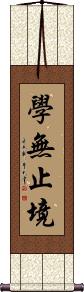
This Chinese philosophy tells of how we continue to learn throughout our lives.
This proverb can be translated in a few ways such as “Study has no end,” “Knowledge is infinite,” “No end to learning,” “There's always something new to study,” or “You live and learn.”
The deeper meaning: Even when we finish school we are still students of the world gaining more knowledge from our surroundings with each passing day.
See Also: An Open Book Benefits Your Mind | Wisdom | Learn From Wisdom
Once in a Lifetime
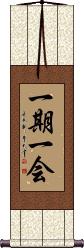
This Japanese title can mean “for this time only,” “chance meeting,” “one meeting, one opportunity,” “never again,” or “one chance in a lifetime.”
The characters literally mean “one time one meeting” - of course, the Kanji characters have meaning far beyond a direct translation like this.
Some might use this proverb to talk of an opportunity that presents itself just once in your life. It could also be a one-and-only chance meeting with your true soul mate. An expression of any event that might happen once in a lifetime.
This is primarily a Japanese title, however, there is also a Traditional Chinese (and old Korean) version of this proverb. Just the last character is different. The traditional form was used in Japan before WWII and in Korea prior to 1900. This title is somewhat known in China.
If you want the older traditional form, just click on the character to the right.
Dignity / Honor / Sanctity / Integrity
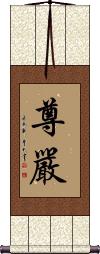
尊嚴 is a form of honor that means showing great respect for yourself, other people, and the rules you live by.
When you are honorable, you keep your word. You do the right thing regardless of what others are doing.
尊嚴 is the kind of personal honor or dignity that is of great value. If you lose this, you have lost yourself and perhaps the reputation of your family as well.
While this is not directly the same thing as “face” or “saving face” in Asian culture, it is associated with the same concept in China.
 In Japan, they currently use a more simplified second character for this word. The ancient Japanese form is the same as China but after WWII some Kanji were changed. If you want the modern Japanese version, just click on the Kanji image shown to the right, instead of the button above.
Daodejing / Tao Te Ching - Chapter 33
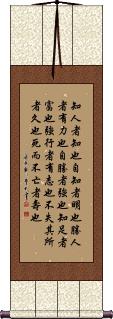
This is referred to as passage or chapter 33 of the Dao De Jing (often Romanized as “Tao Te Ching”).
These are the words of the philosopher Laozi (Lao Tzu).
To know others is wisdom;
To know oneself is acuity/intelligence.
To conquer others is power,
To conquer oneself is strength.
To know contentment is to have wealth.
To act resolutely is to have purpose.
To stay one's ground is to be enduring.
To die and yet not be forgotten is to be long-lived.
To understand others is to be knowledgeable;
To understand yourself is to be wise.
To conquer others is to have strength;
To conquer yourself is to be strong.
To know when you have enough is to be rich.
To go forward with strength is to have ambition.
To not lose your place is to be long-lasting.
To die but not be forgotten -- that's true long life.
He who is content is rich;
He who acts with persistence has will;
He who does not lose his roots will endure;
He who dies physically but preserves the Dao
will enjoy a long after-life.
Notes:
During our research, the Chinese characters shown here are probably the most accurate to the original text of Laozi. These were taken for the most part from the Mawangdui 1973 and Guodan 1993 manuscripts which pre-date other Daodejing texts by about 1000 years.
Grammar was a little different in Laozi’s time. So you should consider this to be the ancient Chinese version. Some have modernized this passage by adding, removing, or swapping articles and changing the grammar (we felt the oldest and most original version would be more desirable). You may find other versions printed in books or online - sometimes these modern texts are simply used to explain to Chinese people what the original text really means.
This language issue can be compared in English by thinking how the King James (known as the Authorized version in Great Britain) Bible from 1611 was written, and comparing it to modern English. Now imagine that the Daodejing was probably written around 403 BCE (2000 years before the King James Version of the Bible). To a Chinese person, the original Daodejing reads like text that is 3 times more detached compared to Shakespeare’s English is to our modern-day speech.
Extended notes:
While on this Biblical text comparison, it should be noted, that just like the Bible, all the original texts of the Daodejing were lost or destroyed long ago. Just as with the scripture used to create the Bible, various manuscripts exist, many with variations or copyist errors. Just as the earliest New Testament scripture (incomplete) is from 170 years after Christ, the earliest Daodejing manuscript (incomplete) is from 100-200 years after the death of Laozi.
The reason that the originals were lost probably has a lot to do with the first Qin Emperor. Upon taking power and unifying China, he ordered the burning and destruction of all books (scrolls/rolls) except those pertaining to Chinese medicine and a few other subjects. The surviving Daodejing manuscripts were either hidden on purpose or simply forgotten about. Some were not unearthed until as late as 1993.
We compared many research by various archeologists and historians before deciding on this as the most accurate and correct version. But one must allow that it may not be perfect, or the actual and original as from the hand of Laozi himself.
A Life of Serenity Yields Understanding
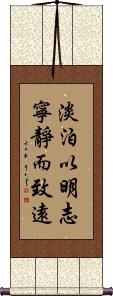
淡泊以明志寧靜而致遠 is a kind of complex ten-character proverb composed by Zhuge Liang about 1800 years ago.
淡泊以明志寧靜而致遠 is a Chinese proverb that means “Leading a simple life will yield a clear mind, and having inner peace will help you see far (into the world).”
What I have translated as “simple life” means NOT being materialistic and NOT competing in the rat race.
The last word means “far” but the deeper meaning is that you will surpass what you can currently see or understand. Perhaps even the idea of opening up vast knowledge and understanding of complex ideas.
The whole phrase has a theme that suggests that if you are NOT an aggressive, cut-throat person who fights their way to the top, no matter how many people they crush along the way, and instead seek inner peace, you will have a happier existence and be more likely to understand the meaning of life.
See Also: Tranquil / Tranquility / Serenity
Drinking the water of a well: One should never forget who dug it
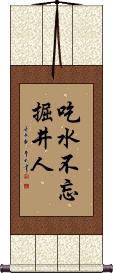
This proverb suggests that one should always be grateful to those who helped one succeed.
And remember your ancestors and those that came before you whose sacrifices made your present life better.
Some Chinese will separate the intended meaning from this proverb and translate this as “Don't forget the people who once helped you.” In Modern China, this idiom is virtually never used to refer to an actual well.
Note: This can be pronounced in Korean but it's not a commonly used phrase.
Healing Hands
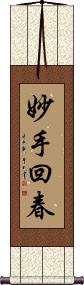
妙手回春 can mean “healing hands.”
The first two characters are used to describe a doctor or medical professional who has admirable skills in curing disease. Literally: Wonderful or skilled hands.
The last two characters mean “Springing back to life.”
Altogether, it suggests that these skilled hands can cure whatever ails you and bring you back to life. 妙手回春 is a great honor to bestow on your doctor or other healthcare professionals that have helped you.
Integrity
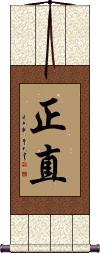
Integrity is living by your highest values. It is being honest and sincere. Integrity helps you to listen to your conscience, do the right thing, and tell the truth. You act with integrity when your words and actions match. Integrity gives you self-respect and a peaceful heart. Please note that the second Kanji sometimes has an alternate form in Japanese. Let us know if you want the alternate form shown to the right.
Note: This entry is cross-listed as “honesty” because it also fits that definition.
Beyond Integrity, this word also means “upright” and “honest” in Chinese. Means “integrity,” “honesty” or “frankness” in Japanese.
See Also: Honor | Honesty | Truth | Trust Your Heart
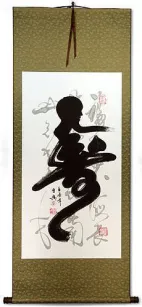
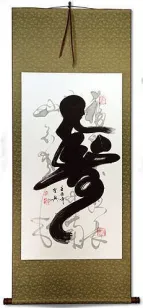
Longevity / Long Life
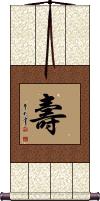
壽 can mean “long life” or “longevity” in the simplest form.
 Please note that Japanese use a simplified version of this character - it also happens to be the same simplification used in mainland China. Click on the character to the right if you want the Japanese/Simplified version.
Mercy / Compassion / Love
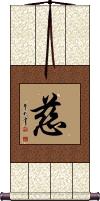
慈 is the simplest way to express the idea of compassion.
This can also mean love for your fellow humans, humanity, or living creatures. Sometimes this is extended to mean charity.
This term is often used in a Buddhist or Christian context. The concept was also spoken of by Laozi (Lao Tzu) in the Dao De Jing (Tao Te Ching).
慈 is considered the direct translation of the Sanskrit word मैत्री (maitrī) Pali word मेत्ता (mettā). In this context, it means benevolence, loving kindness, and goodwill.
This Chinese character is understood in Japanese but is usually used in compound words (not seen alone). Also used in old Korean Hanja, so it's very universal.
See Also: No Mercy | Benevolence | Forgiveness | Kindness
Undaunted After Repeated Setbacks
Persistence to overcome all challenges
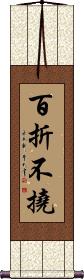
百折不撓 is a Chinese proverb that means “Be undaunted in the face of repeated setbacks.”
More directly translated, it reads, “[Overcome] a hundred setbacks, without flinching.” 百折不撓 is of Chinese origin but is commonly used in Japanese and somewhat in Korean (same characters, different pronunciation).
This proverb comes from a long, and occasionally tragic story of a man that lived sometime around 25-220 AD. His name was Qiao Xuan, and he never stooped to flattery but remained an upright person at all times. He fought to expose the corruption of higher-level government officials at great risk to himself.
Then when he was at a higher level in the Imperial Court, bandits were regularly capturing hostages and demanding ransoms. But when his own son was captured, he was so focused on his duty to the Emperor and the common good that he sent a platoon of soldiers to raid the bandits' hideout, and stop them once and for all even at the risk of his own son's life. While all of the bandits were arrested in the raid, they killed Qiao Xuan's son at first sight of the raiding soldiers.
Near the end of his career, a new Emperor came to power, and Qiao Xuan reported to him that one of his ministers was bullying the people and extorting money from them. The new Emperor refused to listen to Qiao Xuan and even promoted the corrupt Minister. Qiao Xuan was so disgusted that in protest, he resigned from his post as minister (something almost never done) and left for his home village.
His tombstone reads “Bai Zhe Bu Nao” which is now a proverb used in Chinese culture to describe a person of strong will who puts up stubborn resistance against great odds.
My Chinese-English dictionary defines these 4 characters as “keep on fighting despite all setbacks,” “be undaunted by repeated setbacks,” and “be indomitable.”
Our translator says it can mean “never give up” in modern Chinese.
Although the first two characters are translated correctly as “repeated setbacks,” the literal meaning is “100 setbacks” or “a rope that breaks 100 times.” The last two characters can mean “do not yield” or “do not give up.”
Most Chinese, Japanese, and Korean people will not take this absolutely literal meaning but will instead understand it as the title suggests above. If you want a single big word definition, it would be indefatigability, indomitableness, persistence, or unyielding.
See Also: Tenacious / Tenacity | Perseverance / Indomitable / Invincible Fortitude | With All the Strength of Your Heart | Perseverance | Persistence
Eternal Friendship / Friends Forever
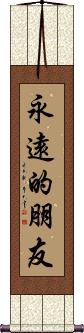
永遠的朋友 means friends that are eternal or a friendship that will last forever - you will remain the best of friends as long as you live.
The first two characters mean forever, eternal, eternity, perpetuity, immortality, and/or permanence.
The middle character links the words (it's a possessive article).
The last two characters represent friendship, or simply “friends.”
See Also: Best Friends
Ninjutsu / Ninjitsu
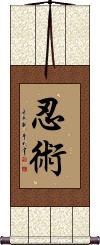
忍術 is the “art of the ninja” in Japanese. Most Japanese people associate ninjas with romance and reverence for Japan's ancient past. But most will accept that the ninja is an idea or way of life whose time has passed. However, this has not stopped floods of movies about ninjas and dojos offering Ninjutsu training from keeping the idea of the ninja alive in modern times.
My modern Japanese dictionary defines this as “assassination, stealth, and combat techniques” or “fighting art of the ninja.”
 Note that when writing this as Kanji, Japanese tend to write the first character in the form shown to the right. Because this is specifically a Japanese title, we only suggest a Japanese calligrapher for this selection - and you will get the form shown to the right if you do that (please ignore the fact that some of the images you see during the following pages in the options process will be the Chinese/alternate form).
All Tenets of the Noble Eightfold Path
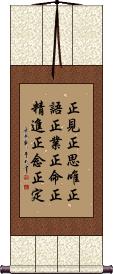
These are the eight tenets of the Buddhist Noble Eightfold Path written altogether.
Here's this list of tenets in English:
1. Right View / Right Understanding / Right Perspective / Perfect View
2. Right Resolve / Right Thought / Right Intention / Perfect Resolve
3. Right Speech / Right Talk / Perfect Speech
4. Right Action / Perfect Conduct
5. Right Living / Right Livelihood / Perfect Livelihood
6. Right Effort / Right Endeavor / Perfect Effort
7. Right Mindfulness / Right Memory / Perfect Mindfulness
8. Right Concentration / Perfect Concentration
Soul Mates
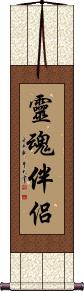
靈魂伴侶 is the literal translation of “Soul Mates.”
This is kind of the western way to express “soul mates” but translated into Chinese, Japanese Kanji, and old Korean Hanja.
The first two characters mean “soul” or “spirit.”
The second two characters mean “mate,” “companion” or “partner.”
Although not the most common title, these characters have good meaning and will be received well in Chinese, Japanese, and Korean. It's a universal title!
Heaven Blesses the Diligent
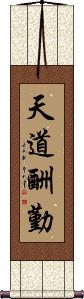
天道酬勤 can be interpreted in a few different ways:
God blesses those who work hard.
It is the way of Heaven to smile on the diligent.
God will reward those that are worthy.
Heaven blesses those who are diligent.
Whichever translation you like, a scroll like this on your wall may serve as a reminder to work hard because your diligence will pay off both in this life and the next.
Note: This can be pronounced in Korean, but it's not a commonly used term.
Impermanence
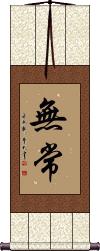
無常 is the state of being “not permanent,” “not enduring,” transitory, or evolving.
It can also mean variable or changeable. In some contexts, it can refer to a ghost that is supposed to take a soul upon death. Following that, this term can also mean to pass away or die.
In the Buddhist context, this is a reminder that everything in this world is ever-changing, and all circumstances of your life are temporary.
If you take the Buddhist philosophy further, none of these circumstances are real, and your existence is an illusion. Thus, the idea of the eternal soul is perhaps just your attachment to your ego. Once you release your attachment to all impermanent things, you will be on your way to enlightenment and Buddhahood.
Language notes for this word when used outside the context of Buddhism:
In Korean Hanja, this means uncertainty, transiency, mutability, or evanescent.
In Japanese, the definition orbits closer to the state of being uncertain.
Learn from Wisdom
(When you see a wise person, try to be like them)
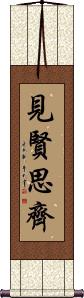
When you meet a wise person, you should learn from them and be inspired to become as wise as they are.
見賢思齊 is a pretty long proverb in English, but in Chinese, it's only four characters.
However, in Chinese, the deeper meaning often surpasses the dictionary definition of each character.
In this case, you should seek wise people to learn from throughout your life...
Always try to learn enough to become equal to them. It also suggests that learning and seeking wisdom is a non-ending cycle.
See Also: Realization and Knowledge
Rabbit / Hare
Year of the Rabbit / Zodiac Sign
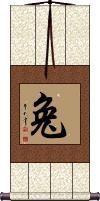
兔 is the character for rabbit or hare in Chinese, old Korean, and Japanese.
If you were born in the year of the rabbit, you...
Are gentle and full of sympathy.
Love to help others.
Enjoy a quiet life.
Are a good worker.
Are, however, a bit of a pushover.
See also our Chinese Zodiac page.
Balance / Equilibrium
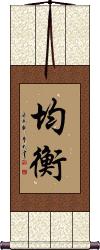
均衡 means balance or equilibrium.
This title is best for a Japanese audience where the word suggests that your life is in balance in all matters (or is a reminder for you to try and keep all matters in balance).
Better to be Happy than Rich
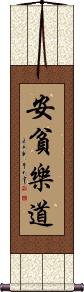
安貧樂道 means “It's better to be happy than rich” in Chinese.
Even if you are poor, you should still feel satisfied in your life...
...Satisfaction, happiness and the meaning of your life come from within yourself and not from money or riches of the world.
In Chinese, there are many four-character proverbs which express some very old philosophies.
Though there are only four characters on this scroll, in Chinese, the meanings often surpass the dictionary definition of each character.
In this case, you should not set your expectations too high for the money or riches you wish to have. One who sets their expectations too high is almost always disappointed. Instead, you should cherish what you have, seek to improve yourself from within, and not measure your worth by the size of your bank account.
Triple Truth of Japanese Buddhism

人間性を再生するのは寛容な心親切な言葉奉仕と思いやりの精神 is known as the Triple Truth of Buddhism in Japanese.
The Buddha ordered that all should know this triple truth...
A generous heart, kind speech, and a life of service and compassion are the things that renew humanity.
That is the English translation most commonly used for this Japanese Buddhist phrase. You might have seen this on a coffee cup or tee shirt.
Note: Because this selection contains some special Japanese Hiragana characters, it should be written by a Japanese calligrapher.
Live Laugh Love
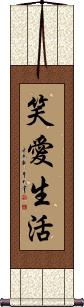
In English, the word order shown in the title is the most natural or popular. In Chinese, the natural order is a little different:
The first character means laugh (sometimes means smile).
The second character means love.
The last two characters mean “live” as in “to be alive” or “pursue life.”
Please note: 笑愛生活 is not a normal phrase in that it does not have a subject, verb, or object. It is a word list. Word lists are not common in Asian languages/grammar (at least not as normal as in English). We only added this entry because so many people requested it.
We put the characters in the order shown above, as it almost makes a single word with the meaning “A life of laughter and love.” It's a made-up word, but it sounds good in Chinese.
We removed the Japanese pronunciation guide from this entry, as the professional Japanese translator deemed it “near nonsense” from a Japanese perspective. Choose this only if your audience is Chinese and you want the fewest-possible characters to express this idea.
In Korean, this would be 소애생활 or “so ae saeng hwar” but I have not confirmed that this makes sense in Korean.
Life in Balance / Balancing Life
The art of balancing your life
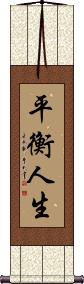
This 平衡人生 title suggests that you are actively trying to keep your life in balance.
Think of this as the action verb of seeking or having a balanced life.
The first two characters mean balance, equilibrium, or keeping things equal.
The last two characters mean “life.” Literally “human life.”
Mercy / Compassion / Buddhist Loving Kindness
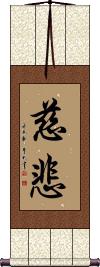
Besides the title above, 慈悲 can also be defined as clemency or lenience and sometimes the act of giving charity.
In the Buddhist context, it can mean “benevolence,” “loving-kindness and compassion,” or “mercy and compassion.”
This Buddhist virtue is perhaps the most important to employ in your life. All sentient beings that you encounter should be given your loving kindness. And trust me, however much you can give, it comes back. Make your life and the world a better place!
This Chinese/Japanese Buddhist term is the equivalent of Metta Karuna from Pali or Maitri Karuna from Sanskrit.
慈 can mean loving-kindness by itself.
悲 adds a component of sorrow, empathy, compassion, and sympathy for others.
See Also: Benevolence
Not Only Can Water Float A Boat, It Can Sink It Also
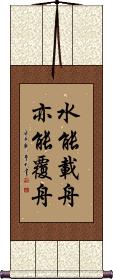
Many things have opposite properties. The water you drink can also drown you. Pork may nourish you and keep you alive but under-cook it and it could kill you. Potassium nitrate is often used as a fertilizer to grow the food that sustains us but it's also been used as an explosive to topple buildings and destroy us.
This concept is easily associated with “yin yang” where an element has two opposite properties that are as different as night and day.
This proverb's meaning can be summed up this way: “Anything that can lead you to success may also contain great risks.”
This phrase is known in literary circles by Korean people (scholars or literature). It is therefore also a valid proverb in Korean Hanja, though most Koreans would not be able to make sense of it.
Please note that there is an unwritten rule when the same character appears twice in the same phrase, the calligrapher will alter the appearance so that no two characters are exactly alike in the same piece. This calligraphy has two repeating characters that will be written differently than they appear here.
Each Time You Stumble and Fall, You Gain Experience and Wisdom
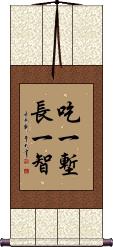
吃一塹長一智 is a Chinese proverb that means “Fall into a moat, and you will gain wisdom from the experience.”
It really suggests that the failures, troubles, frustrations, and setbacks that you encounter in your life are actually helping you to find wisdom. Some would also translate this proverb as “Learn from your mistakes” or “Learn from your experience.”
If you are studying Chinese, you will recognize the first character as “eat,” but in this case, it means to “experience” (as used in this proverb, it is suggesting that you have fallen into a moat and/or had a hard time crossing it).
Translated character by character, this whole proverb is, “Experience one moat, gain one wisdom/knowledge.”
Note: This can be pronounced in Korean, but it's not a commonly used phrase.
4. Right Action / Perfect Conduct
Samyak Karmanta / Samma Kammanta
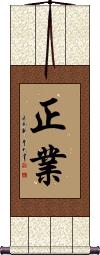
正業 is one of the Noble Eightfold Paths of Buddhism. Right Action, along with Right Speech and Right Living, constitute the path to Virtue.
The five precepts of Right Action are...
1. Refrain from destroying living beings (no murder or any form of taking a life).
2. Refrain from stealing.
3. Refrain from sexual misconduct (adultery, rape, etc.).
4. Refrain from false speech (lying or trickery).
5. Refrain from intoxicants that lead to heedlessness (no drugs or alcohol).
This concept can be summarized as “Avoidance of actions that conflict with moral discipline.”
Note: In Japanese, when read by a non-Buddhist, this will mean “the right job/vocation.”
This term is exclusively used by devout Buddhists. It is not a common term, and remains an unknown concept to most Japanese and Chinese people.
See Also: Buddhism | Enlightenment | Noble Eightfold Path
Eternity / Always and Forever
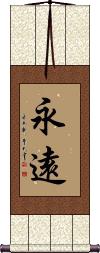
永遠 is the Chinese, Korean and Japanese word for forever.
If we take this word apart, the first character means always, forever, or perpetual. While the second character means far or distant.
See Also: The Key to Immortality is First Living a Life Worth Remembering
Healthy Living
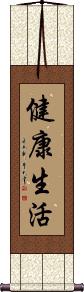
If you are into healthy living, 健康生活 might be an excellent selection for a wall scroll to hang in your home.
The first two characters speak of health, vitality, vigor, and being of sound body. The second two characters mean living or life (daily existence).
See Also: With All the Strength of Your Heart | Vitality | Strong / Healthy
The Noble Eightfold Path
Ashtangika Marga / Astangika-Marga / Atthangika Magga
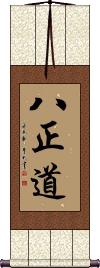
八正道 is a complex set of steps that Buddhists much take to cleanse karma, achieve enlightenment, eventually cease the cycle of rebirth and live in a state of Nirvana.
Note: This term is exclusively used by devout Buddhists. It is not a common term and remains an unknown concept to most Japanese and Chinese people. Sometimes written as 八聖道.
See Also: Buddhism | Enlightenment
Purified Spirit / Enlightened Attitude
A Japanese martial arts title/concept
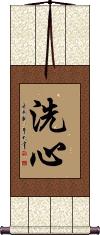
The first Kanji alone means to wash, bathe, primness, cleanse or purify.
The second Kanji means heart, mind, soul, or essence.
Together, these two Kanji create a word defined as “purified spirit” or “enlightened attitude” within Japanese martial arts.
洗心 is one of the five spirits of the warrior (budo) and is often used as a Japanese martial arts tenet. Under that context, it's often defined as a spirit that protects and harmonizes the universe. Senshin is a spirit of compassion that embraces and serves all humanity and whose function is to reconcile discord in the world. It holds all life to be sacred. It is the Buddha mind.
This title will only be familiar to Japanese who practice certain martial arts. Others may not recognize this word at all.
洗心 does not show up as a word in too many Chinese dictionaries, but it can be read and has the same meaning in Chinese.
 There is an issue with the first character. The original, and probably most correct version is shown above. However, many dojo documents and other sources have used a more simple first character. Arguments ensue about which version is correct. If you want to be correct in the Japanese language, use the “Select and Customize” button above. If you want to match the Kanji used by your dojo, click the Kanji shown to the right. There is a slightly different meaning with this first character which means before, ahead, previous, future, precedence.
100 Years of Happy Marriage
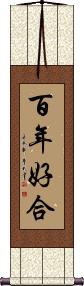
百年好合 is a wish or greeting, often heard at Chinese weddings, for a couple to have 100 good years together.
Some will translate this more naturally into English as: “May you live a long and happy life together.”
The character breakdown:
百 = 100
年 = Years
好 = Good (Happy)
合 = Together
2. Right Resolve / Right Thought / Right Intention / Perfect Resolve
Samyak Samkalpa / Samma Sankappa
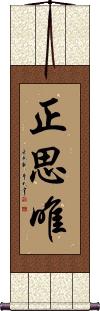
正思唯 is one of the Noble Eightfold Paths of Buddhism. Right Thought, along with the Right View, constitute the path to Wisdom.
In Buddhism, Right Thought, in simple terms, means to free yourself from having ill will towards anyone or anything. It also suggests that you remain harmless to other living creatures.
This can also be defined as “Resolve in favor of renunciation, goodwill, and non-harming of sentient beings.”
 There is an ancient/alternate version of the third character for this selection. You can see that alternation third character to the right. If you want your selection to use that older character, just click on the character to the right, instead of the button above.
Note: This term is exclusively used by devout Buddhists. It is not a common term, and remains an unknown concept to most Japanese and Chinese people.
See Also: Buddhism | Enlightenment | Noble Eightfold Path
Broken Mirror Rejoined
Used in modern times for divorced couples that come back together
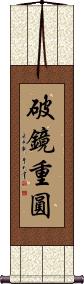
破鏡重圓 is about a husband and wife who were separated and reunited.
About 1500 years ago in China, there lived a beautiful princess named Le Chang. She and her husband Xu De Yan loved each other very much. But when the army of the Sui Dynasty was about to attack their kingdom, disposed of all of their worldly possessions and prepared to flee into exile.
They knew that in the chaos, they might lose track of each other, so the one possession they kept was a bronze mirror which is a symbol of unity for a husband and wife. They broke the mirror into two pieces, and each of them kept half of the mirror. They decided that if separated, they would try to meet at the fair during the 15th day of the first lunar month (which is the lantern festival). Unfortunately, the occupation was brutal, and the princess was forced to become the mistress of the new commissioner of the territory, Yang Su.
At the Lantern Festival the next year, the husband came to the fair to search for his wife. He carried with him his half of the mirror. As he walked through the fair, he saw the other half of the mirror for sale at a junk market by a servant of the commissioner. The husband recognized his wife's half of the mirror immediately, and tears rolled down his face as he was told by the servant about the bitter and loveless life that the princess had endured.
As his tears dripped onto the mirror, the husband scratched a poem into his wife's half of the mirror:
You left me with the severed mirror,
The mirror has returned, but absent are you,
As I gaze in the mirror, I seek your face,
I see the moon, but as for you, I see not a trace.
The servant brought the inscribed half of the mirror back to the princess. For many days, the princess could not stop crying when she found that her husband was alive and still loved her.
Commissioner Yang Su, becoming aware of this saga, realized that he could never obtain the princess's love. He sent for the husband and allowed them to reunite.
This proverb, 破鏡重圓, is now used to describe a couple who has been torn apart for some reason (usually divorce) but have come back together (or remarried).
It seems to be more common these days in America for divorced couples to reconcile and get married to each other again. This will be a great gift if you know someone who is about to remarry their ex.
Clarity
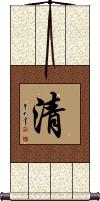
清 is a word that means clarity or clear in Chinese, Japanese Kanji, and old Korean Hanja.
Looking at the parts of this character, you have three splashes of water on the left, “life” on the top right, and the moon on the lower right.
Because of something Confucius said about 2500 years ago, you can imagine that This means “live life with clarity like bright moonlight piercing pure water.” The Confucian idea is something like “Keep clear what is pure in yourself, and let your pure nature show through.” similar to saying, “Don't pollute your mind or body, so that they remain clear.”
This might be stretching the definition of this single Chinese character but the elements are there, and “clarity” is a powerful idea.
Korean note: Korean pronunciation is given above but this character is written with a slight difference in the “moon radical” in Korean. However, anyone who can read Korean Hanja, will understand this character with no problem (this is considered an alternate form in Korean). If you want the more standard Korean Hanja form (which is an alternate form in Chinese), just let me know.
Japanese note: When reading in Japanese, this Kanji has additional meanings of pure, purify, or cleanse (sometimes to remove demons or “exorcise”). Used more in compound words in Japanese than as a stand-alone Kanji.
Ikigai

生き甲斐 is a Japanese word that means something one lives for, a reason for being, a purpose in life, or French, raison d'etre.
Everyone has an ikigai. Finding it requires a deep and often lengthy search for self. Finding your Ikigai is the way to also find satisfaction and meaning in life.
Your Ikigai could be almost anything. For some, it is running for president. For others, satisfaction is found in raising children.
Ikigai is why you get up in the morning; bringing meaning to your life and pursuing your Ikigai makes life worthwhile.
Life-Saving Sword
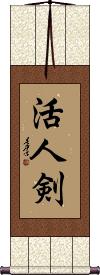
活人剣 is a Japanese title for “life-saving sword” or “katsujinken.”
This title suggests that a sword used for killing can also be used for saving or giving life.
See Also: Sasuke
Life in Harmony / Balanced Life
Harmonious Life
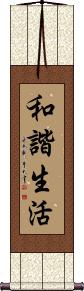
This 和諧生活 title suggests that you have, or want to get your life in balance.
The first two characters regard the idea of balance, harmony, and peace.
The second two characters mean “life.” More specifically this refers to your livelihood, career, and the daily activities that comprise your life or living. Some would translate those two characters as “one's daily existence.”
Note: We have a couple of titles for this idea. This version is more of a noun, thus “The Balanced Life” verses a verb form like “Balancing [Your] Life.”
A Life of Happiness and Prosperity
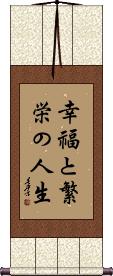
幸福と繁栄の人生 is a Japanese proverb that means “A life of happiness and prosperity” or “A life of happiness and success.”
Note: Because this selection contains some special Japanese Hiragana characters, it should be written by a Japanese calligrapher.
See Also: Prosperity
Live Laugh Love
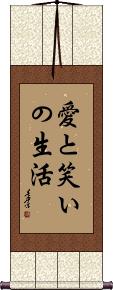
Because a word list of “Live Laugh Love” is not natural in Japanese, this takes the concept and incorporates it into a proper phrase.
愛と笑いの生活 can mean “A life of love and laughter” or “Live life with love and laughter.”
Note: Because this selection contains some special Japanese Hiragana characters, it should be written by a Japanese calligrapher.
Mountain Travels Poem by Dumu

This poem was written almost 1200 years ago during the Tang dynasty.
It depicts traveling up a place known as Cold Mountain, where some hearty people have built their homes. The traveler is overwhelmed by the beauty of the turning leaves of the maple forest that surrounds him just as night overtakes the day, and darkness prevails. His heart implores him to stop, and take in all of the beauty around him.
First, before you get to the full translation, I must tell you that Chinese poetry is a lot different than what we have in the west. Chinese words simply don't rhyme in the same way that English or other western languages do. Chinese poetry depends on rhythm and a certain beat of repeated numbers of characters.
I have done my best to translate this poem keeping a certain feel of the original poet. But some of the original beauty of the poem in its original Chinese will be lost in translation.
Far away on Cold Mountain, a stone path leads upwards.
Among white clouds, people's homes reside.
Stopping my carriage I must, as to admire the maple forest at nights fall.
In awe of autumn leaves showing more red than even flowers of early spring.
Hopefully, this poem will remind you to stop, and “take it all in” as you travel through life.
The poet's name is “Du Mu” in Chinese that is: 
 .
The title of the poem, “Mountain Travels” is: 

You can have the title, poet's name, and even “Tang Dynasty” written as an inscription on your custom wall scroll if you like.
More about the poet:
Dumu lived from 803-852 AD and was a leading Chinese poet during the later part of the Tang dynasty.
He was born in Chang'an, a city in central China and the former capital of the ancient Chinese empire in 221-206 BC. In present-day China, his birthplace is currently known as Xi'an, the home of the Terracotta Soldiers.
He was awarded his Jinshi degree (an exam administered by the emperor's court which leads to becoming an official of the court) at the age of 25 and went on to hold many official positions over the years. However, he never achieved a high rank, apparently because of some disputes between various factions, and his family's criticism of the government. His last post in the court was his appointment to the office of Secretariat Drafter.
During his life, he wrote scores of narrative poems, as well as a commentary on the Art of War and many letters of advice to high officials.
His poems were often very realistic and often depicted everyday life. He wrote poems about everything, from drinking beer in a tavern to weepy poems about lost love.
The thing that strikes you most is the fact even after 1200 years, not much has changed about the beauty of nature, toils, and troubles of love and beer drinking.
Sacrifice / Devotion / Dedication
(complete bodily devotion)
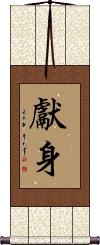
獻身 is used to describe being so devoted to something that you will make sacrifices for that goal/thing/person.
You can also translate this word as any of the following:
Sacrifice one's life for...
To dedicate oneself to...
Self-devotion
Dedication
Devote to...
Self-sacrifice
Giving your whole body to...
This can be a dedication to or for someone but is often used as a dedication or making sacrifices for your country, public service, or a cause. For instance, an Olympic athlete makes great sacrifices to train in their sport for their country and compatriots.

 While the form shown to the upper-left is considered an ancient Japanese version, in modern Japan, they use the simplified version of the first Kanji (shown to the right). Click on the Kanji at the right instead of the button above if you want this modern Japanese version.
If you are looking for a more religious meaning of devotion, see Faith.
See Also: Self-Confidence | Dedication
Shiken Haramitsu Daikomyo
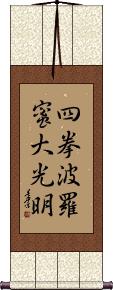
四拳波羅蜜大光明 is “shiken haramitsu daikōmyō,” a famous Japanese Buddhist mantra.
四拳 = shi-ken = four fists (many translate this as “four hearts”).
波羅蜜 = ha-ra-mitsu = A loanword representing pāramitā, or entrance into Nirvana. Awkwardly, it also means jackfruit.
大光明 = dai-kou-myo = big/great light bright (great bright light).
Shiken represents four hearts:
1. The Merciful Heart - Love and caring for all living things.
2. The Sincere Heart - Pursues righteousness, or the right path - sincerely trying to do what is right.
3. The Attuned Heart - Knows that nature and fate have their ways, and thus stay in tune with the universe.
4. The Dedicated Heart - Steadfast on the chosen path to the end.
Success
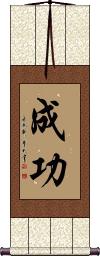
This Chinese and Japanese word for “success” is often used to refer to “career success” but is also used for other successes in life.
It matches the western dictionary definition of “The achievement of something desired, planned, or attempted.” And It's also used in this old Chinese proverb:  which means Failure is the Mother of Success.
Sometimes this word is translated as prosperity, but success, succeed, or successfully are more correct definitions.
See Also: Prosperity
Work Unselfishly for the Common Good
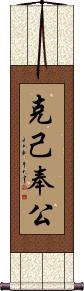
克己奉公 is a Chinese proverb that is often used to express how one should act as a government official. Most of us wish our public officials would hold themselves to higher standards. I wish I could send this scroll, along with the meaning to every member of Congress, and the President (or if I was from the UK, all the members of Parliament, and the PM)
This can also mean: “Place Strict Standards on Oneself in Public Service.”
The story behind this ancient Chinese idiom:
Cai Zun was born in China a little over 2000 years ago. In 24 AD, he joined an uprising led by Liu Xiu, who later became the emperor of the Eastern Han Dynasty.
Later, the new emperor put Cai Zun in charge of the military court. Cai Zun exercised his power in strict accordance with military law, regardless of the offender's rank or background. He even ordered the execution of one of the emperor's close servants after the servant committed a serious crime.
Cai Zun led a simple life but put great demands on himself to do all things honorably. The emperor rewarded him for his honest character and honorable nature by promoting him to the rank of General and granting him the title of Marquis.
Whenever Cai Zun would receive an award, he would give credit to his men and share the reward with them.
Cai Zun was always praised by historians who found many examples of his selfless acts that served the public interest.
Sometime long ago in history, people began to refer to Cai Zun as “ke ji feng gong.”
See Also: Work Unselfishly for the Common Good | Selflessness | Lotus
Ultimate Loyalty to Your Country
The most famous tattoo in Chinese history
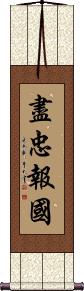
盡忠報國 is a proverb that is the tattoo worn on the back of Yue Fei, a famous Chinese warrior who lived until 1142 A.D.
The tattoo can mean “Serve the country with the utmost loyalty.” More literally, it means “[The] Ultimate Loyalty [is too] Duty [of] Country.”
Legend has it that this tattoo once saved his life when he was accused of treason.
The first two characters have come to create a word that means “serve the country faithfully” or “die for the country.” Note: It's more a willingness to die for one's country than the actual act of dying.
The last two characters have come to mean “Dedicate oneself to the service of one's country.”
Both of these words are probably only in the Chinese lexicon because of this famous tattoo.
If you break it down, character-by-character, here is what you get:
1. To the utmost, to the limit of something, the ultimate.
2. Loyalty or duty (a sense of duty to one's master, lord, country, or job).
3. Report, recompense, give back to (in this case, you are giving yourself to your country as payback).
4. Country, state, nation, kingdom.
Adventure
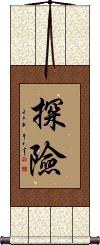
If you lead a life of adventure (like I do), a 探險 wall scroll is for you.
Alone, the first character can mean “to explore,” “to search out,” or “to scout.” The second character holds the meanings of “dangerous” and “rugged.” Together these two characters create the word that means “adventure” or “to explore.”
探険 is a modern Japanese Kanji version, but it more precisely means exploration or expedition rather than adventure. 探險 is the old/ancient Japanese version used before WWII. Let us know if you want the modern Japanese version instead.
See Also: Bon Voyage | Traveler / Wanderer / Vagabond / Rolling Stone
Karma
Single character for Buddhist Karma
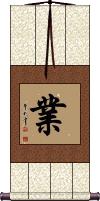
This is the simplest way to express the idea of Karma. This is the Buddhist concept of actions committed in a former life affecting the present and future.
Out of the context of Buddhism, this Karma character means one's profession in life, trade, occupation, business, study, or career.
The Karma definition applies to both Chinese and Japanese for this character. This also works as Korean Hanja as Karma; although the meaning can vary depending on context (my Korean dictionary gives the definition of profession/occupation).
See Also: Buddhism
Life Force
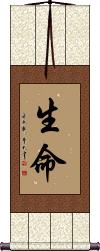
This Chinese, Korean and Japanese word means “life force” or simply “life.”
The first character means “life” or “birth.” The second means “life” or “fate.” Together they create the meaning of “life force,” though some will translate this as “existence” and sometimes “vitality.”
See Also: Vitality | Birth Old-Age Sickness Death
A Life of Happiness and Prosperity
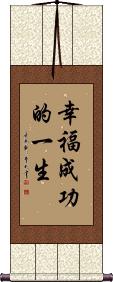
幸福成功的一生 means “A life of happiness and prosperity” or “A life of happiness and success.”
It's a very positive and inspirational wall scroll selection.
See Also: Prosperity
Live In The Moment / Live In The Now
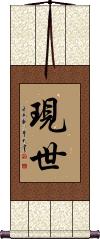
現世 is a very short way to write “live in the moment” or “live in the now” in Japanese.
This short word is open to interpretation. It's used in Japanese Buddhism to mean “the current epoch” or “the current age” (the current age is but a brief moment in the greater scope of existence). In that context, this is pronounced “utsushiyo” or “ustusiyo” in Japanese. Otherwise, it's pronounced “gensei” in Japanese.
Other translation possibilities include:
Earthly world
This world
This life
Present life
Present generation
Present incarnation
This existence
This (momentary) reality
Note: This is also a word in Chinese and old Korean Hanja. While the meaning is more or less the same, this is not recommended for a wall scroll if your audience is Chinese or Korean. This selection is best if your audience is Japanese.
Longevity / Long Life Wishes
A wish for a long and prosperous life
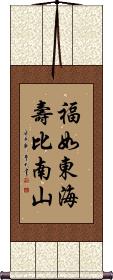
福如東海壽比南山 is a phrase that means “May you have good fortune as great as the eastern oceans, and may your life last as long as the southern mountains.”
In ancient Chinese mythology, the eastern oceans and southern mountains are where God resides (basically it is the same as saying “heaven”). So it's like saying, “May your good fortune and life be as vast as the heavens.”
There is also a longer, 14-character version of this phrase. Also, this can be cut into two scrolls (with half the phrase on each side - great for hanging on either side of a doorway). Just let me know if you'd like a special version (there is an additional cost).
Smooth Sailing
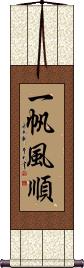
一帆風順 is just what you think it means. It suggests that you are on a trouble-free voyage through life, or literally on a sailing ship or sailboat. It is often used in China as a wish for good luck on a voyage or as you set out on a new quest or career in your life. Some may use this in place of “bon voyage.”
The literal meaning is “Once you raise your sail, you will get the wind you need, and it will take you where you want to go.” Another way to translate it is “Your sail and the wind follow your will.”
This is a great gift for a mariner, sailor, adventurer, or someone starting a new career.
Note: Can be understood in Korean Hanja but is rarely used.
See Also: Bon Voyage | Adventure | Traveler / Wanderer / Vagabond / Rolling Stone
Tranquility Yields Transcendence
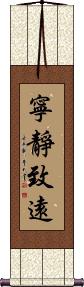
寧靜致遠 is an ancient Chinese idiom that means “tranquility yields transcendence.”
This suggests pursuing a quiet life of profound study.
The first two characters mean tranquility. The last two characters mean “go far,” which suggests achieving much in your life or expanding beyond normal limits. The direct translation would read something like, “[With] tranquility [in your life, you'll] go far.”
Compare this to the English idiom: Still waters run deep.
Year-In Year-Out Have Abundance
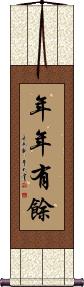
年年有餘 is a common proverb or wish of prosperity you'll hear around the time of Chinese New Year.
Directly translated character by character, it means “Year Year Have Surplus.” A more natural English translation including the deeper meaning would be “Every Year may you Have Abundance in your life.”
On a side note, this phrase often goes with a gift of something related to fish. This is because the last character, “yu” which means surplus or abundance, has exactly the same pronunciation in Mandarin as the word for “fish.”
This is also one of the most common titles for traditional paintings that feature koi fish.
In China, this phrase might make an odd wall scroll - a customer asked especially for this common phrase which is why it appears here. See my other abundance-related words if you want a wall scroll that will seem more comfortable in Chinese culture.
Note: This can be pronounced in Korean, but it's not a commonly used term.
See Also: Prosperity | House of Good Fortune
Beautiful Life / Life in Perfect Harmony
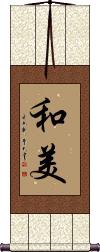
和美 is a word that means “harmonious” or, “in perfect harmony.”
The deeper meaning or more natural translation would be something like, “beautiful life.”
The first character means peace and harmony.
The second character means beautiful. But in this case, when combined with the first character, beautiful refers to being satisfied with what you have in your life. This can be having good relations, good feelings, comfort, and having enough (with no feeling of wanting).
Note: In Japanese, this is often used as the name “Wami.” This title is probably more appropriate if your audience is Chinese.
Bonsai / Penzai
Dwarf Tree Culture
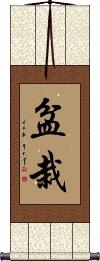
盆栽 is the word that refers to the culture, hobby, and to miniature trees themselves that have become popular around the world.
Like many things, this art migrated from China to Japan some time ago, but we tend to associate it with Japanese culture and even use the Japanese word in English.
Granted, in the present day, this hobby seems to be more popular in Japan but still has a great following in China and even a little in Korea as well.
Note: Many people confuse the title of the bonsai tree with “banzai” which is a form of “hooray” in Japanese. I have also seen it misspelled as “bansai.” The correct Romanization (Romaji) is “bonsai.”
Buddha Heart / Mind of Buddha
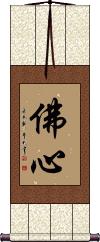
佛心 means the Buddha's mind, Buddha-heart, or the spiritually enlightened heart/mind.
The Buddha Heart is detached from good and evil and other such constructs. The Buddha Heart has mercy, compassion, and loving-kindness for all sentient life, the good, the wicked, and all in between.
The heart and mind (心) are the same concepts in the ancient Orient, so you can use heart and mind interchangeably in this context.
Destiny / Fate
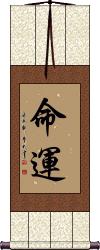
These two characters contain the ideas of fate, destiny, fortune, and luck.
You can also say that it means “what life throws at you” or “your lot in life” because the first character contains the idea of life or living.
This version is really only used in Chinese. There's another version with just the characters reversed that is more universal. In fact, skip this one. The opposite character order is better.
Eternal Life / Future Life
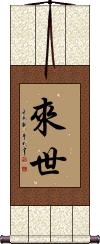
來世 is a word that can be used in many different ways.
It is often used to express the next life (life in heaven or wherever your soul is bound for). So it does have a religious overtone. However, it can also be used to express your life in the future - perhaps during your present lifetime.
It can also be translated as “the next world,” “the next generation,” “the time that is to come,” “otherworld,” or simply “posterity.”
See Also: From Here to Eternity | Samsara / Endless Cycle of Rebirth | Reincarnation / Life in Flux | the Key to Immortality is First Living a Life Worth Remembering
Four Noble Truths: Suffering
Dukkha
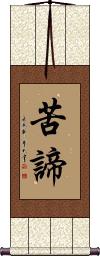
苦諦 relays that part of life in this universe is suffering.
All living things experience some form of suffering, according to Buddhist teaching.
This title is about accepting and understanding that the world is full of suffering.
This term is exclusively used by devout Buddhists. It is not a common term, and is remains an unknown concept to most Chinese, Japanese, and Korean people.
See Also: Buddhism | Enlightenment
Guan Shi Yin: Protector Of Life
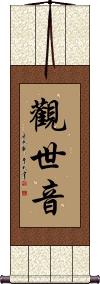
觀世音 is an alternate title for Guanyin, the Bodhisattva of Compassion or Goddess of Mercy.
觀世音 is the Buddhist bestower of children, the protector of life and all in distress (especially of those at sea).
Kindness / Caring
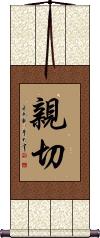
親切 is a Chinese/Japanese/Korean word that can also mean affectionate, cordial, warm, or close (emotionally).
Kindness shows you care and are doing some good to make life better for others. Be thoughtful about people's needs. Show love and compassion to someone who is sad or needs your help. When you are tempted to be cruel, to criticize or tease, decide to be kind instead.
See Also: Love | Caring | Benevolence
Life in Harmony / Balanced Life
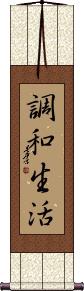
調和生活 is a Japanese title that suggests that you have, or want to get your life in balance.
The first two Kanji mean harmonious or in harmony.
The second two Kanji mean “life.” More specifically this refers to your livelihood, career, and the daily activities that comprise your life or living.
Living / Live Life
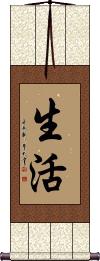
生活 means life, living, to live, or the state of being alive. It can also refer to your daily existence or livelihood. It can also be a suggestion to just “Live life.”
生活 is also the term used in other titles such as “healthy living” or Lance Armstrong's “Livestrong” campaign (Chinese title for Livestrong only).
If you need a reminder that you are alive and to take a breath, this might be the perfect wall scroll for you.
Live For The Day
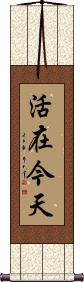
活在今天 is not an eastern concept, so it does not translate into a phrase that seems natural on a wall scroll.
However, if this is your philosophy, the characters shown here do capture your idea of living for today or living in the moment. 活在今天 says “Live in today,” and they are grammatically correct in Chinese.
Note: This kind of makes sense in Korean Hanja but the grammar is Chinese, so it’s not that natural in Korean.
Live Love Die
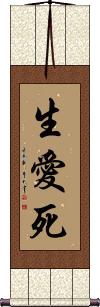
This came from a customer's request, but it's not too bad.
These three simple characters suggest that you are born, you learn to love, and then exit the world.
Live Without Regret
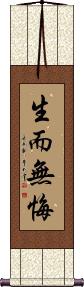
生而無悔 is how to say “live without regrets” in Mandarin Chinese.
Note: There is some debate about whether this makes sense in Japanese. It would be read, “nama ji mu ke,” and be understood in Japanese. But, a Japanese person will probably think it’s Chinese (not Japanese).
See Also: Live for the Day
Live Without Regret
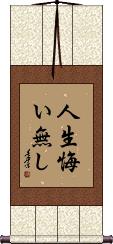
人生悔い無し is how to say “live without regrets” in Japanese.
Note: Because this selection contains some special Japanese Hiragana characters, it should be written by a Japanese calligrapher.
See Also: Live for the Day
Live Strong
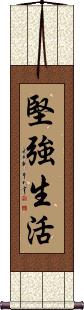
While hard to translate directly, 堅強生活 is the best way to write “Live Strong” in Chinese. If you are a cancer survivor or support Lance Armstrong's ideas, this is a nice selection for a wall scroll.
The first two characters mean strong or staunch. The last two mean living or life (daily existence). While the Chinese version is the reverse order of “Live Strong” it is the only way to write it in a natural form that is grammatically correct.
Note that we are in no way affiliated or connected to Lance or his foundation. This translation is offered because of multiple requests from customers whose philosophies or ideas match those of the Live Strong idea.
Longevity / Long Life
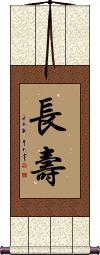
Used as a noun, This means “longevity” or “the ability to live long.”
It can also be an adjective meaning “long-lived.”
Please note that Japanese use a simplified version of the second character of longevity - it also happens to be the same simplification used in mainland China. Click on the character to the right if you want the Japanese/Simplified version of this two-character longevity calligraphy.
The Middle Way
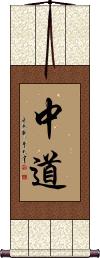
In the most basic translation, 中道 means road through the middle or middle road.
The expanded meaning can be moderation or the golden mean.
But if you are looking for this title, you are probably seeking the Buddhist definition, which is more complex.
中道 is the middle way or middle path of Buddhism. This has various interpretations. In general, it denotes the mean between two extremes and has special reference to the mean between realism and nihilism, or eternal substantial existence and annihilation.
The Buddha teaches that one should not take things to extremes. Don't be extremely evil and engage in debauchery and murder. But do not spend every waking out trying to be a perfect saint. Instead, take the middle path, try to help others, show loving kindness wherever you can, and try not to do harm. If you inadvertently harm another being, make amends if you can, and move on. Realize you are not perfect, but in time, a path of moderation lead toward proper living and enlightenment.
Musashi
The most famous Samurai
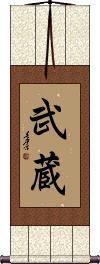
Miyamoto Musashi is probably the most famous Samurai in all of Japanese history.
武蔵 is the short title for a man long in legend. While coming from a lower class, his new sword and fighting techniques put him on par with the best that feudal Japan had to offer. His long career started with his first duel at age 13!
He is credited with using two swords at once and never losing a single battle in his career. After becoming a Buddhist, and getting older, like many old warriors, he took up a peaceful and solitary life until his death around 1645 A.D.
Note: Technically, Musashi is his given name, and Miyamoto is his surname. However, it's suggested that he assumed both of these names and had a few other names in childhood, as well as being given a Buddhist name. It's hard to know what to call him, as with most Kanji, there are multiple pronunciations. The characters for Musashi can also be pronounced Takezō. But everyone in modern times seems to know him by the name Musashi.
New Beginning
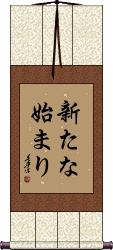
新たな始まり is a Japanese word that means “new beginning” or “new start.”
Here's the character breakdown:
新た (arata) = new; fresh; novel; newly; freshly; or this can be like the prefix “re-” like “re-start” or “reset.”
な (na) is kind of a connecting article. This glues “new” to “beginning.”
始まり (hajimari) = origin; beginning.
Note: Because this selection contains some special Japanese Hiragana characters, it should be written by a Japanese calligrapher.
No Regrets
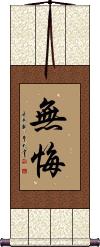
無悔 is how to say “no regrets” in Mandarin Chinese.
This also makes sense in Japanese, though not the most common way to express “no regrets” in Japanese.
See Also: Live for the Day
One who walks by the river may end up with wet feet
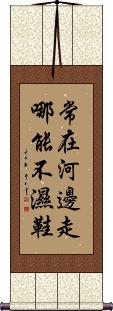
常在河邊走哪能不濕鞋 is an old Chinese proverb that is sometimes compared to the English saying “Shit Happens.”
It's a reflection that there are risks in life, and you should not be surprised when things don't go your way.
A secondary translation might be, “When walking by a river, often one cannot avoid wet shoes.”
The Red Thread of Fate
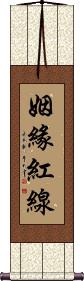
姻緣紅線 is the legendary red string of destiny that binds all soul mates or lovers together.
In ancient Chinese culture, a mythological matchmaker named 月老 (Yuè Lǎo) was the controller of the fate that led lovers to meet. He did this by tying a celestial red string to the ankle of each person. Sometime during their life, they will meet and marry as fate dictates.
While the origin of the red string comes from China, it has spread to other parts of Asia (such as Japan, where it's known as 赤い糸).
Respected Teacher
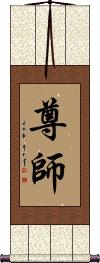
尊師 means “respected teacher,” “revered master,” or “guru” in Japanese and Chinese.
尊師 is a nice gift for a revered teacher in your life whose knowledge and mentoring have meant a lot to you.
Sword of Death
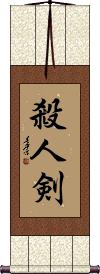
殺人剣 is a Japanese title for “Death Sword,” “Life Taking Sword,” or “satsujinken.”
This is the opposite of katsujinken or the “life-saving sword.” This title is not as commonly used in Japanese but pairs well when hung with katsujinken.
The first two Kanji are a word that translates as homicide, murder or kill (a person). 殺人剣 is specifically to kill a person (as the second character means person or human) as opposed to an animal, etc.
The last Kanji is the Japanese variant of the originally-Chinese character for a sword.
See Also: Bujinkan
Always Striving for Inner Strength
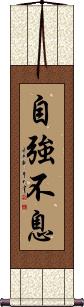
自強不息 is a proverb or idiom that suggests that the pursuit of self-improvement is eternal. It can also be a suggestion to strive unremittingly in life.
The first two characters mean inner strength with the idea of self-improvement. The last two characters mean “never rest” or “striving without giving up.”
Some will translate these four characters as “Exert and strive hard without any let-up.”
Tanjun / Simplicity
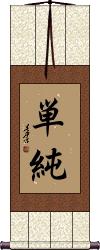
単純 or Tanjun is a Japanese word that means simplicity, simple, and/or uncomplicated.
Do you want to live the “tanjun lifestyle”? Maybe this wall scroll will remind you to uncomplicate your life.
Together Forever in Love
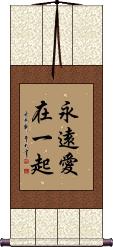
永遠愛在一起 is “together forever in love” in Chinese.
It's a nice phrase if you're a couple who plans to stay together and make your love last as long as you live.
Trust / To Have Faith
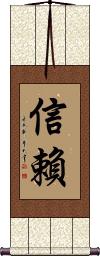
信賴 can also be translated as confidence, reliance, or dependence; thus, it can also mean “to rely on” or “to depend on.”
Trust is having faith in someone or something. It is a positive attitude about life. You are confident that the right thing will happen without trying to control or make it happen. Even when difficult things happen, trust helps us to find the gift or lesson in it.
 There is a slight deviation in the Japanese Kanji form of the second character. If you want the modern Japanese version, please click on the special Kanji shown to the right instead of the button above. Note that the traditional Chinese form is still readable and understood by Japanese people.
See Also: Self-Confidence | Truth | Honor
Stay Strong / Iron Will
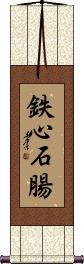
鉄心石腸 is a Japanese proverb that suggests you should have the inner-strength and will as hard and steadfast as iron.
It's the Japanese way of saying, “stay strong.” This is an especially uplifting thing to say to a person in distress or recovering from a disaster. It's kind of the survivor's creed.
If you literally translate this, it means “iron will, stone guts” or “iron heart, rock-hard bowels.”
3. Right Speech / Right Talk / Perfect Speech
Samyag Vaca / Samma Vaca / Samma Vacha
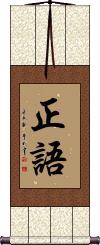
正語 is one of the Noble Eightfold Paths of Buddhism. Right Speech, along with Right Action and Right Living, constitute the path to Virtue.
Right Speech is abstaining from lying, abstaining from divisive speech, abstaining from abusive speech, abstaining from idle chatter, abstaining from slander, abstaining from gossip, or any form of harmful or wrong speech.
This term is exclusively used by devout Buddhists. It is not a common term, and remains an unknown concept to most Japanese and Chinese people.
See Also: Buddhism | Enlightenment | Noble Eightfold Path
5. Right Living / Right Livelihood / Perfect Livelihood
Samyag Ajiva / Samma Ajiva
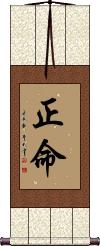
正命 (right living) is one of the Noble Eightfold Paths of Buddhism.
Right Living, along with Right Speech and Right Action, constitute the path to Virtue.
Right Living means that a Buddhist should only take a job or pursue a career in a field that does no harm. Buddhists should not work in the arms trade, as pimps or in the field of prostitution, as a butcher or in a shop that kills or sells meat, in a laboratory that does animal research, or in any other business that involves scheming or unethical behavior.
Another definition: Avoidance of professions that are harmful to sentient beings, such as slaughterer, hunter, dealer in weaponry or narcotics, etc.
This term is exclusively used by devout Buddhists. It is not a common term, and remains an unknown concept to most Japanese and Chinese people.
See Also: Buddhism | Enlightenment | Noble Eightfold Path
Banzai / Wansui
Old Japanese / Traditional Chinese & Korean
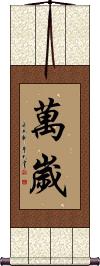
萬歲 is the traditional Chinese, Korean Hanja, and ancient Japanese way of writing banzai.
In modern times, the first character was simplified in Japan and China. So you might want to select the other entry for universal readability.
While it has become a popular, if not an odd, thing to scream as you jump out of an airplane (preferably with a parachute attached), banzai is actually a very old Asian way to say “hooray.” The Japanese word “banzai” comes from the Chinese word “wan sui,” which means “The age of 10,000 years.” It is actually a wish that the Emperor or the Empire live that long.
Imagine long ago when the Emperor made a rare public appearance. 萬歲 is what all people would yell to their leader in respect.
So if you like it as a hooray, or you want to wish someone that they live for 10,000 years, this is the calligraphy for you.
Other translations include Cheers! (not the drinking kind), hurrah!, long live [name]!, and congratulations!
To other things with banzai in their names, I am still waiting for the promised sequel to Buckaroo Banzai.
Notes: Sometimes people confuse banzai with bonsai. A bonsai is a miniature tree. They have nothing to do with each other.
Blessings on this Home
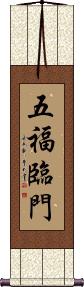
五福臨門 means “five good fortunes arrive [at the] door.”
It is understood to mean “may the five blessings descend upon this home.”
These blessings are known in ancient China to be: longevity, wealth, health, virtue, and natural death (living to old age). This is one of several auspicious sayings you might hear during the Chinese New Year.
Body and Earth in Unity
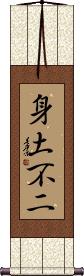
身土不二 (Shindofuni) is originally a Buddhist concept or proverb referring to the inseparability of body-mind and geographical circumstances.
This reads, “Body [and] earth [are] not two.”
Other translations or matching ideas include:
Body and land are one.
Body and earth cannot be separated.
Body earth sensory curation.
You are what you eat.
Indivisibility of the body and the land (because the body is made from food and food is made from the land).
Going further, this speaks of our human bodies and the land from which we get our food being closely connected. This phrase is often used when talking about natural and organic vegetables coming directly from the farm to provide the healthiest foods in Japan.
Character notes: 身(shin) in this context does not just mean your physical body but a concept including both body and mind.
土 (do) refers to the soil, earth, clay, land, or in some cases, locality. It's not the proper name of Earth, the planet. However, it can refer to the land or realm we live in.
Japanese note: This has been used in Japan, on and off, since 1907 as a slogan for a governmental healthy eating campaign (usually pronounced as shindofuji instead of the original shindofuni in this context). It may have been hijacked from Buddhism for this propaganda purpose, but at least this is “healthy propaganda.”
Korean note: The phrase 身土不二 was in use by 1610 A.D. in Korea, where it can be found in an early medical journal.
In modern South Korea, it's written in Hangul as 신토불이. Korea used Chinese characters (same source as Japanese Kanji) as their only written standard form of the language until about a hundred years ago. Therefore, many Koreans will recognize this as a native phrase and concept.
See Also: Strength and Love in Unity
Choose Life
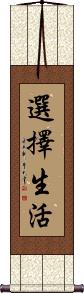
選擇生活 can mean to choose life instead of death (or suicide) or to choose to live life to the fullest.
I think of it as the key phrase used by Renton (Ewan McGregor) in the movie Trainspotting. While Chinese people will not think of Trainspotting when they see this phrase, for me, it will always be what comes near the end of this colorful rant:
Choose life. Choose a job. Choose a career. Choose a family. Choose a fucking big television. Choose washing machines, cars, compact disc players, and electrical tin can openers. Choose good health, low cholesterol, and dental insurance. Choose fixed-interest mortgage repayments. Choose a starter home. Choose your friends. Choose leisure wear and matching luggage. Choose a three-piece suite on-hire purchase in a range of fucking fabrics. Choose DIY and wondering who the fuck you are on a Sunday morning. Choose sitting on that couch watching mind-numbing, spirit-crushing game shows, stuffing fucking junk food into your mouth. Choose rotting away at the end of it all, pissing your last in a miserable home, nothing more than an embarrassment to the selfish, fucked-up brats you have spawned to replace yourself. Choose your future. Choose life.
Die Without Regret
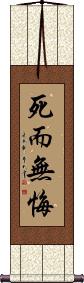
死而無悔 is how to say “die with no regrets” in Mandarin Chinese.
This proverb comes from the Analects of Confucius.
See Also: No Regrets
Doctor
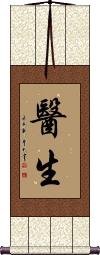
醫生 is the title used to refer to medical doctors or physicians in China.
Note: Sometimes, this same term is used in Korean, but not common.
The meaning is close to “healer [of] life” as the first character, 醫, can mean medicine, the healing art, healing, curing, medical, to cure, or to treat. The second character, 生, means birth or life.

 In Japan, they use a simplified version of the first character (医生 is also used as the Simplified Chinese version of Doctor). If you want this version, please click the characters to the right instead of the button above.
Earth
(Used in Japanese version of five elements)
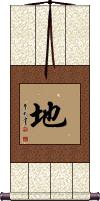
地 is the single-character element and title of the planet Earth in Chinese, old Korean Hanja, and Japanese Kanji.
Because this is a single character, the definition is a little ambiguous and can have many meanings depending on the context in which it is used. These meanings include: earth, ground, land, soil, dirt, place, territory, bottom (of a package, book, etc.), earth (one of the Japanese five elements), the region in question, the local area, skin, texture, fabric, material, weave, base, background, one's true nature, narrative (i.e. descriptive part of a story), real life, actuality, etc.
In Japanese, this Kanji can be pronounced several ways, including chi, ji, tsushi, or tsuchi.
地 is also an element of the Japanese version of the five elements (the original Chinese version uses a different version of earth).
See Also: Five Elements | Chinese Traditional Medicine
Eat Drink and Be Merry
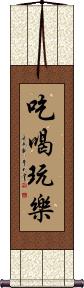
吃喝玩樂 is the short version of, “Eat, drink, and be merry.”
This is a Chinese proverb that suggests abandoning oneself to a life of pleasure.
Eternal Life / Everlasting Life / Immortality
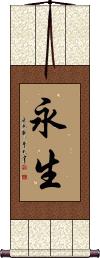
永生 are the last two words from John 3:16 in the Chinese Union Bible.
Although not specifically Christian, this is the way to express ever-lasting life or eternal life in Chinese.
In Japanese, this can either mean eternal life or immortality.
See Also: From Here to Eternity | Samsara / Endless Cycle of Rebirth | Reincarnation / Life in Flux | the Key to Immortality is First Living a Life Worth Remembering
Eternal / Eternity
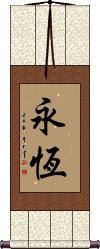
永恆 is the Chinese word for eternity.
The first character means always, forever, and perpetual. The second character holds the meaning of permanent. Together, they create a word that means eternal, eternally, or infinite time.
See Also: The Key to Immortality is First Living a Life Worth Remembering
This in-stock artwork might be what you are looking for, and ships right away...