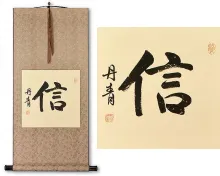
Buy a Believe Chinese or Japanese Calligraphy Wall Scroll
We have many options to create artwork with the Chinese characters / Asian symbols / Japanese Kanji for Believe on a wall scroll or portrait.
Switched to secondary search mode due to lack of results using primary.
These secondary results may not be very accurate. Try a different but similar meaning word or phrase for better results. Or:
Look up in my Japanese Kanji & Chinese Character Dictionary(My dictionary is a different system then the calligraphy search you just tried)
If you want a special phrase, word, title, name, or proverb, feel free to contact me, and I will translate your custom calligraphy idea for you.
4. Passionate Love / Ardent Love and Devotion
5. Art of War: 5 Points of Analysis
7. Believe
10. Believer
11. Chastity
12. Christian Friend
14. Commitment
15. Confidence / Faithful Heart
16. The Five Tenets of Confucius
17. Dana: Almsgiving and Generosity
18. Dedication
19. Dependable
20. Devotion / Dedication / Attentive / Focused
21. Devotion / Diligence / Vigorous / Energetic
22. Devotion to your Profession / Career
23. Religious Devotion / Faith in God / Religious Faith
24. Diligence
25. Dogen
26. Eishin-Ryu
27. Enthusiasm
28. Everything Happens for a Reason
30. Faith / Trusting in the Unseen
31. Faith is the bird that feels the light when the dawn is still dark
32. Faith Hope Love
33. Faith Love Peace
34. Faith
35. Faithfulness
36. Faithlyn
37. Fate / Opportunity / Chance
38. Fidelity / Personal Integrity / Honor
40. Forgive
44. Goldfish
45. Good Intentions / Good Will / Good Faith
46. Guan Yu
47. Faithful / Honorable / Trustworthy / Fidelity / Loyalty
48. Honesty
51. Hope
52. Integrity
53. Integrity: Sincere Honest and Faithful
54. John 3:16
55. Joshua 24:15
56. Tang Soo Do / Tang Hand Way
57. Karma
59. Firm Belief / Strong Faith
60. Resolute Mind
61. Lei
62. Journey of Life
65. Loyalty
67. Loyalty / Faithful / Devoted
68. Mercy / Compassion / Buddhist Loving Kindness
69. Namu Amida Butsu
70. Nichiren
71. There is no god but Allah, and Muhammad is His Messenger
72. Nothingness
73. One Heart / One Mind / Heart and Soul
76. Enthusiasm / Passion for a Cause
77. Patience / Perseverance / To Endure / Tolerant
79. Pure Land / Jodo
80. Sacrifice / Devotion / Dedication
81. Sangha
82. Self-Confidence
83. Semper Fidelis / Always Faithful
85. Shaolin Temple
86. Faith Dojo
88. Sincerity and Faithfulness
89. Soul Mates
1 Corinthians 13:4-8
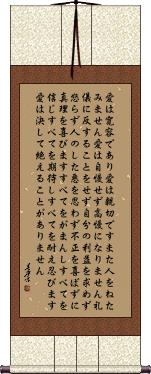
Here is 1st Corinthians 13:4-8 (just the first sentence of verse 8) in Japanese.
In the familiar NIV, this would read:
Love is patient, love is kind. It does not envy, it does not boast, it is not proud.
It does not dishonor others, it is not self-seeking, it is not easily angered, it keeps no record of wrongs.
Love does not delight in evil but rejoices with the truth.
It always protects, always trusts, always hopes, always perseveres.
Love never fails...
The Japanese text is from the 新改訳聖書 (Shinkaiyaku) or New Japanese Bible. Popular among most Protestant denominations in modern Japan.
Note: Because this selection contains some special Japanese Hiragana characters, it should be written by a Japanese calligrapher.
1 Corinthians 14:22
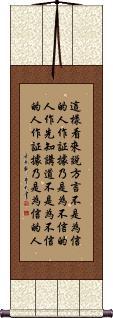
Here is 1 Corinthians 14:22 in Chinese.
The text with punctuation:
这样看来,说方言,不是为信的人作证据,乃是为不信的人。作先知讲道,不是为不信的人作证据,乃是为信的人。
Hand-painted calligraphy does not retain punctuation.
This translation is from the Chinese Union Bible.
You may know it from the KJV as:
Wherefore tongues are for a sign, not to them that believe, but to them that believe not: but prophesying serveth not for them that believe not, but for them which believe.
Five Codes of Tang Soo Do
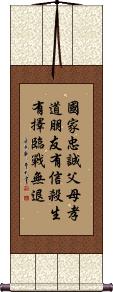
国家忠诚父母孝道朋友有信杀生有择临战无退 are the five codes of Tang Soo Do.
I suggest you have this arranged in five columns when you get to the options page for your custom calligraphy wall scroll.
Here are my translations of each of the five codes:
國家忠誠 Be loyal to your country.
父母孝道 Regarding parents, behave in a filial way.
朋友有信 Be faithful in friendship.
殺生有擇 When fighting for life and death, make noble choices.
臨戰無退 No retreat in battle.
Note: “Tang Soo Do” is a romanization of 唐手道. It's 당수도 in Korean Hangul. It can also be romanized as “Tangsudo” or “Dangsudo.”
Passionate Love / Ardent Love and Devotion
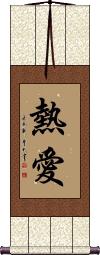
熱愛 means love passionately, ardent love, devotion, adoration.
The literal meaning is “hot love,” as the first character means heat, fervent, hot, and warm. Sometimes it can mean fever, restlessness, or zeal. The second character is, of course, love. If you adore and are devoted to someone with all your love, this is the title for you.
Art of War: 5 Points of Analysis
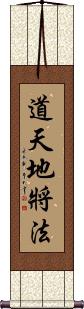
道天地將法 is a list of five key points to analyzing your situation from the first chapter of Sun Tzu's Art of War.
This reads like a 5-part military proverb. Sun Tzu says that to sharpen your skills, you must plan. To plan well, you must know your situation. Therefore, you must consider and discuss the following:
1. Philosophy and Politics: Make sure your way or your policy is agreeable among all of your troops (and the citizens of your kingdom as well). For when your soldiers believe in you and your way, they will follow you to their deaths without hesitation and will not question your orders.
2. Heaven/Sky: Consider climate / weather. This can also mean considering whether God is smiling upon you. In the modern military, this could be waiting for clear skies so that you can have air support for an amphibious landing.
3. Ground/Earth: Consider the terrain in which the battle will take place. This includes analyzing defensible positions, and exit routes, while using varying elevations to your advantage. When you plan an ambush, you must know your terrain and the best location from which to stage that ambush. This knowledge will also help you avoid being ambushed, as you will know where the likely places in which to expect an ambush from your enemy.
4. Leadership: This applies to you as the general and your lieutenants. A leader should be smart and be able to develop good strategies. Leaders should keep their word, and if they break a promise, they should punish themselves as harshly as they would punish subordinates. Leaders should be benevolent to their troops, with almost a fatherly love for them. Leaders must have the ability to make brave and fast decisions. Leaders must have steadfast principles.
5. [Military] Methods: This can also mean laws, rules, principles, models, or systems. You must have an efficient organization in place to manage both your troops and supplies. In the modern military, this would be a combination of how your unit is organized and your SOP (Standard Operating Procedure).
Notes: This is a simplistic translation and explanation. Much more is suggested in the actual text of the Art of War (Bing Fa). It would take many study to master all of these aspects. In fact, these five characters can be compared to the modern military acronyms such as BAMCIS or SMEAC.
CJK notes: I have included the Japanese and Korean pronunciations but in Chinese, Korean and Japanese, this does not make a typical phrase (with subject, verb, and object) it is a list that only someone familiar with Sun Tzu’s writings would understand.
Belief / Trust
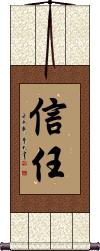
信任 means belief or trust in Chinese characters, old Korean Hanja, and Japanese Kanji.
It can also mean having confidence in or credence.
Believe
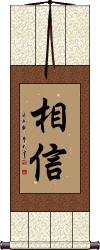
相信 is the Chinese way to say believe.
This specifically means to be convinced that something is true or to accept something as true or real.
This can also be translated as “convinced of,” “have trust in,” or “have faith in.”
Believe / Faith / Trust
śraddhā
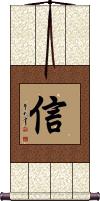
信 can mean to believe, truth, faith, fidelity, sincerity, trust, and confidence in Chinese, old Korean Hanja, and Japanese Kanji.
This single character is often part of other words with similar meanings.
It is one of the five basic tenets of Confucius.
In Chinese, it sometimes has the secondary meaning of a letter (as in the mail) depending on context but it will not be read that way when seen on a wall scroll.
In the Buddhist context, this is śraddhā (faith through hearing or being taught).
See Also: Faith | Trust Your Heart | Confucius
Believe in Yourself

相信自己 means “believe in yourself” in Chinese.
Believe in Yourself
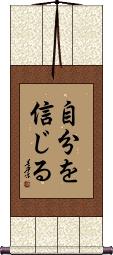
自分を信じる means “believe in yourself,” “have faith in yourself,” or “believe in myself” (can be myself or yourself depending on if you're saying it to yourself or someone else).
Note: Because this selection contains some special Japanese Hiragana characters, it should be written by a Japanese calligrapher.
Believer
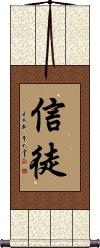
信徒 is the Chinese, Japanese Kanji, and old Korean Hanja word for “believer.”
Just as in English, this word can be used for a follower of virtually any religion.
This word can also be translated into English as layman, adherent, follower, laity, disciple, or devotee.
Chastity
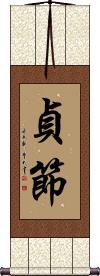
In Chinese, 貞節 would be defined as “The state of being sexually pure” or “chaste.”
Culturally, this especially applies to young women. 貞節 is not actually far off from our western view on this subject. In Japanese and Korean, this could also be used to express virtue, faithfulness, and fidelity.
See Also: Modesty
Christian Friend
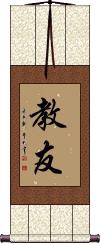
Depending on the context, 教友 can mean Christian or “friend of the same religion.”
While technically, it could be any religion, this is used mainly within the Christian faith. You can also translate this as “Christian friend” and, in some cases, “Church member.”
Christianity / Christian
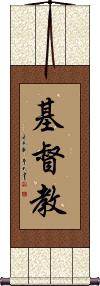
基督教 is the Chinese, Japanese, and Korean word for “Christianity.”
Just as in English, this word is often used to mean “Protestant” but includes Catholics in the true definition.
It is the word used to refer to the whole “Christian religion” or “Christian Faith,” and therefore, it can mean “Christianity.” However, used as an adjective in regard to a person, it would translate as “Christian.” But more like saying, “His religion is Christianity,” rather than a noun form.
If you break it apart, the characters mean Base/Foundation Leading/Supervising Religion/Teaching. It makes more sense in Japanese, Chinese, and Korean. The first two characters together are translated as “Christ.” So you can also say this means “Christ's Religion” or “Christ's Teachings” when directly translated, or in reverse, “The Religion of Christ” or “The Teaching of Christ.”
Notes: The last character has a slight difference in one stroke - however, in calligraphic form, this will not be apparent. This entry can easily be read by any Korean person who knows Hanja characters (Chinese characters used in Korean).
See Also: Jesus Christ | God of Zion / God of Abraham
Commitment
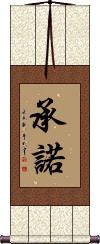
承諾 embodies the idea of commitment but also means to make a big effort or to undertake a great task.
Commitment is caring deeply about something or someone. It is deciding carefully what you want to do and then giving it 100%, holding nothing back. You give your all to a friendship, a task, or something you believe in. You finish what you start. You keep your promises.
In Chinese, this word directly means to undertake something or to make a promise to do something.
Outside of the commitment idea, this particular word can also mean approval, acceptance, consent, assent, acquiescence, or agreement, depending on context (especially in Japanese and Korean). Therefore, this word is probably best if your audience is Chinese.
See Also: Partnership: Marriage | Hard Work | Dedication
Confidence / Faithful Heart
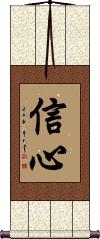
信心 is a Chinese, Japanese, and Korean word that means confidence, faith, or belief in somebody or something.
The first character means faith, and the second can mean heart or soul. Therefore, you could say this means “faithful heart” or “faithful soul.”
In Korean especially, this word has a religious connotation.
In the old Japanese Buddhist context, this was a word for citta-prasāda (clear or pure heart-mind).
In modern Japan (when read by non-Buddhists), this word is usually understood as “faith,” “belief,” or “devotion.”
See Also: Self-Confidence
The Five Tenets of Confucius
The Five Cardinal Rules / Virtues of Confucius
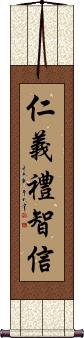
仁義禮智信 are the core of Confucius's philosophy.
Simply stated:
仁 = Benevolence / Charity
義 = Justice / Rectitude
禮 = Courtesy / Politeness / Tact
智 = Wisdom / Knowledge
信 = Fidelity / Trust / Sincerity
Many of these concepts can be found in various religious teachings. It should be clearly understood that Confucianism is not a religion but should instead be considered a moral code for a proper and civilized society.
This title is also labeled “5 Confucian virtues.”
 If you order this from the Japanese calligrapher, expect the middle Kanji to be written in a more simple form (as seen to the right). This can also be romanized as “jin gi rei satoshi shin” in Japanese. Not all Japanese will recognize this as Confucian tenets but they will know all the meanings of the characters.
See Also: Tea | Martial Morality / Martial Arts Ethics / Virtue
Dana: Almsgiving and Generosity
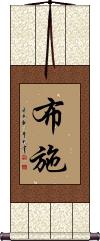
布施 is the Buddhist practice of giving known as Dāna or दान from Pali and Sanskrit.
Depending on the context, this can be alms-giving, acts of charity, or offerings (usually money) to a priest for reading sutras or teachings.
Some will put Dāna in these two categories:
1. The pure or unsullied charity, which looks for no reward here but only in the hereafter.
2. The sullied almsgiving whose object is personal benefit.
The first kind is, of course, the kind that a liberated or enlightened person will pursue.
Others will put Dāna in these categories:
1. Worldly or material gifts.
2. Unworldly or spiritual gifts.
You can also separate Dāna into these three kinds:
1. 財布施 Goods such as money, food, or material items.
2. 法布施 Dharma, as an act to teach or bestow the Buddhist doctrine onto others.
3. 無畏布施 Courage, as an act of facing fear to save someone or when standing up for someone or standing up for righteousness.
The philosophies and categorization of Dāna will vary among various monks, temples, and sects of Buddhism.
Breaking down the characters separately:
布 (sometimes written 佈) means to spread out or announce, but also means cloth. In ancient times, cloth or robs were given to the Buddhist monks annually as a gift of alms - I need to do more research, but I believe there is a relationship here.
施 means to grant, to give, to bestow, to act, to carry out, and by itself can mean Dāna as a single character.
Dāna can also be expressed as 檀那 (pronounced “tán nà” in Mandarin and dan-na or だんな in Japanese). 檀那 is a transliteration of Dāna. However, it has colloquially come to mean some unsavory or unrelated things in Japanese. So, I think 布施 is better for calligraphy on your wall to remind you to practice Dāna daily (or whenever possible).
Dedication
Dedicated to One Thing
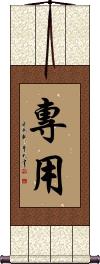
專用 is the dedication you might have to your job or a person.
Trivia: It is the same word used as an adjective in front of the word for “network” to say “dedicated network” in Chinese.
Please note: While this is a word in Korean, the meaning is private or “exclusive use.” So this is best if your audience is Chinese.
See Also: Sincerity and Devotion | Passions / Feelings / Emotions | Tenacious / Tenacity | Commitment
Dedication
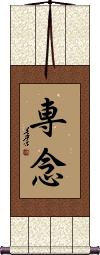
専念 is the Japanese word for dedication.
It means “give undivided attention” or “devote oneself to (something).”
Note: This can be pronounced in Korean, but it's not a commonly used term.
See Also: Sincerity and Devotion | Passions / Feelings / Emotions | Tenacious / Tenacity | Commitment
Dependable
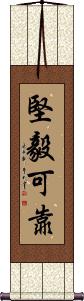
The first two characters mean resolute with firm determination.
The second two characters mean reliable.
Together, this creates a 4-character expression that means dependable.
Devotion / Dedication / Attentive / Focused
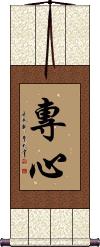
專心 makes a word that means “paying attention with your heart.”
It's often translated as “dedication,” as in “be absorbed in” or “concentrate one's efforts.” It's also used to mean “with the single mind,” “whole-heartedly,” “paying attention,” “undivided attention,” “concentration (-ed),” “engrossed,” “devotionally (listening/watching),” and/or “attentive.”
The first character means “for a particular person, occasion, or purpose,” “focused on one single thing,” “concentrated,” and sometimes, “special.”
The second character means “heart” or “mind” by itself.
My favorite translation, which comes from the Oxford Advanced Chinese/English Dictionary, is, “wholehearted devotion.”
If it seems like the meaning of this word is quite open, you are correct. The context in which the word is used matters a lot. It can mean different things depending on how you use it. This makes it useful as you can decide what this means to you (within some limits). This is always positive in meaning, so even if a Chinese person reads it differently than you, it will still have a good meaning.
 In Japanese, they tend to use a variation of the second character which has one less stroke. If you want your calligraphy written this Japanese form, please click on the Kanji shown to the right instead of the button above. Note: Japanese and Chinese people will recognize either form.
See Also: Faith | Sincerity and Devotion
Devotion / Diligence / Vigorous / Energetic
vīrya
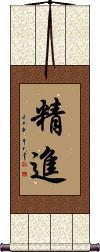
精進 is a wide-ranging word that is used in Chinese, Japanese, and Korean.
It can mean devotion, diligence, concentration, aggressive, enterprising, vigorous, energetic, purification, pushing, asceticism, assiduity, or virility. 精進 is deep, and these two characters can express ideas that take a full English phrase to describe, such as “concentration of mind,” “to forge ahead vigorously,” or “to dedicate oneself to progress.”
Used in the context of Buddhism, it means “making earnest efforts to cultivate virtue and get rid of evil” or “zeal in one's quest for enlightenment.”
Devotion to your Profession / Career
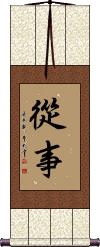
從事/従事 is often used to describe the devotion someone has to their profession - However, it can just mean career, depending on context.
We don't highly recommend this selection for a wall scroll.
In more simple terms, this word also means undertake / to deal with / to handle / to do. It does not have to refer to a career issue, as it could be used to encourage someone that is beginning their university studies etc.
This kind of makes sense in Japanese, however, there is a slight deviation in the way they write the first Kanji in Japanese.
 Please note that Japanese use an alternate version of the first character. Click on the character to the right if you want the Japanese version of this two-character Devotion-to-your-Profession calligraphy.
Religious Devotion / Faith in God / Religious Faith
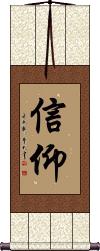
信仰 means firm belief, faith, persuasion, conviction, and sometimes religion or creed in Chinese, Japanese Kanji, and old Korean Hanja.
This clearly fits the religious connotation of the English word “devotion.”
This is often used to refer to a person of faith or a religious person.
This can be directly translated as “firm belief,” “creed,” “conviction,” or simply as “religious,” depending on context.
Some will also use this to mean “trust in God” in Japanese (though the term for God is not actually in this title).
It should be noted that this word is a little strange alone on a wall scroll.
While this can be pronounced in Japanese, it’s not a great selection for a wall scroll if your audience is Japanese.
See Also: Faith | Trust Your Heart | Sincerity and Devotion | Trust in God
Diligence
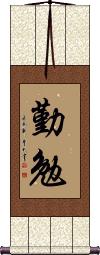
勤勉 can mean diligence, industrious, assiduity, assiduous, diligent, or sedulity.
Diligence is working hard and doing your absolute best. You take special care by doing things step by step. Diligence helps you to get things done with excellence and enthusiasm. Diligence leads to success.
See Also: Hard Work | Tenacious / Tenacity | Commitment | Passion for a Cause
Dogen
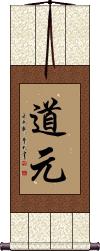
Usually, when people are looking for 道元 or “Dogen,” they are referring to the Japanese Zen monk by this name.
He lived from 1200-1253. This Dogen name or title literally means “The Way Origin” or “Beginning of the Path.” It is understood to mean “beginning of right doctrine or faith” in the context of his name and work to establish the Sōtō school of Zen in Japan.
To accomplish that task, this humble monk traveled from Japan and across China to find the more original or pure forms of Buddhism.
Eishin-Ryu
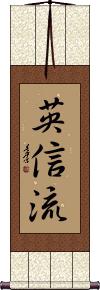
英信流 is the Japanese martial arts term, Eishin-ryu.
This can also be pronounced Hidenobu-ryu. The direct meaning is something like, hero faith school (or school of heroic faith).
Enthusiasm
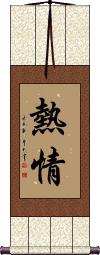
熱情 is a Chinese and Korean word for enthusiasm that can also be translated as passion (for a cause), ardency, ardor/ardour, enthusiasm, or zeal.
Enthusiasm is being warm, cheerful, happy, and full of spirit. It is doing something wholeheartedly and eagerly. When you are enthusiastic, you have a positive attitude.
In some contexts, this could mean being extremely fond of something or having a fondness for a cause or person.
This Chinese word can also be translated as “sincere and warm” or literally “warm sentiment / affection.”
See Also: Motivation | Passions / Feelings / Emotions | Commitment | Tenacious / Tenacity
Everything Happens for a Reason
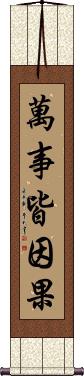
萬事皆因果 means “Everything happens for a reason” in Chinese.
The first two characters mean “all things” or “everything.”
The middle character roughly means “in all cases.”
The last two characters create a complex word that can be defined in many ways, such as “karma,” “cause and effect,” “fate,” and “every cause has its effect, as every effect arises from a cause.”
Keep in mind that Chinese grammar is a bit different than English, so trust me that this makes a natural-sounding proverb in Chinese.
Extreme Faithfulness
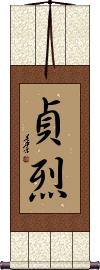
貞烈 is the Japanese Kanji for “Extreme Faithfulness.”
The first Kanji means “firm adherence to one's principles,” chastity (of a woman), chaste, etc.
The second Kanji means ardent, intense, fierce, stern, upright, to give one's life for a noble cause, exploits, achievements, virtuous, and in some contexts, heroic.
Now you get the idea why this refers to someone who is extremely faithful (to a cause, themselves, their religious beliefs, or their philosophy.
Faith / Trusting in the Unseen
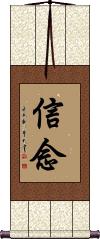
信念 expresses the idea of “having a belief” or “trusting in the unseen.”
信念 could also be translated as beliefs or convictions.
Note: Also considered to be one of the Seven Heavenly Virtues.
See Also: Sincerity and Devotion | Dedication | Trust Your Heart
Faith is the bird that feels the light when the dawn is still dark
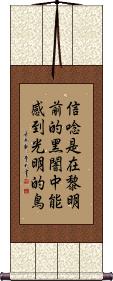
信唸是在黎明前的黑闇中能感到光明的鳥 is a philosophical poem/quote from Indian Poet and Philosopher, Rabindranath Tagore.
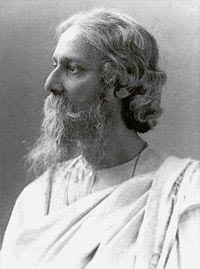
Rabindranath Tagore, 1915
This quote is not sourced, and therefore several variations exist in English. Some suggest the original was in the Bengali language.
This, of course, is the Chinese translation that has the meaning of, “Faith is the bird that feels the light and sings when the dawn is still dark.”
More about Rabindranath Tagore
Faith Hope Love
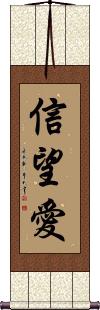
信望愛 is a Chinese list of words meaning faith, hope, and love.
This is not a typical phrase in Chinese but rather just random words strung together. There's no bad meaning, it's just not typical Chinese grammar.
Faith Hope Love
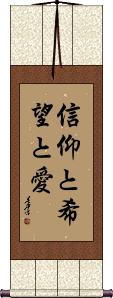
信仰と希望と愛 is a Japanese list of words (not really a phrase) meaning faith, hope, and love.
Some have associated this word list with Corinthians 13:13, though there are no specific religious connotations in this word list, and it's not directly from that Japanese Bible verse.
Note: Because this selection contains some special Japanese Hiragana characters, it should be written by a Japanese calligrapher.
Faith Love Peace
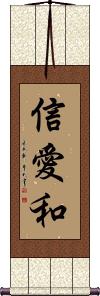
信愛和 is a word list that reads, “Faith Love Peace.”
This is not a natural phrase in Chinese or Japanese, as it lacks a subject, verb, or object. But if this is what you want, here it is.
Faith
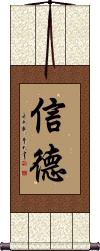
信德 is a term used often in Buddhism to express faith.
信德 is sometimes translated as the merit of the believing heart, faith of virtue, the power of faith, or virtuous faith.
In this context:
信 = Faith
德 = Virtue
Faithfulness
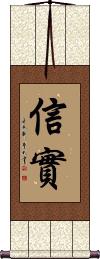
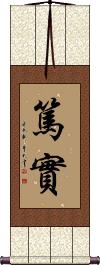
信實 means trustworthy, reliable, to believe something, to be true, and/or to be faithful.
Faithlyn

費斯林 is the name Faithlyn in Chinese (Mandarin).
Faithlyn

フェイスリン is the name Faithlyn in Japanese Katakana.
Note: Because this title is entirely Japanese Katakana, it should be written by a Japanese calligrapher.
Fate / Opportunity / Chance
The Buddhist idea of Fate
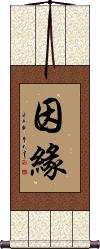
因緣 is the Buddhist concept of a chance meeting or an opportunity that presents itself by fate.
Sometimes this is used to describe a cosmic chain of events or cause and effect.
It also is used to describe predestined relationships between people - and sometimes married couples (although if you want one about marriage, try this: Fate / Destiny of Lovers.
因緣 can also be translated as origin, karma, destiny, affinity, connection, and relation. This all depends on context - seen alone on a wall scroll, this will be read with a “fate/chance” meaning by a Chinese person or a Korean person who can read Hanja.
The more complex definition of this word would be, “Direct causes and indirect conditions, which underlie the actions of all things.”
This concept is known as nidana in the original Sanskrit. Also sometimes presented as hetupratyaya (or “hetu and prataya”), which I believe is Pali.
Note: Japanese will tend to use this version of the second Kanji: 
If you order this from the Japanese master calligrapher, expect that you’ll get this version. However, this word often carries a negative connotation in Japanese (bad things happen), as it is used that way in a certain Japanese idiom. Therefore, this may not be the best choice if Japanese is your target language.
See Also: Buddhism | Opportunity
Fidelity / Personal Integrity / Honor
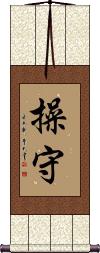
操守 is the Chinese and Japanese Kanji for personal integrity, constancy, fidelity, and honor/honour.
The original meaning of the first character is chastity, fidelity, honor, and/or faith.
The second character means to defend, guard, keep watch, and be observant.
So, this is about being observant of and guarding your integrity and honor.
Fidelity Honor Courage
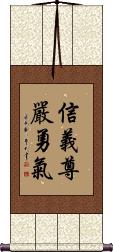
信義尊嚴勇氣 means fidelity, honor, and courage in Chinese.
This is a word list that was requested by a customer. Word lists are not common in Chinese, but we've put this one in the best order/context to make it as natural as possible.
We used the “honor” that leans toward the definition of “dignity” since that seemed the best match for the other two words.
Please note: These are three two-character words. You should choose the single-column format when you get to the options when you order this selection. The two-column option would split one word or be arranged with four characters on one side and two on the other.
Forgive
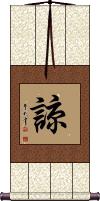
This single character means “forgive” in Chinese.
In Korean, this roughly means forgive but also has slightly different definitions of considering, excuse, faithful or believe.
Fragrant / Good Smell
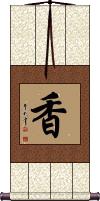
香 is the Chinese, Japanese Kanji, and old Korean Hanja that means: fragrant; sweet smelling; aromatic; savory; appetizing; perfume; incense; aroma; fragrance; scent; good smell.
Fragrance or incense is known to be one of the Buddha's messengers to stimulate faith and devotion.
Galatians 5:22-23

Here is Galatians 5:22 and a bit of 23 in Chinese.
The text with punctuation:
圣灵所结的果子,就是仁爱,喜乐,和平,忍耐,恩慈,良善,信实,温柔,节制。
Hand-painted calligraphy does not retain punctuation.
This translation is from the Chinese Union Bible.
You may know it from the KJV as:
5:22 But the fruit of the Spirit is love, joy, peace, longsuffering, gentleness, goodness, faith,
5:23 Meekness, temperance...
Devout / Godly / Faithful
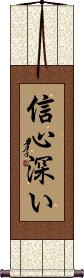
信心深い is a Japanese word that means deeply religious, devout, godly, and/or faithful.
Goldfish
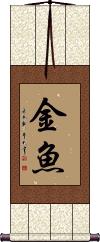
金魚 is the title for goldfish in Chinese and Japanese.
There was a time in ancient China when only the Emperor could possess the actual yellow-gold colored fish. This is why alternate coloration such as orange, black, red, and white was bred. Many believe this is why colors other than yellow-gold are more common for “goldfish” in pet shops today.
Good Intentions / Good Will / Good Faith
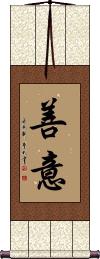
善意 is a word that means good intentions, goodwill, or to things done in good faith in Chinese, Japanese, and old Korean Hanja.
It's the reason you do good deeds or the desire you have inside yourself to do the right thing.
This can also be translated as benevolence, kindness, virtuous mind, positive mindset, or favorable sense.
善意 is also used in the legal context for things done in good faith (regardless of outcome).
In Japanese, this can be the personal name Yoshi or Yoshii.
Guan Yu
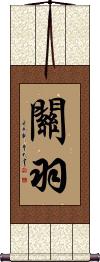
關羽 is the name Guan Yu, Army General for the Kingdom of Shu.
He is also known as Guan Gong (like saying Duke Guan or Sir Guan)
He was immortalized in the novel, “Romance of the Three Kingdoms.”
He was a fearsome fighter, also famous for his virtue and loyalty. He is worshiped by some modern-day soldiers and has the title “Warrior Saint” in China. Some believe he offers safety and protection for military servicemen.
Guan Yu lived until 219 A.D.
Faithful / Honorable / Trustworthy / Fidelity / Loyalty
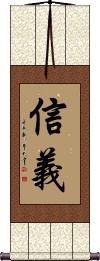
信義 is a word often used to describe a person with an honest and loyal reputation.
Simply put, this applies to somebody you can trust (with your life).
In Chinese, this is often defined as good faith, honor, trust, and justice.
In Korean, This means fidelity, truthfulness, or faithfulness.
In Japanese: faith, fidelity, and loyalty. It's also a Japanese male given name when pronounced “Nobuyoshi.”
Honesty
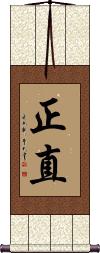
正直 or honesty is being truthful and sincere. It is important because it builds trust. When people are honest, they can be relied on not to lie, cheat or steal. Being honest means that you accept yourself as you are. When you are open and trustworthy, others can believe in you.
正直 is one of the 8 key concepts of Tang Soo Do.
Note: This entry is cross-listed as “integrity” because it also fits that definition.
 Please note that the second Kanji sometimes has an alternate form in Japanese. Let us know if you want the alternate form shown to the right.
See Also: Truth | Trust Your Heart | Integrity
Honesty
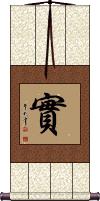
實 means real, true, honest, or solid.
It is one of several ways to express the idea of truth.
Note: In some contexts, this can carry extended meanings of reality, actuality, sincerity, or substance.
See Also: Truth | Trust Your Heart | Justice / Rectitude / Right Decision
Honesty
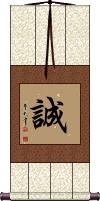
誠 means truth, faith, fidelity, sincerity, trust, and/or confidence.
As a single-character wall scroll, this suggests that you believe “honesty is the best policy,” as your personal philosophy.
This is also a virtue of the Samurai Warrior
See our page with just Code of the Samurai / Bushido here
See Also: Sincerity and Faithfulness | Sincere Heart
Honesty / Fidelity
信 is another character that expresses the idea of honesty.
It can also mean truth, faith, belief in, fidelity, sincerity, trust, and/or confidence.
Some have included this in the list for the Bushido, although “makoto” is probably more common/popular.
Note: In some contexts, this character can mean a letter (mail), news, or envoy. However, alone, it will generally be read with the honesty-meaning.
See our page with just Code of the Samurai / Bushido here
See Also: Two
Honor Courage Commitment
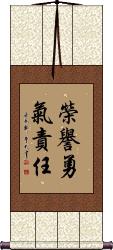
榮譽勇氣責任 is a word list that reads, “榮譽 勇氣 責任” or “honor courage commitment.”
If you are looking for this, it is likely that you are in the military (probably Navy or Marines).
We worked on this for a long time to find the right combination of words in Chinese. However, it should still be noted that word lists are not very natural in Chinese. Most of the time, there would be a subject, verb, and object for a phrase with this many words.
Honor Courage Commitment
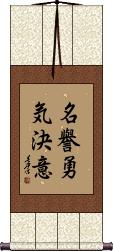
This means “Honor, Courage, Commitment” in Japanese.
名譽勇気決意 is a common military phrase in English used in the Navy and Marines.
This is a word list, which is not the most natural kind of composition in Japanese (usually there is a subject, object, and verb - or a single word).
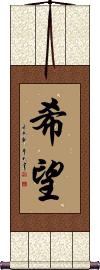
Hope
Integrity
Integrity is living by your highest values. It is being honest and sincere. Integrity helps you to listen to your conscience, do the right thing, and tell the truth. You act with integrity when your words and actions match. Integrity gives you self-respect and a peaceful heart.Please note that the second Kanji sometimes has an alternate form in Japanese. Let us know if you want the alternate form shown to the right.
Note: This entry is cross-listed as “honesty” because it also fits that definition.
Beyond Integrity, this word also means “upright” and “honest” in Chinese. Means “integrity,” “honesty” or “frankness” in Japanese.
See Also: Honor | Honesty | Truth | Trust Your Heart
Integrity: Sincere Honest and Faithful
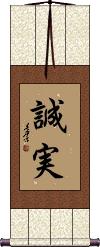
誠実 is the Japanese version of integrity which can also be defined as a combination of “sincere, honest, and faithful.”
Some may also define this as “loyal” or “loyalty.” In some contexts, it can mean “genuine.” Yes, all of this meaning in just one Japanese word!
John 3:16

神愛世人甚至將他的獨生子賜給他們叫一切信他的不至滅亡反得永生 is the full translation of John 3:16 into Chinese.
This is from the Chinese Union Bible which comes from a revised version of the King James. This Chinese Bible was originally translated and printed in 1919 (several revisions since then).
Because of the origin being the KJV, I'll say that in English, this would be, “For God so loved the world, that he gave his only begotten Son, that whosoever believeth in him should not perish but have everlasting life.”
As with any translation, there are interesting cultural and linguistic issues. For instance, the word used for “world” in Chinese can also mean “common people.” So you could say that it means “For God so loved the common people...”
This does not take away from the text, as it will be understood with the same meaning and connotation.
There is no direct Greek-to-Chinese translation in print (that I know of), so this is the best available. Of course, you can ask any Greek person of faith, and they will claim that a bit is lost from the original Greek of the New Testament to any of the English versions of the Bible in print.
Joshua 24:15
This House Serves the LORD
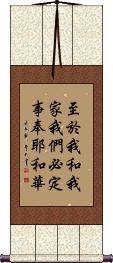
至於我和我家我們必定事奉耶和華 is the last sentence of Joshua 24:15 in Chinese.
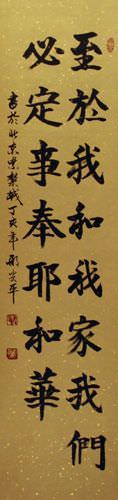
What your
calligraphy
might look like
from our
Chinese Master
Calligrapher
Joshua 24:15 (KJV) ...as for me and my house, we will serve the LORD.
Joshua 24:15 (NIV) ...as for me and my household, we will serve the LORD.
We used the only official Christian Chinese Bible that I know of so that the translation would be as accurate and standard as possible. Any Chinese Christian worth their salt will easily be able to identify this verse from the Chinese words on this scroll.
I think it is a bit like having a secret code on your wall that quietly expresses to whom you are faithful.
A great gift for your devout Christian or Jewish friend if they happen to be fond of Asian art.
Or perhaps a wonderful “conversation starter” for your own home.
Note: If you are curious, the last three characters represent the way “LORD” is used in most English Bibles. In Chinese, this is actually the phonetic name from Mandarin Chinese for “Jehovah.”
Joshua 24:15
This House Serves the LORD
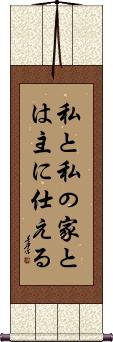
私と私の家とは、主に仕える is the last bit of Joshua 24:15 in Japanese.
Joshua 24:15 (KJV) ...as for me and my house, we will serve the LORD.
Joshua 24:15 (NIV) ...as for me and my household, we will serve the LORD.
This came from the Shinkaiyaku Japanese Bible. This is the most commonly-used Bible translation in Japan for both Protestants and Catholic Japanese folks.
I think it is a bit like having a secret code on your wall that quietly expresses to whom you are faithful.
This will be a nice gift for a friend or a wonderful expression of faith for your own home.
Note: Because this selection contains some special Japanese Hiragana characters, it should be written by a Japanese calligrapher.
Tang Soo Do / Tang Hand Way
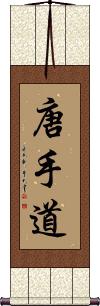
唐手道 is the alternate title for Karate-do.
This title uses a character, 唐, which represents the Tang Dynasty of China. Thus, this is often translated as the “Tang Hand Way” or incorrectly, “Tang Fist Way.”
I have also seen some call it “China Hand Way.”
Many in Korea refer to and romanize these characters as “Tang Soo Do” (당수도) where these characters refer to a kind of Korean style of Karate.
There is not many information on this title but some believe that a simplified form of Kung Fu that started in China and ended up very popular in Japan used this title initially. It was later changed in Japan to a different Karate title which means “Empty Hand” (as in, without weapons).
Note: When used in Korean, this is pronounced 당수도. This title is often romanized as “Tang Soo Do,” “Tangsudo,” “Dang Su Do,” or “Dangsudo.” The last two romanizations on that list are the official Korean government romanization, though martial arts schools tend to use other non-standard versions.
Karma (of your past lives)
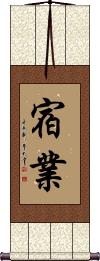
宿業 is the Buddhist concept of Past Karma. Simply put, it's the sum of all the good and bad from all previous lives (perhaps earlier in your current life). This term is not commonly used outside of the Buddhist faith (you'll have a tough time finding a non-Buddhist Asian person that knows this word).
Other ways to translate this are “The karma of previous existence,” “The karma remaining from prior existences,” or simply “Former karma.”
See Also: Buddhism
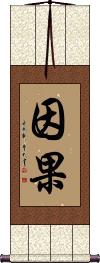
Karma - Cause and Effect
Firm Belief / Strong Faith
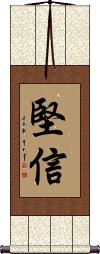
堅信 means to believe firmly, with firm faith, or without any doubt.
Japanese Christians sometimes use this term to mean the rite of confirmation.
This can also be the Japanese given name Kenshin.
Resolute Mind
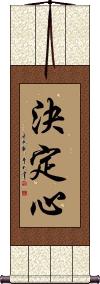
決定心 means the mind of certainty, resolute mind, imperturbable mind, firm determination, firm resolution, or stable commitment.
In the context of Buddhism, this is the deep resolution needed to attain enlightenment.
If you go to a deeper meaning, this is a condition of settling into the thought that occurs in the process of perception subsequent to the “seeking mind” or “尋求心.”
Lei
Surname
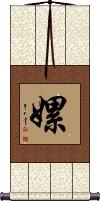
This is one Chinese surname that romanizes as Lei.
There are other characters that romanize as Lei, and are surnames. Make sure you get the right one.
I believe this is also a surname in Korean, where it's written as 루 and pronounced like “Ru” or “Lu” in modern Korean.
Journey of Life
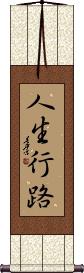
If you believe that life is a journey, this is a nice Japanese title for your wall.
人生行路 means “journey of life” in Japanese Kanji. The actual word order is more like “life (人生) journey (行路)” as Japanese grammar is a bit different than English.
Note: The “journey” part can also be translated as “road,” so this is also how to say “the road of life.”
Love Faith Strength
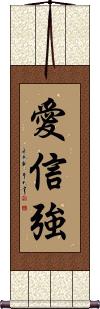
愛信強 is the shortest way to write the word list, “love faith strength.”
The first character is love, the second is faith or believe, and the third means strong or strength.
It should be noted that word lists like this are not as natural sounding in Chinese as word lists can be in English. it’s more common to have a full phrase (with subject, verb, and object) or single words on calligraphy wall scrolls in Asia.
Love Faith Strength
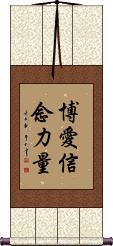
博愛信念力量 is the verbose way to write the word list, “love faith strength.”
It should be noted that word lists like this are not as natural sounding in Chinese as word lists can be in English. it’s more common to have a full phrase (with subject, verb, and object) or single words on calligraphy wall scrolls in Asia.
Loyalty to Duty or Master
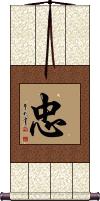
忠 is the simplest way to write the word loyalty in Chinese and Japanese.
A single character like this leaves the meaning open. But alone, a Chinese or Japanese person would think of loyalty to duty or loyalty to one's master (in ancient times). I suppose that it could be loyalty to your boss or company in this day in age.
忠 can also mean fidelity or faithfulness.
This can also be romanized as “chung.”
Loyalty
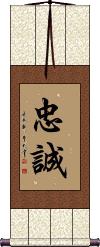
忠誠 is the written form of loyalty that is universal in Chinese, Japanese Kanji, and old Korean Hanja.
Loyalty is staying true to someone. It is standing up for something you believe in without wavering. It is being faithful to your family, country, school, friends, or ideals when the going gets tough and when things are good. With loyalty, you build relationships that last forever.
Notes:
1. There is also a Japanese version that is part of the Bushido Code which may be more desirable depending on whether your intended audience is Japanese or Chinese.
2. This version of loyalty is sometimes translated as devotion, sincerity, fidelity, or allegiance.
See Also: Honor | Trust Your Heart | Integrity | Sincerity and Faithfulness
Loyalty / Devotion
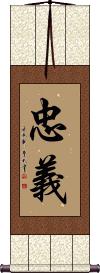
忠義 is another form of loyalty or devotion.
In Chinese, this is more specifically about being loyal and devoted to your friends.
In Japanese, this is more often used to mean loyalty to your country or nation.
Except for the slight difference noted above between Japanese and Chinese, this word is understood universally in Chinese, Japanese Kanji, and old Korean Hanja. It can also be used to describe devotion or fidelity.
It should be noted that this Kanji combination is being used less and less in modern Japan (this is a better choice if your audience is Chinese, though any Japanese person will clearly understand it).
Loyalty / Faithful / Devoted
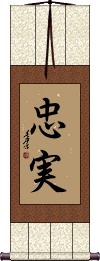
忠実 is a Japanese way to write “Loyalty” - it also contains the ideas of being faithful, devoted, true, and obedient.
The second character is a modified form only used in the Japanese lexicon; however, Chinese speakers can easily guess the meaning.
This is also a virtue of the Samurai Warrior
See our page with just Code of the Samurai / Bushido here
Mercy / Compassion / Buddhist Loving Kindness
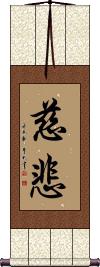
Besides the title above, 慈悲 can also be defined as clemency or lenience and sometimes the act of giving charity.
In the Buddhist context, it can mean “benevolence,” “loving-kindness and compassion,” or “mercy and compassion.”
This Buddhist virtue is perhaps the most important to employ in your life. All sentient beings that you encounter should be given your loving kindness. And trust me, however much you can give, it comes back. Make your life and the world a better place!
This Chinese/Japanese Buddhist term is the equivalent of Metta Karuna from Pali or Maitri Karuna from Sanskrit.
慈 can mean loving-kindness by itself.
悲 adds a component of sorrow, empathy, compassion, and sympathy for others.
See Also: Benevolence
Namu Amida Butsu
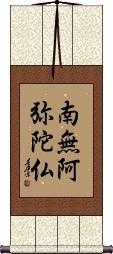
南無阿弥陀仏 is the modern Japanese version of “Namu Amida Butsu” or “The Compassionate Amitabha Buddha.”
Some will translate this as “I sincerely believe in Amitabha; Lord have mercy on me.”
This phrase especially applies to Japanese Pure Land Buddhists.
There is a universal version using ancient characters (with more strokes) for the 4th and last characters. That version is also used in Chinese, Korean, and occasionally Vietnamese.
This is used to pay homage to Amitabha Buddha.
See Also: Bodhisattva | Buddhism | Nirvana
Nichiren
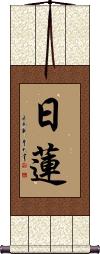
日蓮 is the title Nichiren.
This title refers to a Buddhist priest who lived from 1222 to 1282. He is the founder of the Nichiren sect of Buddhism.
According to historical documents, the Nichiren sect was established in 1252. Adding the character 宗 for sect, this would be 日蓮宗 (Nichiren sect), which is also known as the 法華宗 or Lotus sect.
According to Soothill-Hodous...
Nichiren's chief tenets are the three great mysteries 三大祕法, representing the trikāya:
1. 本尊 or chief object of worship, being the great maṇḍala of the worlds of the ten directions, or universe, i.e., the body or nirmāṇakāya of Buddha.
2. 題目 the title of the Lotus Sutra 妙法蓮華經 Myo-ho-ren-ge-kyo, preceded by Namo, or “Adoration to the scripture of the lotus of the wonderful law,” for it is Buddha's spiritual body.
3. 戒壇 the altar of the law, which is also the title of the Lotus as above; the believer, wherever he is, dwells in the Pure-land of calm light 寂光淨土, the saṃbhogakāya.
There is no god but Allah, and Muhammad is His Messenger
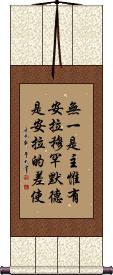
無一是主惟有安拉穆罕默德是安拉的差使 is one of the key creeds of Islam.
While perhaps more often seen in Arabic as
there are many native Chinese Muslims (especially the Hui ethnicity) that do not speak Arabic.
Instead, they use this Chinese phrase to express this idea or statement of faith.
Nothingness
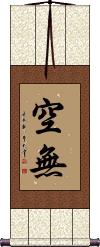
空無 is “nothingness” in a Buddhist context.
The first character means empty but can also mean air or sky (air and sky have no form).
The second character means have not, no, none, not, or to lack.
Together these characters reinforce each other into a word that means “absolute nothingness.”
I know this is a term used in Buddhism, but I have not yet figured out the context in which it is used. I suppose it can be the fact that Buddhists believe that the world is a non-real illusion, or perhaps it's about visualizing yourself as “nothing” and therefore leaving behind your desire and worldliness.
Buddhist concepts and titles often have this element of ambiguity or, rather, “mystery.” Therefore, such ideas can have different meanings to different people, and that's okay. If you don't get it right in this lifetime, there will be plenty more lifetimes to master it (whatever “it” is, and if “it” really exists at all).
Soothill defines this as “Unreality, or immateriality, of things, which is defined as nothing existing of independent or self-contained nature.”
One Heart / One Mind / Heart and Soul
Isshin
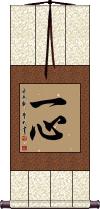
一心 can mean “one mind,” “single-minded focus,” or “wholehearted devotion,” from Chinese, Japanese Kanji, and old Korean Hanja.
Colloquially or figuratively, it means: wholeheartedly; heart and soul; of one mind; single-mindedness, wholeheartedness; one's whole heart; with the whole mind or heart; one mind in heart.
I'm not kidding, all of those came right from the dictionary for this one title.
In martial arts usage, this term emphasizes total commitment, where intent, attention, and action are unified without distraction.
In Japanese budō, it often conveys wholehearted dedication to practice or principle, whereas in Chinese usage it tends toward inner mental cultivation.
In Buddhism, this can refer to the bhūtatathatā, or the whole of things; the universe as one mind, or a spiritual unity.
In Japanese, this can be the female given name, Hitomi.
Partnership: Marriage
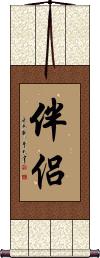
伴侶 is a Chinese, Japanese, and old Korean word that expresses the kind of partnership in which a good marriage is founded.
伴侶 could also be translated as mates or companionship or as a noun to refer to a partner or companion.
This does not have to include marriage but at least refers to a partnership with a deep relationship or bond.
Note that this is not the same as a business partner. Different words are used for various types business partnerships.
See Also: Friendship
Passion for a Cause
Depending on the context, 熱情 can mean “cordial,” “enthusiastic,” “passionate,” or “passionately.”
This version is sometimes used in Japanese, but the character order is more common in Chinese and Korean Hanja. The meaning in Japanese for this Kanji order is ardor/ardour or zeal but rarely used in modern Japan. I suggest you choose a different version of “passion” if your audience is Japanese.
See Also: Persistence | Sincerity and Devotion | Tenacious / Tenacity | Commitment | Motivation
Enthusiasm / Passion for a Cause
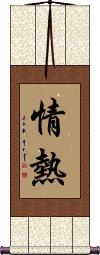
情熱 is the Japanese word that means enthusiasm or “passion for a cause.”
In some contexts, this could mean being extremely fond of something or having a fondness for a cause or person.
Can also be translated as passion, zeal, ardor/ardour, or fervor.
Note: This word (or character order) is not natural in Chinese. However, a typical Chinese person can guess this is a Japanese or Korean word and understand the intended meaning. This selection is best if your audience is Japanese or old-school Korean.
See Also: Persistence | Sincerity and Devotion | Tenacious / Tenacity | Commitment | Motivation
Patience / Perseverance / To Endure / Tolerant
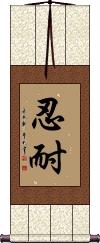
忍耐 is patience, the quiet hope, and trust that things will turn out right.
You wait without complaining. You are tolerant and accepting of difficulties and mistakes. You picture the end in the beginning and persevere to meet your goals.
忍耐 can also mean “to endure,” “restrain oneself,” or “forbearance,” and in some contexts, it can mean “perseverance” or “endurance.”
忍耐 is also used as a tenet of Taekwondo, Tang Soo Do, and other Korean martial arts where it's titled “Endurance” and romanized as “In Neh.”
 Note that when writing this as Kanji, Japanese will tend to write the first character in the form shown to the right. If you select our Japanese master calligrapher, please expect this Kanji form (yes,
it’s
just one stroke that is slightly different in location, crossing another stroke in the Japanese Kanji form).
Note that when writing this as Kanji, Japanese will tend to write the first character in the form shown to the right. If you select our Japanese master calligrapher, please expect this Kanji form (yes,
it’s
just one stroke that is slightly different in location, crossing another stroke in the Japanese Kanji form).
See Also: Worldwide Peace | Peace / Harmony | Perseverance
Personal Integrity
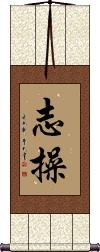
志操 is personal integrity - basically, holding yourself to a higher standard of honesty and reliability. These two characters also contain the ideas of constancy, principles, and faithfulness.
Note: In Japanese, this just means “principle.”
Pure Land / Jodo
Also a sect of Buddhism
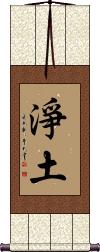
淨土 literally means “pure land” or “clean earth.”
淨土 is also the abbreviated title of a Buddhist sect that involves faith in the rebirth of Buddha Amitabha (Amitābha) in the Western Heaven. Sometimes this sect is translated as “Paradise of the West.” Other titles of this school of Buddhism include Amidism or Elysium.
See Also: Nirvana | Shin Buddhism
Sacrifice / Devotion / Dedication
(complete bodily devotion)
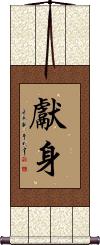
獻身 is used to describe being so devoted to something that you will make sacrifices for that goal/thing/person.
You can also translate this word as any of the following:
Sacrifice one's life for...
To dedicate oneself to...
Self-devotion
Dedication
Devote to...
Self-sacrifice
Giving your whole body to...
This can be a dedication to or for someone but is often used as a dedication or making sacrifices for your country, public service, or a cause. For instance, an Olympic athlete makes great sacrifices to train in their sport for their country and compatriots.

 While the form shown to the upper-left is considered an ancient Japanese version, in modern Japan, they use the simplified version of the first Kanji (shown to the right). Click on the Kanji at the right instead of the button above if you want this modern Japanese version.
If you are looking for a more religious meaning of devotion, see Faith.
See Also: Self-Confidence | Dedication
Sangha
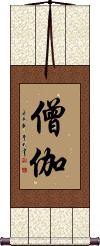
In Buddhism, 僧伽 refers to a community of monks and/or nuns (one of the “Three Jewels”). In general terms, it can simply mean “all followers of the Buddha.”
Notes: Though there are not vast numbers of Chinese Hindus, in the Hindu faith, this term means “community together.”
The original Sanskrit word is also Romanized as samgha.
The first character means “monk.” The second character means Buddha or Shakyamuni.
僧伽 is a transliteration of the original Sanskrit, but it uses two very profound Chinese characters related to Buddhism.
Some may pronounce this as “seng qie” or “seng jia” in Mandarin (two possible pronunciations for the second character). Note that “qie” sounds like “chee-ah” using typical English pronunciation. Chinese Romanization is not actually designed to match English sounds.

 Note that when writing this as Kanji, Japanese will tend to write the first character in the form shown to the right. If you select our Japanese master calligrapher, please expect this special Kanji form. However, it should also be noted that this is not a common term in Japanese (except by certain sects of Buddhism or perhaps devout Buddhists in Japan).
Self-Confidence
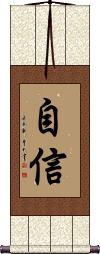
自信 is created by simply putting the character for “faith/believe/confidence” with the character for “oneself” in front of it.
The literal translation holds the same meaning in English, Chinese, and Japanese.
It's like a self-affirmation to say, “you can do it.”
Some may also use this to mean self-esteem or a sense of self-worth. 自信 is also how to say “believe in oneself.”
See Also: Self-Confidence
Semper Fidelis / Always Faithful
U.S. Marines Slogan
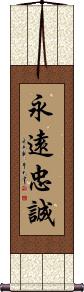
永遠忠誠 is the clearest and most natural way to translate “Semper Fidelis” or “Always Faithful” into Mandarin Chinese. 永遠忠誠 is meant explicitly for U.S. Marines who often use the shortened term “Semper Fi.”
The first two characters are a word that always means, forever, and/or eternally.
The last two characters are a word that means fidelity, loyal, and/or devotion.
I spent 10 years in the Marines, so it was a no-brainer to add this to our calligraphy database.
Semper Fidelis / Always Faithful
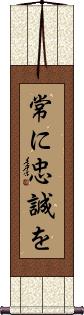
常に忠誠を is “Semper Fidelis” or “Always Faithful” in Japanese. This is specifically meant for U.S. Marines who often use the shortened term “Semper Fi.”
The first two Kanji mean “always” or “constantly.” The last three Kanji mean “faithful,” “loyal,” “devoted,” and/or “diligent.” It's most often read as “faithful.”
Note: Because this selection contains some special Japanese Hiragana characters, it should be written by a Japanese calligrapher.
Semper Fidelis / Always Faithful
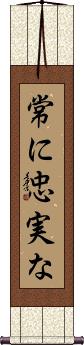
常に忠実な is an alternate way to write “Semper Fidelis” or “Always Faithful” in Japanese.
Note: Because this selection contains some special Japanese Hiragana characters, it should be written by a Japanese calligrapher.
Seven Heavenly Virtues
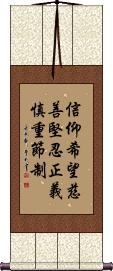
信仰希望慈善堅忍正義慎重節制 is a list in Chinese and Japanese Kanji of an interpretation of the Seven Heavenly Virtues.
1. Faith is belief in God, and the right virtues.
2. Hope is taking a positive future view that good will prevail.
3. Charity is a concern for, and active helping of, others.
4. Fortitude is never giving up.
5. Justice is being fair and equitable with others.
6. Prudence is care of and moderation with money.
7. Temperance is moderation of needed things and abstinence from things that are not needed.
The full list is here. 信仰希望慈善堅忍正義慎重節制 is a word list, not a common phrase. While all Chinese and Japanese people will recognize the words in the list, they may not understand what the list is about (unless they are familiar with the Seven Heavenly Virtues).
don’t get this as a tattoo or anything like that without first consulting a native translator in the target language. These are fine for a wall scroll but a long discussion is needed before you commit to this for a lifetime inking commitment.
Shaolin Temple
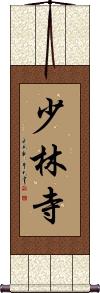
少林寺 is the full title of the Shaolin Temple.
This refers to the Buddhist monastery famous for its kung fu monks.
少林寺 is also known in Japanese, where they use the same characters but romanize them as Shourinji or Shōrinji.
Some believe this monastery and temple represent where Bodhidharma sat with his face to a wall for nine years, leading to his discovery of enlightenment and the establishment of Buddhism in China.
Faith Dojo

Sincerity and Devotion
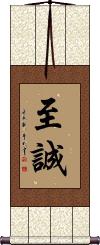
至誠 is the idea that you enter into something with the utmost sincerity and fidelity. Ideas such as devotion, honesty, and “one's true heart” are also contained in this word.
至誠 is a universal word as the Chinese, Japanese Kanji, and Korean Hanja are all identical.
Sincerity and Faithfulness
Soul Mates
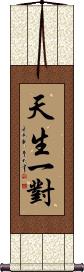
It was tough to find the best way to say “soul mates” in Chinese. We settled on 天生一對 as an old way to say, “A couple selected by heaven.”
The first two characters together mean “natural” or “innate.” Separated, they mean “heaven” and “born.” The last two characters mean “couple.” So this can mean “A couple that is together by nature,” or “A couple brought together by heaven's decree.” With a slight stretch, you could say, “A couple born together from heaven.”
It's a struggle to find the best way to describe this idea in English but trust me, it is pretty cool, and it is a great way to say “soulmates.”
If you're in a happy relationship or marriage and think you have found your soul mate, this would be a wonderful wall scroll to hang in your home.
Spiritual Peace / Enlightened Peace
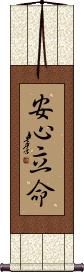
These Japanese Kanji, 安心立命, can mean “religious enlightenment” or “spiritual peace gained through faith.”
Other dictionaries define as “spiritual peace and enlightenment” or “keeping an unperturbed mind through faith.”
My Buddhist dictionary defines it as “spiritual peace and realization of enlightenment.”
In the Zen school, this is about settling one's body and life; attaining complete peace, and establishing one's course of life in accord with the ultimate reality.
This in-stock artwork might be what you are looking for, and ships right away...